""Here’s the way things are supposed to work and normally do: Banks take in deposits and then lend that money out.Low returns from US Treasurys are, at best, better than taking chances with credit risks and, at worst, better than a sharp stick in the eye. I suppose it falls somewhere inbetween...
And here’s what’s happening more frequently now: People are doing a better job of spending less than they earn, but any leftover money is going toward paying down debt, not taking on new debt.
So to the extent that banks have deposits, they can’t lend them out in the quantity they used to (or aren’t because of tightened credit policies). Instead, they buy Treasury bills, according to Bill Hampel, the chief economist for the Credit Union National Association. And those don’t pay as they once did because of the interest rate environment. Nor do they deliver the kind of returns the banks would get if they were lending the money under normal conditions. ""
Saturday, December 4, 2010
Validation of my rant in class about the Fed-to-Banks-to-US Treasury circular flow of money/circular flow of logic that reminds me of a hamster on a treadmill...
Last class period I explained one of the pieces of the puzzle as to why the banking system is not lending as much money as they could be. even though the Federal Reserve is/has been on a bond buying spree. The short version---(1) Federal Reserve BUYS a $1,000 bond from a bank--(2) Bank withholds more than is required (or another way of saying this, is they lend out less than they are able to) because they believe it is too risky to lend to people/businesses right now--(3) Bank buys US Treasury Bonds/Notes as a way to earn interest on the money...Repeat steps 1 through 3...Some lending is occurring, but not on the level required to get the economy going. Just so you can see that I am not making this up because it sounds so preposterous, here is a comment from today's NYTIMES:
The Reserve Requirement in action!! Hey, it is as rare as Haley's Comet...Let me enjoy the spectacle that is a Monetary Policy tool rarely employed by a Central Bank...
The reserve requirement is the Monetary Policy tool of last resort for the US Federal Reserve to employ to control the money creation process in the banking system, but it is used by other Central Banks around the world on occassion. Click HERE for more detailed explanation of the Reserve Requirement and click HERE for my explanation of the Required Reserve and how it affects lending by the banking system.
From WSJ: Brazil Joins China in Push to Cool Overheating Economy
""Brazil's central bank rolled out a series of measures to tame rapid credit growth and prevent inflation pressures, joining other large expanding economies such as China that are trying to curb rising prices and fast moving capital inflows.Brazil's Central Bank President Henrique Meirelles said the directives announced Friday, which aim to withdraw some 61 billion Brazilian reais ($35.88 billion) from the financial system, will have an impact on inflation and economic activity, and would also be felt in interest rates.
The Central Bank said it would raise reserve requirements on term deposits to 20% from 15%...
"As we have seen during the past year, central banks have often been using reserve requirements as the first step down the tightening path, and such hikes have almost universally been followed by policy rate hikes as well,." said Win Thin, Global Head Of Emerging Markets Strategy at Brown Brothers Harriman in New York.""
Friday, December 3, 2010
An excellent, short video illustrating the economic progress the world has made in the last 200 years
Well worth a viewing. This gives you a long term view of economic progress...All boats have been lifted,some more than others, but as economists are fond of saying---it is all relative...
Thursday, December 2, 2010
How would YOU do on this test administered to 8th Graders in 1895...yes, that's right, 1895...I would have dropped out in 5th grade.
This is the eighth-grade final exam from 1895 from Salina, KS. USA.
It was taken from the original document on file at the Smoky Valley
Genealogical Society and Library in Salina, KS and reprinted by the
Salina Journal.
8th Grade Final Exam: Salina, KS - 1895
Grammar (Time, one hour)
1. Give nine rules for the use of Capital Letters.
2. Name the Parts of Speech and define those that have no modifications.
3. Define Verse, Stanza and Paragraph.
4. What are the Principal Parts of a verb? Give Principal Parts of do, lie, lay and run.
5. Define Case, Illustrate each Case.
6. What is Punctuation? Give rules for principal marks of Punctuation.
7 - 10. Write a composition of about 150 words and show therein that you understand the practical use of the rules of grammar.
Arithmetic (Time, 1.25 hours)
1. Name and define the Fundamental Rules of Arithmetic.
2. A wagon box is 2 ft. deep, 10 feet long, and 3 ft. wide. How many bushels of wheat will it hold?
3. If a load of wheat weighs 3942 lbs., what is it worth at 50 cts. per bu., deducting 1050 lbs. for tare?
4. District No. 33 has a valuation of $35,000. What is the necessary levy to carry on a school seven months at $50 per month, and have $104 for incidentals?
5. Find cost of 6720 lbs. coal at $6.00 per ton.
6. Find the interest of $512.60 for 8 months and 18 days at 7 percent.
7. What is the cost of 40 boards 12 inches wide and 16 ft. long at $20 per m?
8. Find bank discount on $300 for 90 days (no grace) at 10 percent.
9. What is the cost of a square farm at $15 per are, the distance around which is 640 rods?
10. Write a Bank Check, a Promissory Note, and a Receipt.
U.S. History (Time, 45 minutes)
1. Give the epochs into which U.S. History is divided.
2. Give an account of the discovery of America by Columbus.
3. Relate the causes and results of the Revolutionary War.
4. Show the territorial growth of the United States.
5. Tell what you can of the history of Kansas.
6. Describe three of the most prominent battles of theRebellion.
7. Who were the following: Morse, Whitney, Fulton, Bell, Lincoln, Penn, and Howe?
8. Name events connected with the following dates:
1607
1620
1800
1849
1865
Orthography (Time, one hour)
1. What is meant by the following: Alphabet, phonetic, orthography, etymology, syllabication?
2. What are elementary sounds? How classified?
3. What are the following, and give examples of each: Trigraph, subvocals, diphthong, cognate letters, linguals?
4. Give four substitutes for caret 'u'.
5. Give two rules for spelling words with final 'e'. Name two exceptions under each rule.
6. Give two uses of silent letters in spelling. Illustrate each.
7. Define the following prefixes and use in connection with a word: Bi, dis, mis, pre, semi, post, non, inter, mono,super.
8. Mark diacritically and divide into syllables the following, and name the sign that indicates the sound: Card, ball, mercy, sir, odd,cell, rise, blood, fare, last.
9. Use the following correctly in sentences, Cite, site, sight, fane,fain, feign, vane, vain, vein, raze, raise, rays.
10. Write 10 words frequently mispronounced andindicate pronunciation by use of diacritical marks and by syllabication.
Geography (Time, one hour)
1. What is climate? Upon what does climate depend?
2. How do you account for the extremes of climate in Kansas?
3. Of what use are rivers? Of what use is theocean?
4. Describe the mountains of North America.
5. Name and describe the following: Monrovia, Odessa, Denver, Manitoba,Hecla, Yukon, St. Helena, Juan Fermandez, Aspinwall and Orinoco.
6. Name and locate the principal trade centers of the U.S.
7. Name all the republics of Europe and give capital of each.
8. Why is the Atlantic Coast colder than the Pacific in the same latitude?
9. Describe the process by which the water of the ocean returns to the sources of rivers.
10. Describe the movements of the earth. Give inclination of the earth.
It was taken from the original document on file at the Smoky Valley
Genealogical Society and Library in Salina, KS and reprinted by the
Salina Journal.
8th Grade Final Exam: Salina, KS - 1895
Grammar (Time, one hour)
1. Give nine rules for the use of Capital Letters.
2. Name the Parts of Speech and define those that have no modifications.
3. Define Verse, Stanza and Paragraph.
4. What are the Principal Parts of a verb? Give Principal Parts of do, lie, lay and run.
5. Define Case, Illustrate each Case.
6. What is Punctuation? Give rules for principal marks of Punctuation.
7 - 10. Write a composition of about 150 words and show therein that you understand the practical use of the rules of grammar.
Arithmetic (Time, 1.25 hours)
1. Name and define the Fundamental Rules of Arithmetic.
2. A wagon box is 2 ft. deep, 10 feet long, and 3 ft. wide. How many bushels of wheat will it hold?
3. If a load of wheat weighs 3942 lbs., what is it worth at 50 cts. per bu., deducting 1050 lbs. for tare?
4. District No. 33 has a valuation of $35,000. What is the necessary levy to carry on a school seven months at $50 per month, and have $104 for incidentals?
5. Find cost of 6720 lbs. coal at $6.00 per ton.
6. Find the interest of $512.60 for 8 months and 18 days at 7 percent.
7. What is the cost of 40 boards 12 inches wide and 16 ft. long at $20 per m?
8. Find bank discount on $300 for 90 days (no grace) at 10 percent.
9. What is the cost of a square farm at $15 per are, the distance around which is 640 rods?
10. Write a Bank Check, a Promissory Note, and a Receipt.
U.S. History (Time, 45 minutes)
1. Give the epochs into which U.S. History is divided.
2. Give an account of the discovery of America by Columbus.
3. Relate the causes and results of the Revolutionary War.
4. Show the territorial growth of the United States.
5. Tell what you can of the history of Kansas.
6. Describe three of the most prominent battles of theRebellion.
7. Who were the following: Morse, Whitney, Fulton, Bell, Lincoln, Penn, and Howe?
8. Name events connected with the following dates:
1607
1620
1800
1849
1865
Orthography (Time, one hour)
1. What is meant by the following: Alphabet, phonetic, orthography, etymology, syllabication?
2. What are elementary sounds? How classified?
3. What are the following, and give examples of each: Trigraph, subvocals, diphthong, cognate letters, linguals?
4. Give four substitutes for caret 'u'.
5. Give two rules for spelling words with final 'e'. Name two exceptions under each rule.
6. Give two uses of silent letters in spelling. Illustrate each.
7. Define the following prefixes and use in connection with a word: Bi, dis, mis, pre, semi, post, non, inter, mono,super.
8. Mark diacritically and divide into syllables the following, and name the sign that indicates the sound: Card, ball, mercy, sir, odd,cell, rise, blood, fare, last.
9. Use the following correctly in sentences, Cite, site, sight, fane,fain, feign, vane, vain, vein, raze, raise, rays.
10. Write 10 words frequently mispronounced andindicate pronunciation by use of diacritical marks and by syllabication.
Geography (Time, one hour)
1. What is climate? Upon what does climate depend?
2. How do you account for the extremes of climate in Kansas?
3. Of what use are rivers? Of what use is theocean?
4. Describe the mountains of North America.
5. Name and describe the following: Monrovia, Odessa, Denver, Manitoba,Hecla, Yukon, St. Helena, Juan Fermandez, Aspinwall and Orinoco.
6. Name and locate the principal trade centers of the U.S.
7. Name all the republics of Europe and give capital of each.
8. Why is the Atlantic Coast colder than the Pacific in the same latitude?
9. Describe the process by which the water of the ocean returns to the sources of rivers.
10. Describe the movements of the earth. Give inclination of the earth.
Wednesday, December 1, 2010
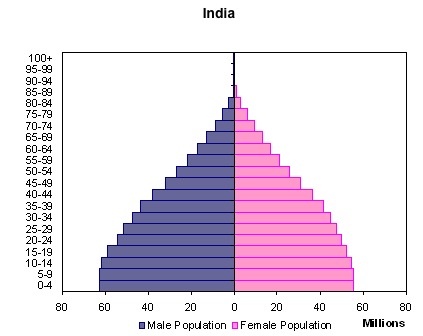
Population Pyramids for China and India compared to the US---Pictures are worth a thousand embedded economic concepts...
Two graphs comparing the size of different age groups in China and India, the worlds two most populated countries. Together, they represent between 1/4 to 1/3 of the worlds population. India is going to be young for a LONG time and China is going to face the problem much of the developed world is encountering now---an aging population with a relatively smaller replacement birth rate...I can see power and the economic landscape shifting in the coming decades....


 |
| Source: Business Insider |
 |
| Source: Bussiness Insider |
Tuesday, November 30, 2010
Is Cyber-Monday "Creatively Destroying" Black-Friday? I sure hope so...
Although it will make the news a bit more boring if it does. No more video of people shoving each other through doors to get to the "Deals". That always puts me in the Christmas spirit...
'Cyber Monday' Sales Show Strength
'Cyber Monday' Sales Show Strength
Online retailers experienced a sales surge Monday, capping off a holiday shopping week in which more Americans than ever decided to skip the mall and buy on the Web.
Early estimates indicated overall sales gains of about 20% from a year earlier for "Cyber Monday," the nickname for the Monday after Thanksgiving.
..That comes on top of strong online sales growth on Thanksgiving Day and Black Friday. For those two days combined, comScore Inc. reported that online shoppers spent about $1.1 billion, up more than 15% from $913 million a year earlier.
Online shopping is on pace to take even more share away from the rest of American retail. Through the four-day Thanksgiving weekend, a survey by the National Retail Federation reported that traffic to stores and websites was up 8.7%, with the average shopper spending 6.4% more than a year ago.
Driving activity were Cyber Monday discounts of as much as 60% on sites such as Toysrus.com, as well as extensive free shipping offers.
Sunday, November 28, 2010
"Wait a minute Mr. Postman"...Actually, dont wait...you are being "creatively destroyed" by the marketplace...You might soon only exist in song...

There are lots of micro-economic concepts embedded with analyzing a company like Netflix, not the least of which is "creative destruction". I was taken aback at the amount of postage they pay to mail DVD's. Technology already has decreased a significant portion of the Post Offices revenue. How do they possibly replace that? Dont see how they can expand the market for mail. Seems like a dead end road.
Netflix’s Move Onto the Web Stirs Rivalries
""...For the first time, the company will spend more over the holidays to stream movies than to ship DVDs in its familiar red envelopes (although it is still spending more than half a billion dollars on postage this year). And that shift coincides with an ominous development for cable companies, which long controlled home entertainment: for the first time in their history, cable television subscriptions fell in the United States in the last two quarters — a trend some attribute to the rise of Netflix, which allows consumers to bypass their cable box to stream movies and shows...""
Media interpretation of the Same Pentagon report---Match the headline with the paper---
Here are two headlines from the Wall Street Journal and the NY Times reporting on the SAME pentagon report on the SAME day...Can you guess which headline corresponds with the respective newspaper? (HT: Aidwatchers)


Saturday, November 27, 2010
"I am an economist and I am here to classify your unemployment status...Oh, you already are getting re-training on your own? I am going to have to go back and research this to see if in theory you are making the right decision!"
There is lots of discussion in the economic blogoshpere about the nature of unemployment in the US. Are workers skills still relevant and all is needed is an increase in demand for what they do/did to get them back to work in the same or similar jobs (Demand-side argument). Or has the nature of today's jobs, and the skills needed to do them, changed such that worker skills are obsolete and not applicable to the current and future work force (Supply-side argument)?
As the ivory tower academics and Washington policy makers talk amongst themselves, this article suggests people are are not waiting around for someone to tell them what classification of unemployment they fit into. Enrollment in community colleges is up sharply as people upgrade skills or, more likely, re-train for a career that is altogether different from what they were doing.
Washington Post: Workers seek new skills at community colleges, but classes are full
As the ivory tower academics and Washington policy makers talk amongst themselves, this article suggests people are are not waiting around for someone to tell them what classification of unemployment they fit into. Enrollment in community colleges is up sharply as people upgrade skills or, more likely, re-train for a career that is altogether different from what they were doing.
Washington Post: Workers seek new skills at community colleges, but classes are full
In one small anatomy lab, there's a craps dealer training to become an anesthetist, a cocktail waitress who wants to be a dental hygienist, and a former stripper seeking to become a nurse.
"People are always going to be going to the dentist," explained Misty Stevenson, 36, the aspiring hygienist, a mother of three and a cocktail waitress for 16 years, explaining her career choice after her income plunged during the downturn.
The trouble is getting a seat in class.
All over the United States, community college enrollments have surged with unemployed and underemployed people seeking new skills.
Thursday, November 25, 2010
Need money for College? The Dallas Federal Reserve Bank Essay contest may be for you!
This is a great opportunity for you if you like to write and are at least a little bit interested in economics. You don't need alot of economic knowledge for this contest, but it helps! Check out the topic. It is an easy one this year...From what I gather, they don't get alot of entries so you have a better than average chance of winning...Go to the essay contest webpage HERE for more details...I will be happy to assist you in getting started with your essay...
21st Annual Essay Contest 2011
Topic: Consume or Conserve?
Essay contest deadline: March 11, 2011
 One of the basic questions of economics is the choice between consumption and saving. When scarce resources are used today, what is the impact? Will future generations lack important resources because they have been depleted? Can the use of some types of resources cause irreparable harm to the environment?
A variety of public and private initiatives seek to encourage consumers to conserve natural resources in order to slow resource depletion or minimize environmental impact.
Curbside recycling in a city
Land that is set aside through private or public initiatives
Mandatory fuel standards or tax credits for hybrid vehicles
Carbon taxes or cap and trade systems
Green building codes
The 2011 Economic Essay Contest, Consume or Conserve?, asks you to judge one of these conservation initiatives or one of your own choosing. Use basic economic concepts, such as scarcity and opportunity costs, and fundamental economic models, like supply and demand, to analyze the merits and effectiveness of a specific conservation plan or environmental regulation. The initiative that you analyze might be local, national or global in scope. In your essay, describe the plan and its benefits, evaluate the costs of the plan and draw a conclusion about the effort.
Contest Details
The contest is open to 11th and 12th grade students attending schools in the Eleventh Federal Reserve District, which covers Texas, northern Louisiana and southern New Mexico. Participants submit essays to the appropriate office of the Dallas Fed, as determined by the location of their school. See the list of Eleventh District counties to determine the appropriate office.
21st Annual Essay Contest 2011
Topic: Consume or Conserve?
Essay contest deadline: March 11, 2011

A variety of public and private initiatives seek to encourage consumers to conserve natural resources in order to slow resource depletion or minimize environmental impact.
Curbside recycling in a city
Land that is set aside through private or public initiatives
Mandatory fuel standards or tax credits for hybrid vehicles
Carbon taxes or cap and trade systems
Green building codes
The 2011 Economic Essay Contest, Consume or Conserve?, asks you to judge one of these conservation initiatives or one of your own choosing. Use basic economic concepts, such as scarcity and opportunity costs, and fundamental economic models, like supply and demand, to analyze the merits and effectiveness of a specific conservation plan or environmental regulation. The initiative that you analyze might be local, national or global in scope. In your essay, describe the plan and its benefits, evaluate the costs of the plan and draw a conclusion about the effort.
Contest Details
The contest is open to 11th and 12th grade students attending schools in the Eleventh Federal Reserve District, which covers Texas, northern Louisiana and southern New Mexico. Participants submit essays to the appropriate office of the Dallas Fed, as determined by the location of their school. See the list of Eleventh District counties to determine the appropriate office.
Wednesday, November 24, 2010

Tuesday, November 23, 2010
Disney raises admission prices to DisneyWorld...How do they know what my elasticity is?? Oh, I forgot, Disney knows everything!!

Disney parks hike admission fees
Admission at Disney's theme parks is going up effective Thursday.
Walt Disney World has hiked its admission price to a whopping $82 for adults, up from $79. And since childhood ends at age 10 in the Magic Kingdom, the increase could be significant for families. Children's prices will jump to $74, up $6 at the Orlando park.
Adult ticket prices increased by 3.8% ($3.00 divided by $79.00 times 100) and children's prices increased by 8.82% ($6.00 divided by $68.00 times 100). For the example I use below, let's round these percentages to 4% and 9%, respectively, for simplicity The Law of Demand states that at a higher price the quantity demanded of a good or service will decrease. To find out how this impacts them, Disney must determine how sensitive customers will be to this price change. They need to estimate what their Elasticity of Demand is for their admissions tickets. Elasticity of Demand measures changes in quantity demanded relative to changes in prices. Let's do a simple example with simple math.
Assume the quantity demanded for park tickets BEFORE the price change was 1,000 adult tickets purchased and each adult brought 3 kids with them, so the number of kids tickets purchased was 3,000. Before the change in price, the total revenue in ticket sales was $283,000 (1,000 adults X $79 = $79,000 PLUS 3,000 kids X $68 = $204,000).
Let's assume Disney believes that the quantity demanded for adult tickets will decrease by 6% (now only 940 adults buy tickets) as a result of the 4% price increase. Now the total revenue from adult ticket sales with 6% fewer adults will be $77,080. Yikes, they lost money on the adult ticket sales! This can't be good...
We cannot forget the kids. If 60 fewer parents go then a total of 180 fewer kids will not go as well. Now instead of 3,000 tickets sold, there will be 2,820 sold, a percentage decrease of 2% Total revenue from the sale of kids tickets will now be $208,680. With fewer tickets sold to kids, Disney INCREASED total revenue from selling kids tickets.
What is the overall effect on revenues from the increase in ticket prices for both adults and children? Disney went from revenues of $283,000 to 285,760, or an increase of $2,760 in revenues.
What we have just illustrated is the Total Revenue Test for Elasticity of Demand. For adults there was a larger decrease in quantity demanded for tickets relative to the change in price so total revenues decreased. For kids there was a smaller decrease in quantity demanded for tickets relative to the change in price so total revenues increased. When taken together, we find the combined elasticity of demand for Disney admissions tickets is relatively INELASTIC. In other words, in terms of change in quantity demanded, families are not sufficiently sensitive to the price increase to the detriment of Disney's total revenues.
What is the "magic" here (sorry, could not resist) from raising the admissions price? Disney calculates that the decrease in quantity demanded by adults will not be MORE than 4% and the decrease in quantity demanded for kids tickets will not be MORE than 9%. Who am I to judge? I don't even ask how much it costs when I go there...
Google, Yahoo don't just hire tech geeks---they also hire economics geeks, err, I mean majors...
For those of you thinking about majoring in Economics and wondering what you can do with it, this article may inspire you. I took a few excerpts but you may want to read the whole thing. As I have said in class often, all sorts of organizations (business, government, NGO's, etc) are looking for people who can look at processes and resources in new and creative ways. I believe "the economic way of thinking" does just that.
Google, Yahoo, other Silicon Valley tech giants add economists to arsenal
Google, Yahoo, other Silicon Valley tech giants add economists to arsenal
In addition to software engineers, computer scientists and Web designers, Silicon Valley giants ranging from Yahoo to Google to eBay are scrambling to hire economists, little-known and increasingly valuable weapons as these companies create new businesses and fine-tune existing ones...
"Other companies have recognized that economists really have a lot to contribute," said Varian, who joined Mountain View-based Google full time in 2007 after having worked as a consultant for the search giant since 2002. Google has 10 economists, statisticians and other quantitative analysts on Varian's staff, and is looking to hire more.
Internet companies see the economists as critical in their efforts to fine-tune advertising networks that serve millions of online ad impressions a day, and to better understand e-commerce platforms with tens of millions of buyers and sellers. Economists can also help determine whether new businesses or approaches will be effective.
"Gooble, Gooble" that is not a turkey talking. That is the sound of the cash register taking your money when you buy a turkey...
""35%: The increase in the price of whole turkeys, from their pre-recession levelNumber of the Week: Talking Turkey on Inflation
Consumer prices in the U.S. are broadly stable. But for people prone to worry about inflation, this could be a harrowing Thanksgiving.
Thanks to rising feed costs, falling stockpiles and developing-world consumers’ growing demand for meat, the price of a whole turkey has taken flight. The U.S. city average stood at $1.68 per pound in October, according to the Labor Department. That’s up 13.3% from a year earlier, and 35.1% from three years earlier, before the recession hit.""

Need an excellent, concise explanation of why we have such a large trade imbalance with China? No, I did not write it, that is why it is excellent and concise...

""...Put more simply, China has exported goods and services to America, while America has exported ownership of its real and financial assets to China. This is a major area of concern for US policy makers, who would like to see a more balanced current account between the two countries, since it is the export of goods and services that creates jobs for American workers, not the sale of bonds, stocks and real estate."" ---WelkerswikinomicsI recommend you read the whole blog entry. It will be well worth your time!
Subscribe to:
Posts (Atom)
 View My Stats