Just doing some reading and came across an article on Coca-Cola's lobbying effort to make sure soft drinks are not excluded from purchase under the SNAP program (formerly known as "food stamps). SNAP stands for Supplemental Nutrition Assistance Program.
I wondered why they would be so interested.
The lobbying group Science in the Public Interest estimates that $4 Billion of the $80 Billion allocated to the SNAP program (that's 5%) is spent on carbonated soft drinks by recipients. This total does NOT include non-carbonated drinks like Monsters, Gatorade, etc, so the total on high sugar content drinks is likely significantly higher.
I was curious about how much this $4 Billion in transfer payments was as a percent of total soft drink sales.
In 2012 total soft drink sales were about $60 Billion, however that includes all outlets where soft drinks can be purchased such as restaurants, vending machines, sporting venues, grocery and convenience stores.
SNAP benefits cannot be used at all these locations. They can only be used at grocery and convenience stores primarily. According to a WSJ article total sales in grocery stores and convenience stores are about $28.7 Billion of the $60 Billion.
$4 Billion as a percent of $28.7 Billion is 14% of total soft drink sales that are derived from the SNAP program.
NOW I know why they are so interested---that is substantial for the industry...and Coke.
Let the special interest money flow...
Showing posts with label Society. Show all posts
Showing posts with label Society. Show all posts
Sunday, May 26, 2013
Saturday, June 25, 2011
This "Summer" we need to "Fall" for the Arab "Spring" or it will be a dark "Winter" for seasons to come for us. The issue in one chart here...
Further evidence (for me) that the underlying reason for the "Arab Spring" movement in the Middle East can be explained in economic terms. The chart below shows the rate of unemployment for young(er) people in select Middle Eastern countries relative to other parts of the world. Below that are snapshots of most of the countries represented in the chart. Focus just on the population pyramids in each one.
There is a toxic mix of a lack of economic opportunity AND a demographic balance tilted toward the very young. Also, as noted here, "In contrast to most of the world, joblessness in many Middle Eastern countries tends to increase with schooling: the unemployment rate among those with college degrees exceeds 15 percent in Egypt, Jordan, and Tunisia."
Hmmm...lots of young, educated people with access to technology, diffuse knowledge of the "outside" world and a lack of opportunity domestically---Change in the region is inevitable--regardless of the despots actions today...
There is a toxic mix of a lack of economic opportunity AND a demographic balance tilted toward the very young. Also, as noted here, "In contrast to most of the world, joblessness in many Middle Eastern countries tends to increase with schooling: the unemployment rate among those with college degrees exceeds 15 percent in Egypt, Jordan, and Tunisia."
Hmmm...lots of young, educated people with access to technology, diffuse knowledge of the "outside" world and a lack of opportunity domestically---Change in the region is inevitable--regardless of the despots actions today...
 |
Source: The Conversable Economist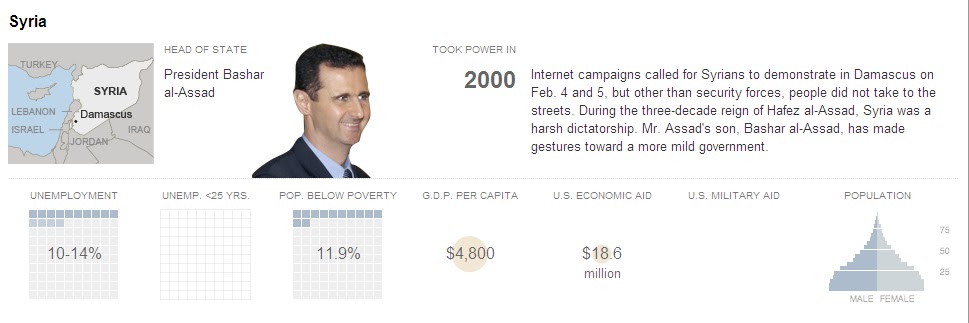     |
Sunday, December 12, 2010
I LOVE Millionaires and Billionaires!! And you do too, but don't really know it...

Do you know who any of these people are? Maybe one or two (Bill Gates, Steve Jobs, etc) but in general these millionaires are nameless, faceless people (to us) who got to where they are by producing goods or services most of us use on a daily basis and improve our lives in a relatively seamless way. Their profit is not at our expense but adds to our surplus! I have no idea who the owner of Jiffy Lube is, but I am glad he is rich and I am glad I don't have to change my oil. I consider that an even exchange!
I think this gets lost in the debate over taxes and tax rates. We are not doing a good enough job in discerning who is rich, but more importantly, how they got that way. Listening to politicians/media one would think only Wall Street bankers, insurance and oil executives are millionaires. If you really think about it, the only rich people vilified publicly are people who profit GREATLY because of bailouts, subsidies, and an other-wise cozy relationship with politicians and bureaucracies. In economics we call these "rent-seekers", private citizens/industries that use political access to profit and limit competition. Let me say this as clearly as possible: I ABHOR rent-seekers! They are worst kind of "millionaires" because they got that way at the expense of the public (that means YOU).
Go back to your personal results from the first paragraph. How many of these goods/services were the result of rent-seekers or businesses/entrepreneurs, who only got "rich" providing you something that enhanced your life without you thinking much about it? It probably did not even cost you that much either (relative to the benefit you received). The rent-seekers good/service probably cost you the most and gave you the least satisfaction. I am guessing a vast majority of the items came from the "silent majority" of millionaires who risked capital to bring that good or service to the market place.
In a purely non-partisan fashion, ask yourself: "How much more do these people owe society than what they have already given?". Is it not useful to consider this before you lump all rich people together? I am not saying the rich pay nothing in taxes, but should some consideration be taken to assess the benefits they endow on society before we decide how much "we" should take from them? Have they not already proven to be good stewards of societal resources, in general? Just askin'...What do you think?
Note: I am not a "rich guy" (well, not monetarily anyway). I only recognize the value of the PROPER millionaire/billionaire...We hover in the mid-range of the 28% tax bracket. Hey, I have a productive wife whose skills are valued more in society than mine as a teacher....but that is ANOTHER debate! :)
Subscribe to:
Comments (Atom)
 View My Stats