Showing posts with label Foreign Exchage. Show all posts

Tuesday, August 15, 2017

Wording for Correct answers for Foreign Exchange Market (FOREX) on the AP Macroeconomics FRQ's

On the AP Macroeconomics exam you can be 99% certain you will be asked Foreign Exchange Market question(s) on the FRQ section of the test.

Precise and to the point answers are required.  They are looking for the proper linkages from the various cause and effect scenarios you are presented with.

Below I wrote out what would be the "best way" to respond to these questions.  You may be asked to identify and explain ALL the effects under each bullet point or maybe just one (for example, only what happens to Exports given an event---all the rest is implied and you have to understand it in order to get to what happens to Exports).

My advice is to memorize these until they "click".  Again, they contain ALL the key words/phrases that past FRQ rubics have required students explicitly mention.

NOTES:  BE CAREFUL with #3 through #6.  They seem very counter-intuitive what happens to the value of the dollar given the scenario.  These can easily trip you up.


1. “If the interest rate in the U.S. INCREASES relative to the Rest of the World (ROW), U.S. financial assets become more desirable.  The demand for the dollars INCREASES and APPRECIATES the value of the dollar internationally. “
Effect on Exports: When the dollar APPRECIATES in value, U.S. goods and services become relatively MORE expensive and Exports will DECREASE.
Effect of Imports: When the dollar APPRECIATES in value, Foreign goods and services become relatively LESS expensive and Imports will INCREASE.
Effect on Net Exports (N(x): If Exports Decrease and Imports Increase, then net exports will DECREASE.

2.If the interest rate in the U.S. DECREASES relative to the Rest of the World (ROW), U.S. financial assets become less desirable.  The supply of the dollars INCREASES and DEPRECIATES the value of the dollar internationally. “
Effect on Exports: When the dollar DEPRECIATES in value, U.S. goods and services become relatively LESS expensive and Exports will INCREASE.
Effect of Imports: When the dollar DEPRECIATES in value, Foreign goods and services become relatively MORE expensive and Imports will DECREASE.
Effect on Net Exports (N(x): If Exports Increase and Imports Decrease, then net exports will INCREASE.

3. If price levels in U.S. are LOWER relative to Rest of the World (ROW) then U.S. goods and services become MORE desirable. The demand for the dollars INCREASES and APPRECIATES the value of the dollar internationally. “
Effect on Exports: When the dollar APPRECIATES in value, U.S. goods and services become relatively MORE expensive and Exports will DECREASE.
Effect of Imports: When the dollar APPRECIATES in value, Foreign goods and services become relatively LESS expensive and Imports will INCREASE.
Effect on Net Exports (N(x): If Exports Decrease and Imports Increase, then net exports will DECREASE.
4. If price levels in U.S. are HIGHER relative to Rest of the World (ROW) then Foreign goods and services become MORE desirable. The supply of dollars INCREASES and DEPRECIATES the value of the dollar internationally.
Effect on Exports: When the dollar DEPRECIATES in value, U.S. goods and services become relatively LESS expensive and Exports will INCREASE.
Effect of Imports: When the dollar DEPRECIATES in value, Foreign goods and services become relatively MORE expensive and Imports will DECREASE.
Effect on Net Exports (N(x): If Exports Increase and Imports Decrease, then net exports will INCREASE.

5. If GDP INCREASES in the U.S. relative to the Rest of the World, then Americans will want to buy not only MORE domestic goods/services, but MORE foreign goods/services also. The supply of dollars INCREASES and DEPRECIATES the value of the dollar internationally.
Effect on Exports: When the dollar DEPRECIATES in value, U.S. goods and services become relatively  LESS expensive and Exports will INCREASE.
Effect of Imports: When the dollar DEPRECIATES in value, Foreign goods and services become relatively MORE expensive and Imports will DECREASE.
Effect on Net Exports (N(x): If Exports Increase and Imports Decrease, then net exports will INCREASE.

6. If GDP DECREASES in the US relative to the Rest of the World. then Americans will not only buy FEWER domestic goods/services, but FEWER Foreign goods/services also.  The supply of dollars DECREASES and APPRECIATES the value of the dollar internationally.
Effect on Exports: When the dollar APPRECIATES in value, U.S. goods and services become relatively MORE expensive and Exports will DECREASE.
Effect of Imports: When the dollar APPRECIATES in value, Foreign goods and services become relatively LESS expensive and Imports will INCREASE.
Effect on Net Exports (N(x): If Exports Decrease and Imports Increase, then net exports will DECREASE.

Thursday, September 25, 2014

Price of iPhones, in select countries, converted into US dollars. Is arbitrage the reason for long lines?

I found the prices of the new iPhone6 in various countries at this link HERE.  They have the prices for the "regular" one and the "Plus".

The conversion I do below is just for the "regular" iPhone With NO CONTRACT.

In the first column are the prices in local currency for the respective country.

The second column I calculated how much the holders of those currencies would have to exchange in order to buy the iPhone in the US instead.

The third column shows the difference in local currency between what it would cost residents to buy an iPhone in their own country at the local price vs how much they would have to convert to buy it in the US in US dollars.

For example, in the UK a 16GB phone is  £539.  In the US it is $649.  At today's exchange rate of 1 pound sterling exchanges for $1.633384 dollars, a Brit would need exactly £397.22 to buy the phone in the US.  That is a SAVINGS of £141.78 for them over the UK retail price!

In US dollars that is $231.58 ( £141.78 X $1.633384). A lot, isn't it?  Seems like a GREAT opportunity for "Arbitrage".  Buy low at retail in the US and still sell below the retail price in the UK and make some money, right?


Included in the price quoted above for the UK (and I believe for the other countries listed) is a thing called the Value Added Tax or "VAT.

Here is the breakdown for the UK (found HERE)

16GB - £539 (£449.17 ex VAT)
64GB - £619 (£515.83 ex VAT)
128GB - £699 (£582.50 ex VAT)

So the ACTUAL prices of the phones, minus the VAT, are in parenthesis.  If you take these numbers and subtract  the 2nd column numbers it will show a much lower difference, hence a smaller arbitrage opportunity. It almost disappears if you were to add on the Sales Tax to the US prices listed.

It seems to only way to make money buying in the US and selling in the UK (and the other countries listed EXCEPT Japan) is to trade on the Black Market to avoid the steep VAT taxes.

I am sure that is not the reason for the long lines in the US and people buying multiple phones....RIGHT?

Saturday, September 14, 2013

Has "King Dollar" been demoted to a Prince? Nice chart showing all major currencies and their ranking in terms of use in international transactions....

Here is a chart showing a list of currencies and their ranking in terms of use to facilitate a whole host of international transactions, such as the buying and selling of goods and services, or physical and/or financial assets. (The chart is from HERE with a HT from The Conversable Economist.)

The US dollar is still by far the most desired "medium of exchange" for engaging in international trade.

With most major commodities such as oil and agricultural products, US dollars are used to between the countries trading, even if the countries themselves do not use the US dollar as the currency of record.

In other words, if Russia sells oil to China the transaction is conducted in US dollars, not Rubles or Renminbi.

One interesting note from the chart is since 2001 the share of US dollars used in international transactions has decreased a bit but the use of the Chinese Renminbi has increased dramatically, moving from 35th place to 9th place in a relatively short period of time.

Source: TriennialCentral Bank Survey Foreign exchange turnover in April 2013: preliminary global results 

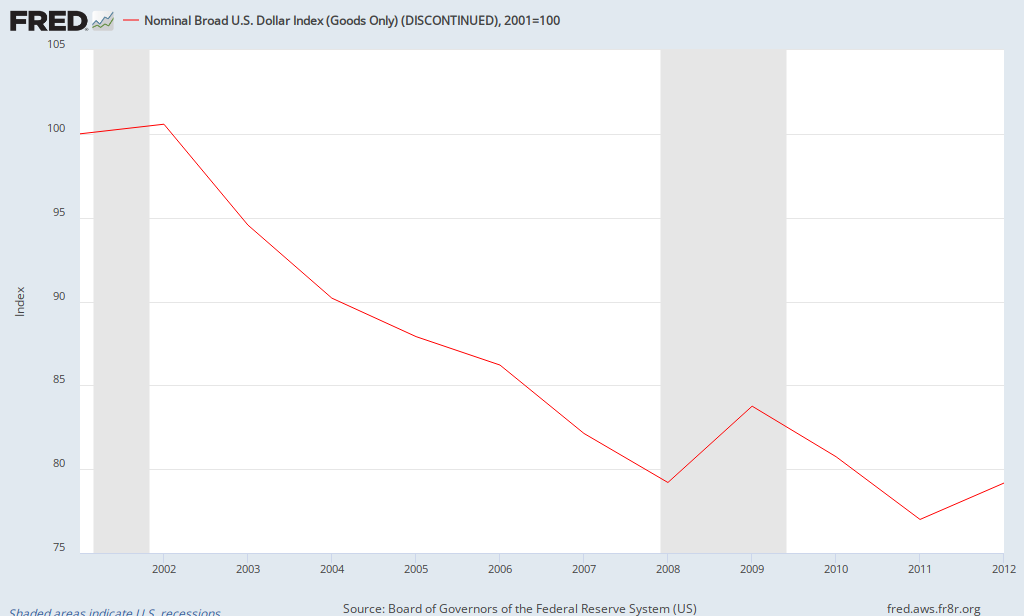
If the use of the US dollar in international transactions has declined since 2001, we might expect the value of the dollar to fall as well.  Not to imply correlation is causation, but the graph below shows how the value of the US dollar has changed compared to a "basket of other major currencies".

Using 2001 as a base year, the dollar has declined in value roughly 21%.

Has "King Dollar" been demoted to "Prince"? Not yet, but he should be looking over his shoulder.

FRED Graph


Thursday, September 22, 2011

Is the US dollar a "safe-haven" currency anymore? King Dollar may be demoted to Prince in the future...


This article in the WSJ today emphasizes one of the determinants that cause an increase in the demand for a particular currency: A currency as a "safe-haven" against loss or depreciation. 


If a holder of a particular currency is unsure of its immediate or future value, they may elect to exchange it for a currency they believe will, at the minimun, maintain its value.


According to the article, there is not a firm consensus as to which currency is a dependable safe-haven. The dollar historically has played this role, but not so much today. 

Investors Show a Yen for the Dollar

""There may be no lack of investors seeking safety, but there is a shortage of safe havens in the currency market.

That was in evidence during Thursday's global rout in financial markets, when just about the only islands of strength were the U.S. dollar and the yen.

It isn't lost on investors that both the U.S. and Japan have significant fiscal and economic woes. But when markets turn scary, the ease of trading in both countries' currencies and in their deep underlying bond markets overwhelms those longer-term concerns.

The Swiss franc, long a traditional safe haven, has been largely taken out of the equation by the Swiss National Bank's efforts to cap the currency's rise, and it declined about 1% against the dollar Thursday. Even gold fell 3.7% on Thursday, as investors cut back on positions after the metal's long march higher. Currencies recently touted as safe havens, such as the Norwegian krone and Swedish krona, both lost about 2% against the dollar.

In times of trouble, "at the end of the day you just buy dollars," says Gravelle Pierre, founder of Iron Harbor Capital Management. ""


Saturday, September 17, 2011

Nice graphic showing Financial Capital Inflows into select countries...A great resource for Macroeconomics OR to impress your teacher/professor...

We just completed a unit on the Foreign Exchange Market in AP Macroeconomics last week. This week we are going to look at how the government tracks international flows of currency through "The Balance of Payments".

This interactive graphic shows the Financial Capital Inflows to select countries and the corresponding effects on the currency exchange rates with the US dollar from 2001 and 2011. It will be very helpful when we learn about the Financial/Capital Account side of the Balance of Payments.

Go HERE for the interactive. What do you notice about the relationship between financial capital inflows and the relative value of the currencies of the respective countries?

Source: Wall Street Journal

Tuesday, July 12, 2011

The "Carry-Trade" explained---Short lesson on how to make money in the Foreign Exchange Market. Don't try this at home!

Here is a quick lesson on the "Carry Trade". In its most simplest terms, this is borrowing money in one currency (i.e. US dollars) at a low interest rate and investing it in another country that currently offers savers/investors a high interest rate (i.e. Brazil--currency called the "Real").  I will use Brazil because it does in fact offer relatively high interests rates to savers/investors.  Of course, we will have to exchange our dollars for the foreign country currency in order to do this so we have to take into consideration the prevailing exchange rate for the two currencies.

There are 2 ways for the holders of dollars to make money--(1) the difference on the spread between the interest rate at which you borrowed the money and interest rate you received from the investment you put the money in (assume the exchange rate stays constant), and (2) IF the foreign currency you currently have the money invested in APPRECIATES in value during the time you hold the investment. 

Look at the first scenario first.  Right now it is "cheap" to borrow money in the US and the interest rates that Brazilian banks offer savers in relatively high.  I am going to use ballpark numbers because, well frankly, the math is easier.  Assume I can borrow money in the US at a 5% interest rate for one year.  If I borrow $1,000 I will have to pay the bank back $1,000 plus $50 after 1 year ($1,000 times 5% = $50)) for a total of $1,050.  I am going to invest this $1,000 in a bank in Brazil because it offers 10% interest rate to savers. 

First, I have to exchange my US Dollars for Brazilian Reals. Assume today the exchange rate is $1.00  = 1.76 Reals. With my $1.000 US dollars I can "purchase" 1,760 Reals. I put those Reals in the bank and start earning my 10% interest.

After one year I will have 1,936 Reals in my Brazilian bank (1,760 + 176 (10% of 1,760). I must withdraw this money so I can pay back the US bank for the money I originally borrowed.  ASSUME the exchange rate did not change at all (it did, but more on that in a minute).  To go from Reals to Dollars, I have to calculate the reciprocal of the exchange rate. The reciprocal of $1.00 = 1.76 Reals is 1.00 Real = $.5681 cents.   If we multiply 1,936 Reals by $.5681 we get $1,100 (rounded). We now take $1,050 of this and repay the bank what we owe them.  We have $50 left over! In real life, we would have to pay a fee for the currency transaction when we bought and sold, so we would have to subtract that from our $50.  BUT, you can see how you can make money by borrowing in one currency and saving/investing in another.

Now, what if the exchange rate changed while you had your money in the Brazilian bank? The exchange rate I used above for the Real was the exchange rate from July 12, 2010, one year ago.  TODAY the exchange rate is $1.00 = 1.58 Reals.  Now $1.00 US buys FEWER Brazilian Reals which means the inverse is true---The Brazilian Real buys MORE US Dollars than before (1.00 Real =$.6329 cents). Let's use this to see how our investment fared.

If today we exchange our 1,936 Reals for dollars we get 1,936 times $.6229 cents = $1,225 (rounded). NOW, when we pay back the loan plus interest of $1050 we will have $75 left over (minus fees).  We have an additional $25 just because to the change in the exchange rate between the Dollar and the Real. Easy money, right???

The trick to this is to (1) find a country where the interests are higher relative to the US, (2) it is stable enough to invest in, and (3) the currency appreciates while it is earning interest.  Of these number 3 is the most risky and difficult to predict. If the Real had DEPRECIATED in this time period, you could have lost not only the interest you earned BUT some of the principle as well.

Even if the exchange rates stay relatively constant, you can see how you can make money in the "carry-trade". The appreciation of the Real was a bonus.  However, this strategy is risky and is not recommended by professional financial advisers unless your investment portfolio can withstand the risk.
View My Stats