Friday, January 20, 2012

Noticed the price of tires increasing lately? Wonder why? Prepare to burn some mental rubber after you read this...

Tariffs are taxes too!  It is probably THE most regressive tax as well (disproportionately hurt lower income people).  Because they are embedded in the price of a good we don't see them.

 Tariffs are generally imposed to keep the price of a good higher than it normally would be in order to "protect" a domestic producer from lower priced foreign goods. But what if there is no, or very little, domestic production of the good in the first place? Why tax something that is purchased by a wide majority of lower income people to benefit a relatively small number of producers? 

In 2009 a hefty 35% tariff was levied on low-priced tires imported from China, at the request of the US Steel Workers Union. At that time I blogged the possible effects this would have on the industry and consumers (HERE).  Looky here at what has happened to imports of tires from various location.

Source : Wall Street Journal
Since the imposition of the tariff, imports of tires from China have decreased significantly (SUCCESS!!), but other countries not subject to the tariff have picked up the slack (OPPS!).  Net effect: No change in imports BUT higher prices.  Nice---Predictable--Econ 101.  From the excerpts below you will see the tariff has had the effect of raising the price of tires and no appreciable effect on domestic production, hence jobs.

As I have noted with low-priced shoes, tariffs imposed on goods that have little domestic production and support relatively few jobs, are bad for the poor.  Want to help the poor? Review and repeal unnecessary tariffs. 

Get-Tough Policy on Chinese Tires Falls Flat
"The tariffs didn't have any material impact on our North American business," says Keith Price, a spokesman for Goodyear Tire & Rubber Co., echoing a sentiment expressed by some other manufacturers. "The stuff coming in from China is primarily low end. We got out of that market years go."
After the tariff was enacted in 2009—35% in the first year—imports from China did in fact drop sharply. But that business quickly shifted to Thailand, Indonesia, Mexico and elsewhere. Tire imports to the U.S. from these countries rocketed, proving once again that the world has become one big fungible production platform: If it doesn't get built in China and it's too expensive to make in the U.S., it will get made in a cheap locale somewhere else. 
"So far as saving American jobs, it just isn't working," says Roy Littlefield of the Tire Industry Association, which has 6,000 members. "And it really hurt a lot of people in the industry—smaller businesses that geared up to bring these tires in from China."
"This is a China tire, it costs me $69 today," says the owner of Cybert Tire & Car Care in New York City. "Before it cost $39." A big part of that increase: The fat tariff the U.S. has placed on Chinese tires.

"It all gets passed to the customer," says Mr. Everett.

Mr. Everett, the tire shop owner, says prices jumped not just for China-made tires but for tires made in the U.S., too. Wholesalers, he said, used the cover of the tariff to raise prices across the board. Bob Ulrich, editor of Modern Tire Dealer, a trade publication, says prices are up 29% in the replacement market since 2009...

Thursday, January 19, 2012

Great Cartoon: Hostess HAS to be the WORST Corporation ever if they can't stay in business selling junk food to Americans...

Source: The Big Picture

Nice Info-Graphic showing key Economic and Demographic characteristics between the US and China...Important stuff!!!

Click HERE to go to the site to view this info-graphic in better detail.  Nice summary of key economic and demographic details between the US and China.  HT: David Mayer

Source: The Mint via David Mayer

Healthcare costs have been the enemy of the "Middle Class" for the last decade. Nice explanation and chart here...

A workers income comes in two forms: Wage and Non-Wage compensation. "Wage compensation" is what you are paid per hour or in salary (before any deductions). "Non-wage compensation" is what your employer might pay on your behalf in addition to what they pay you, such their half of the Social Security and Medicare tax, unemployment tax, retirment plans, etc.

Healthcare premiums/costs is another one and one that is rising much more than any other cost of employing a worker.  The employer share of your healthcare costs ARE a cost of employing you.  The more they have to pay for healthcare coverage (Non-Wage compensation) , the less available to pay you (Wage compensation). 

While income for the median wage earner has risen very modestly, it COULD have risen more if in the last decade healthcare costs had risen at only the rate of everything else in the Consumer Price Index. 

A significant source of Middle Class income stagnation, would you say? Healthcare costs are the (or one of) enemy of the middle class. Seems quite clear to me...The following is from economist Tim Taylor...
'''To paint an accurate picture of how health care cost growth is affecting the finances of a typical American family, RAND Health researchers combined data from multiple sources to depict the effects of rising health care costs on a median income married couple with two children covered by employer-sponsored insurance. The analysis compared the family’s health care cost burden in 1999 with that incurred in 2009. The take-away message: Although family income grew throughout the decade, the financial benefits that the family might have realized were largely consumed by health care cost growth, leaving them with only $95 more per month than in 1999. Had health care costs tracked the rise in the Consumer Price Index, rather than outpacing it, an average American family would have had an additional $450 per month—more than $5,000 per year—to spend on other priorities."
Here are the calculations for that median family. The row showing "Taxes devoted to health care" is the cost of Medicare, Medicaid, and other public health programs.''
Note: These are MONTHLY COSTS!
Source: Tim Taylor

Wednesday, January 18, 2012

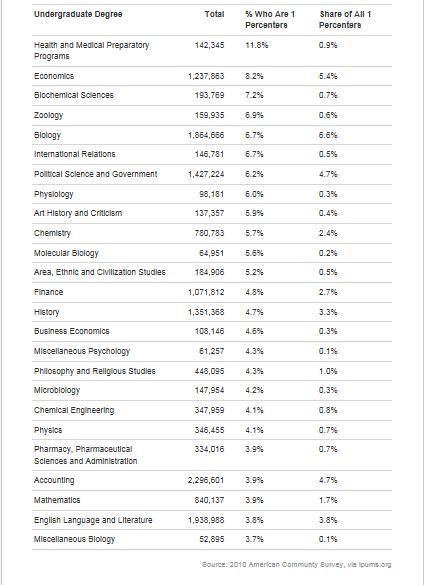
What should you major in to have the BEST chance of getting into the 1% of income earners? This list really surprised me. Worth a look!

This is an interesting list. I am VERY surprised by some of the results and how relatively diverse it is in terms of undergraduate majors. However, it is weighted  heavily on the side of the Math and Sciences. You English and Lit majors have hope!!! :)  Source: Economix for more discusson...
Source: Economix

Just found THE BEST interactive website where you can see who in the House and/or Senate is likely to support/oppose SOPA/PIPA. Sort by Party affiliation, state, CAMPAIGN CONTRIBUTIONS, etc. MOST EXCELLENT!! Click HERE to link to it...

The link is HERE.  Be advised---the site is explicit when it says these are representative/senators that have either signed on as sponsors of the bill(s) or based on previous statements or voting records are likely to vote for or against these bills.  It DOES NOT show all the members of the House and Senate, but it is reveals the inertia of the direction voting might go.  The Senate seems to be the real problem for the opponents of the bills...

Also, PC WORLD has an excellent primer that is pretty impartial on the issues that surround these two bills. Very short and covers the high and low points..

YIKES! Google is using a Supply-Side economics (Point #2) argument to get people to sign their petition. You Keynesians out there DON'T fall for it, it is a trap!!

Below is point #2 from GOOGLE's message to the world.  It quite nicely summarizes a "supply-side" argument for a source of economic growth.  Google is suggesting Federal Regulations create uncertainty, hurt competitives, costs jobs, stiffles R&D, and discourages investment/entrepreneurship...ALL the things we have heard lately that are NOT problems in our economy.  Why is this all of a sudden unique to the internet and not many other industries?

In tough economic times in the 70's, Pres Nixon is famous for saying "We are all Keynesians now".  Is Google suggesting "We are all Supply-siders now."?

GOOGLE: 2. SOPA and PIPA would be job-killers because they would create a new era of uncertainty for American business.''
Law-abiding U.S. internet companies would have to monitor everything users link to or upload or face the risk of time-consuming litigation. That’s why AOL, EBay, Facebook, Google, LinkedIn, Mozilla, Twitter, Yahoo and Zynga wrote a letter to Congress saying these bills “pose a serious risk to our industry’s continued track record of innovation and job-creation.” It’s also why 55 of America’s most successful venture capitalists expressed concern that PIPA “would stifle investment in Internet services, throttle innovation, and hurt American competitiveness”. More than 204 entrepreneurs told Congress that PIPA and SOPA would “hurt economic growth and chill innovation”.

Tuesday, January 17, 2012

Terrific Info-graphic: Everything you wanted to know about Gold but were afraid to ask (no, this has NOTHING to do with Ron Paul)...

All The World's Gold
Add caption
From: Number Sleuth

A nice interactive: Enter your household income and see how you rank in terms of the 1% or 99% in different parts of the country...

I took a screen shot of a household (all the wage earners under one roof , technically) income of $70,000 (assuming this is Pre-Tax income, but not sure).  This could be the rough income of two young, married teachers.

The green boxes show the percent ranking of this household in terms of income "class", in that geographic area. In the D/FW area you would be in the Top 41% of wage earners.  In

Go HERE and to enter YOUR household income and see where you rank
NYTIMES
T

Monday, January 16, 2012

The Urban Dictionary definition of an Economist...Love the way they use it in a sentence...So true!

The following is from Urban Dictionary...I love the way it is used in a sentence. I think i am going to use this from now on... :)
economist:
one who, starting from a position of over-educated and under-informed logical supposition, commences making erroneous and devastating judgements about the functioning of the world, and then formally codifies their misunderstanding in dogmatic and arrogant absurdity
 
Used in a sentence:
 
"man, that guy is such an *economist*, i wish he'd just listen to people once in a while!"
 

Sunday, January 15, 2012

Nice chart showing gas taxes in various "rich" countries and an excellent graph showing the effect of these taxes on the quantity demanded for gasoline. Bet you can guess what the answer is.

One of the primary reasons for the differences in the retail price of gasoline in the "rich world" is the differences in the gas/fuel tax levied on each gallon of gasoline.

This first graph shows, in US dollars, the amount of tax various countries levy on gasoline and diesel fuels.  Quite a difference!
Source: Econbrowser
Here is a chart from a different source showing the pre and post tax price of gas and diesel in the coutries listed above and some others.  The blue line is pre-tax. You can see the price of fuel is basically the same in all areas

Source: HERE

The post-tax retail price of gasoline is going to be higher when the above taxes are added to the pre-tax price of gasoline, to state the obvious.

The Law of Demand in economics states that the price and quantity demanded of a good are INVERSELY related---price increases the quantity demanded decreases---price decreases the quantity demanded increases.  Makes sense, right?

The next graph illustrates this point explicitly.  Note the price on this graph is along the horizontal axis and the quantity demanded of fuel is on the vertical. This is the OPPOSITE of what is traditionally done in economics textbooks.  The inverse relationship between price and quantity demanded holds up rather well.

Source: Econbrowser

What are the implications?  If you want to seriously decrease the consumption of carbon-based fuels, the most effective way is through an increase in gas prices at the retail level.  Is this politically possible? Absolutely not.

To read more about this important topic go HERE for the source for this posting and/or go HERE for the original research paper that has more in detail. Worth a look if you are at all interested.

Saturday, January 14, 2012

An excellent article on the state of manufacturing and employment in that sector. Please read it to get beyond the screeches of "It's the foreigners fault! "(Righties) or "It's the greedy corporations fault!" (Lefties). Unless you want to just screech and be uninformed

Manufacturing in the US is not, I repeat NOT, what it used to be for many reasons.  Manufacturing output for the US is higher than at any time in history, however, employment in the manufacturing sector is about at 1940's level (surprised by that? I was too).  In other words, we make a lot more stuff than ever but are doing it with significantly fewer workers.  I know, that seems strange.  But if you take the time to read the article below, you will begin to better understand the issues surrounding the alleged demise of US manufacturing. 

The level of detail in this article is excellent does a nice job of covering the human aspect of technologically driven change in manufacturing.  One of the best I have read on the topic. Enjoy! :)

Making It in America

I first met Madelyn “Maddie” Parlier in the “clean room” of Standard Motor Products’ fuel-injector assembly line in Greenville, South Carolina. Like everyone else, she was wearing a blue lab coat and a hairnet. She’s so small that she seemed swallowed up by all the protective gear.

Tony Scalzitti, the plant manager, was giving me the grand tour, explaining how bits of metal move through a series of machines to become precision fuel injectors. Maddie, hunched forward and moving quickly from one machine to another, almost bumped into us, then shifted left and darted away. Tony, in passing, said, “She’s new. She’s one of our most promising Level 1s.”

Later, I sat down with Maddie in a quiet factory office where nobody needs to wear protective gear. Without the hairnet and lab coat, she is a pretty, intense woman, 22 years old, with bright blue eyes that seemed to bore into me as she talked, as fast as she could, about her life. She told me how much she likes her job, because she hates to sit still and there’s always something going on in the factory. She enjoys learning, she said, and she’s learned how to run a lot of the different machines. At one point, she looked around the office and said she’d really like to work there one day, helping to design parts rather than stamping them out. She said she’s noticed that robotic arms and other machines seem to keep replacing people on the factory floor, and she’s worried that this could happen to her. She told me she wants to go back to school—as her parents and grandparents keep telling her to do—but she is a single mother, and she can’t leave her two kids alone at night while she takes classes.

I had come to Greenville to better understand what, exactly, is happening to manufacturing in the United States, and what the future holds for people like Maddie—people who still make physical things for a living and, more broadly, people (as many as 40 million adults in the U.S.) who lack higher education, but are striving for a middle-class life. We do still make things here, even though many people don’t believe me when I tell them that. Depending on which stats you believe, the United States is either the No. 1 or No. 2 manufacturer in the world (China may have surpassed us in the past year or two). Whatever the country’s current rank, its manufacturing output continues to grow strongly; in the past decade alone, output from American factories, adjusted for inflation, has risen by a third.


Friday, January 13, 2012

Video explaining the basics of GDP...Whoa! Slow down with the enthusiasm... :)

A very nice and concise video explaining the basics of GDP...(HT: Jason Welker)

Would you like a little sugar with your plastic? Yes, plastic contains sugar! It also has another ingredient that is THE most important one. See what it is here...

BASF Will Join Venture to Make Plastics for Sugar
""Renmatix, based in King of Prussia, Pa., is one of several start-ups that have been pursuing a cost-effective replacement for fossil fuels from non-edible crops, amid mounting concerns about high oil prices and global warming over the past decade. ""
I did not know sugar was used/could be used in the manufacturing of plastic. We under-appreciate the significance of chemistry/science in the production of, well, just about everything.

The use of science in the pursuit of lowering the cost of producing has a three-fold effect: (1) better utilizes societal resources in a more efficient way (2) increases profits, and (3) lowers prices for consumers. 

However,  HOW this research actually gets conducted is what most interests me:

""Renmatix, which is backed by the Silicon Valley venture capital firm Kleiner Perkins Caufield & Byers, has raised $70 million.""
This particular research and development would not take place without this outside financial capital from this (or any other) firm.  Venture capital is vital for funding innovation "at the margin" of the marketplace. Innovations that have potential but in general are "not quite there" yet.  It is investment that, by definition, is very risky. 

Where does this investment capital come from that helps deliver to YOU goods that are better, cheaper and more widely available?

That is a rhetorical question. I know the answer, and so do you.  Many others know it too but don't want to acknowledge it.  Even they get to enjoy the fruits of venture capital without a nod to where it came from...

Thursday, January 12, 2012

We have a current observable case of income redistribution that promotes significant economic growth. Why don't we try this???

One persons idea of an income redistribution plan is another persons idea of piracy.  A new study suggests that some areas of Somalia are prospering because of the additonal "income" generated by the spending of ill-gotten ransom gains. How do you say Keynesian Multiplier in Somali?

 Below are a some excerpts from a BBC article and below that are the satellite photos from the actual report (HERE)

Somali piracy 'boosts Puntland economy'

""New research suggests piracy has led to widespread economic development in some parts of Somalia....

""Analysis of daytime satellite image showed that Garowe almost doubled in area between 2002 and 2009, with significant housing, industrial and commercial developments...""

""Many houses were newly built or repaired between those dates and a much larger number have vehicles parked outside.""

""The report concludes that significant amounts of ransom money are spent in the regional centres, with the benefits being shared out between a large number of people due to the clan structures in place...""


View My Stats