Wednesday, April 27, 2011

A nice primer on Inflation and who it hurts and who it helps...Yes, inflation can be your friend...

Inflation-talk is the rage right now, domestically and internationally. It is still open to debate whether we are  in the midst of the classic definition of inflation---a general rise in the average price level---or do we just have increasing prices in a limited, but vital, number of commodities (gas and food, primarily). This blog post from "Supply and Demand--In that order" is a nice primer on the topic of the effects of inflation on all the interested parties...

""Normally, inflation is one of the most harmful taxes, but these days inflation may do less harm than good.
During most of our lifetimes, the prices of things we buy have generally increased over time. We can name some exceptions, but most items (even houses) have prices that are higher now than they were 10, 20 or 30 years ago. This general increase in consumer prices is called inflation.
The Federal Reserve is charged with limiting the rate of inflation, which it can do over the long run by limiting the supply of money and similar assets in the hands of the public.
Inflation is widely disliked. A number of economists think that inflation’s bad reputation is undeserved, and that, while people complain that inflation makes things more expensive, they fail to recognize that inflation also raises their wages.

The net result of inflation could be to increase wages and prices in the same proportion, without harming consumer’s purchasing power.

A person on a fixed income, such as a pensioner receiving a specific number of dollars a month – a so-called “defined benefit” pension – does have less purchasing power when prices rise. However, Social Security benefits automatically increase with wages in the economy, and thereby automatically increase with inflation in the long run.

Why a commission to investigate speculation in the oil/gasoline markets will not be productive---We are missing the REAL story---See why in one easy to read graph...

We can appoint 100 commissions to investigate the role of speculators (read that Hedge Funds investing in oil futures) in the rising price of oil, but I would prefer to look at one underlying fundamental that will remain long after these commissions issue their reports (with vague findings, after spending lots of money to do so---mark my words). 

The graphic below speaks volumes and starkly illustrates what I don't think most Americans are aware of, or want to be aware of---there are major emerging economy's with large populations and they are consuming more oil based energy every day. 

Speculation in the oil markets happens (see, I said it!). No reasonable person denies that.  However, it will not be the long term cause of higher oil prices, hence gas prices.  THIS WILL:

Source: WSJ

""The U.S. Energy Department on Wednesday reported a 1.6% decline in a closely watched gauge of gasoline consumption, compared with a year ago. In the past, when U.S. drivers cut back, that has dented global demand for oil and depressed prices. After a lag, the lower prices would help the economy regain its footing—or at least remove a substantial headwind.


But many oil experts believe that scenario won't play out this time, because U.S. drivers are no longer calling the shots. The rapidly industrializing economies of China, India, Brazil and even Saudi Arabia are. A possible result: an extended period of sluggish U.S. growth amid high oil prices.


"It's a new world," said oil economist James D. Hamilton, a professor at the University of California, San Diego. "The growth in newly industrialized countries is the key factor driving oil prices."""

Donald Trump will get tough with China on Trade...Hmmm...then who is going to make his signature shirts and ties?

Donald Trump has said he will get tough with the Chinese on trade. He believes they take advantage of the US and plays us for chumps. Is he going to get tough BEFORE or AFTER they make the shirts with his name on them...just askin'...
Source: HT Carpe Diem

Tuesday, April 26, 2011

Another United Nations "Fail"---How do you become a member of the UN Human Rights Council? If you are Syria you murder protesters in the streets. This is the upside down world of the UN...

Despite Reports of Brutality Toward Civilians, Syria to Join U.N.'s Human Rights Council
The brutal crackdown by Syrian President Bashar Assad may finally be getting the attention of world leaders -- but apparently not enough to stop Syria from becoming the newest member of the U.N. Human Rights Council.


And despite calling for an independent investigation into the crackdown, which has left hundreds dead, U.N. Secretary-General Ban Ki-moon apparently won’t do much about blocking Syria’s path to the human rights group.

"That's not really for the secretary general to suggest to a member state," said Martin Nesirky, a spokesman for the secretary-general, when asked if the U.N. chief would ask Syria to drop out of the running for the post. When asked if Ban had brought up the point during his telephone conversation April 9 with Assad, Nesirsky told Fox News, "that's not really something the secretary general would raise specifically, because it's for other member states to decide on the membership of the Human Rights Council."

Sunday, April 24, 2011

If you like beer, don't make over $22,000 per year--Apparently you become too sophisticated and responsible at that income level...

Perhaps the MOST interesting thing about the study quoted below is that it came from an organization called "The American Association of Wine Economists"--Yes, you read that right. Who says economists are boring...But I digress...

This blog entry at Economix is about the increase in consumption of beer by the Chinese, but I was intrigued by this nugget of information:

...That story can be repeated for any number of consumer goods, of course. But what’s interesting about beer is that the trend is not likely to last. A paper by two economists at the University of Leuven, in beer-loving Belgium, finds that people drink more beer as their incomes rise, until they make about $22,000 a year.

Then they start drinking less beer.
The paper, brought to my attention by the Reuters blogger Felix Salmon, doesn’t offer much in the way of explanations, but perhaps the most obvious one is something many Americans personally experience in their 20s. As you start making more money, and assuming more responsibility, there is less opportunity to drink -– and the potential consequences become more costly.
An income of $22,000 seems to be the breaking point where beer crosses over from a normal good to an inferior good.  If income increases and the demand for a good increases then it is considered a normal good. If income increases and the demand for a good decreases then it is considered an inferior good--people substitute away from the inferior good to a normal good as income increases.  In this case, the study finds wine becomes the normal good as income goes over $22,000.   

This type of information is important to marketers of all products, not just alcohol.  A nice example of how research at a Microeconomics level is useful to businesses...It also can be an example of potential "research bias"--I wonder who funds the "American Association of Wine Economists". Well, maybe the wine industry does not fund it, but I am guessing "the drinks are on the house" at the minimum...

I especially liked the comment in the last line (underlined)---as with most things economically related it starts (and ends) with OPPORTUNITY COSTS... :)

Saturday, April 23, 2011

No good deed goes unpunished...States want to tax electric cars because, well, they don't consume enough gas...Go figure...

States are experiencing declining revenues from gas taxes that are assessed on each gallon of gas.  More fuel efficient cars= less gas consumed over time=less tax revenue collected. The reasoning is these cars still impose wear and tear on the roads and are not contributing their "fair share"(there is that phrase again) in order to maintain road infrastructure.  What do you think? Fair/Not Fair?   

Wash. considers annual flat fee for electric cars
""Drivers of electric cars may have left the gas pump behind, but there's one expense they may not be able to shake: paying to maintain the roads.

After years of urging residents to buy fuel-efficient cars and giving them tax breaks to do it, Washington state lawmakers are considering a measure to charge them a $100 annual fee — what would be the nation's first electric car fee.
State lawmakers grappling with a $5 billion deficit are facing declining gas tax revenue, which means less money to maintain or improve roads.
"Electric vehicles put just as much wear and tear on our roads as gas vehicles," said Democratic state Sen. Mary Margaret Haugen, the bill's lead sponsor. "This simply ensures that they contribute their fair share to the upkeep of our roads."

Proof in this Graphic: We continue to buy stuff we don't need with money we don't have to impress people we don't know"...WHY do we do this??

Wall Street Journal


Number of the Week: Americans Buy More Stuff They Don't Need
As it turns out, quite a lot. A non-scientific study of Commerce Department data suggests that in February, U.S. consumers spent an annualized $1.2 trillion on non-essential stuff including pleasure boats, jewelry, booze, gambling and candy. That’s 11.2% of total consumer spending, up from 9.3% a decade earlier and only 4% in 1959, adjusted for inflation. In February, spending on non-essential stuff was up an inflation-adjusted 3.3% from a year earlier, compared to 2.4% for essential stuff such as food, housing and medicine.


To be sure, different people can have different ideas of what should be considered essential. Still, the estimate is probably low. It doesn’t, for example, account for the added cost of certain luxury items such as superfast cars and big houses.

Interestingly, people who spend more on luxuries have experienced less inflation. As of February, the weighted average price of non-essential goods and services was up only 0.2% from a year earlier and 82% from January 1959, according to the Commerce Department. By contrast, the cost of all consumer goods was up 1.6% from a year earlier and 520% from January 1959.

The sheer volume of non-essential spending offers fodder for various conclusions. For one, it could be seen as evidence of the triumph of modern capitalism in raising living standards. We enjoy so much leisure and consume so much extra stuff that even a deep depression wouldn’t – in aggregate — cut into the basics.
Alternately, it could be read as a sign that U.S. economic growth relies too heavily on stimulating demand for stuff people don’t really need, to the detriment of public goods such as health and education. By that logic, a consumption tax – like the value-added taxes common throughout Europe—could go a long way toward restoring balance.

Do you feel lucky? It is true you can create your own luck. See how it worked for Steve Jobs (and learn how popular fonts came into being)...Now, THAT was LUCK!

This is a very good article about creating the conditions to become more "lucky"...There are some very interesting antedoctes related to Steve Jobs and how things might be different except for a few right turns in his life. I excerpt a couple here but read the article. It is short but shows you how by just being more aware you can improve your luck...The last paragraph is my favorite. So many of us get hung up on trying to telegraph the placement of future "dots", we forget that those dots to the future are laid down today using what we learned yesterday...
 
What Lucky People Do Different

“For the past 33 years I have looked in the mirror every morning and asked myself: “If today were the last day of my life, would I want to do what I am about to do today?” And whenever the answer has been “No” too many days in a row, I know I need to change something.”--Steve Jobs


“Unlucky people miss chance opportunities because they are too focused on looking for something else. They go to parties intent on finding their perfect partner, and so miss opportunities to make good friends. They look through the newspaper determined to find certain job advertisements and, as a result, miss other types of jobs. Lucky people are more relaxed and open, and therefore see what is there, rather than just what they are looking for.”


“Reed College at the time offered perhaps the best calligraphy instruction in the country. Throughout the campus every poster, every label on every drawer, was beautifully hand calligraphed. Because I had dropped out and didn’t have to take the normal classes, I decided to take a calligraphy class and learn how to do this. I learned about serif and san serif typefaces, and about varying the amount of space between different letter combinations, about what makes great typography great.”--Steve Jobs

Here’s the kicker:

“If I had never dropped in on that single course in college, “ Jobs explained, “the Mac would have never had multiple typefaces or proportionately spaced ones. And since Windows just copied the Mac, it’s likely that no personal computer would have them.”

He added,

“Of course it was impossible to connect the dots looking forward when I was in college. But it was very, very clear looking backwards ten years later. Again, you can’t connect the dots looking forward; you can only connect them looking backwards. So you have to trust that the dots will somehow connect in your future. You have to trust in something—your gut, destiny, life, karma, whatever. This approach has never let me down, and it has made all the difference in my life.”

"Mary had a little Lamb"...Wait, what is the price of Lamb per pound? Really?..."Mary USED TO have a little lamb..."

Lamb prices surge as supply drops, demand rises

Demand by U.S. consumers is up, imports are down and prices have soared. “You have almost what you can call a perfect storm,” said Fisher, 64, who has about 3,100 animals on his acreage near Sonora. “The great part is we have record prices for lambs — the highest ever by a whole lot.” Last year’s May delivery of lamb fetched about $1.39 a pound; this year the price is around $2.20 a pound, said Fisher, the immediate past president of American Sheep Industry Association.......Still, Mazen Munaser, whose father owns the Islamic Village Market in Dearborn, said demand remains strong.
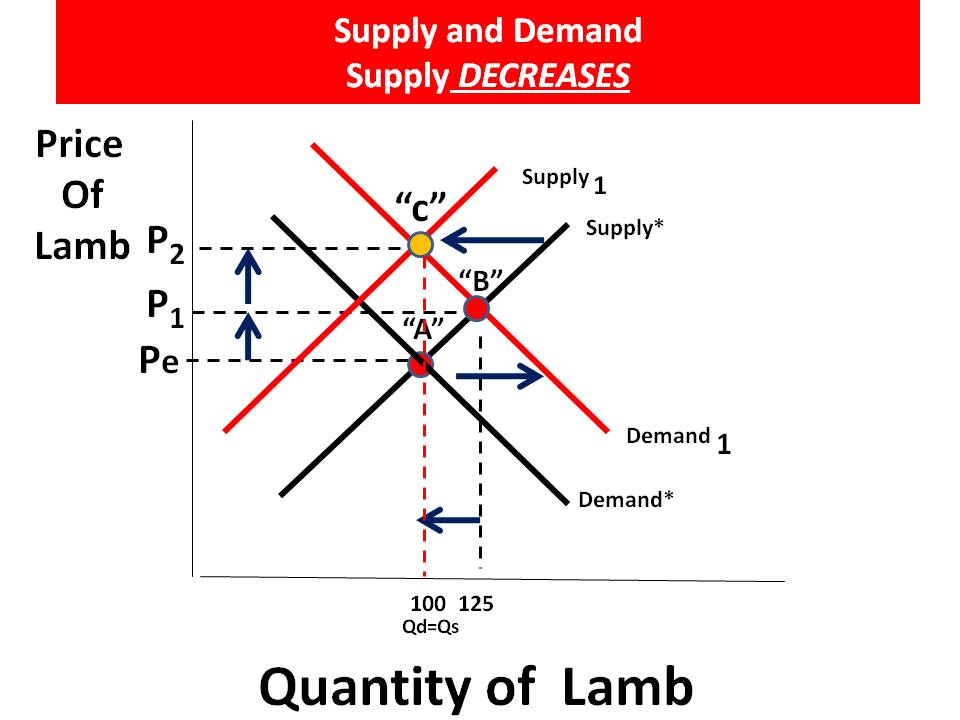
The determinant of demand in this case seems to be a change in preferences. Lamb is also a substitute for other meats (Mutton is mentioned in the article). It has become a more preferable meat source. The demand curve shifts to the right because, relative to the original demand curve, there is a greater quantity demanded at "Pe" and we assume this will be the case at every other price as well. "Demand 1" will lie to the right of "Demand*".


The first graph illustrates the Market for Lamb at equilibrium.  The second shows the increase in demand, or a shifting of the demand curve to the right.


On the supply side:

That increased demand comes as supply drops, in part due to decreased production in Australia and New Zealand, two of the world leaders in production and large exporters to the U.S., Orwick said.

Australia has about 70 million sheep, down from 170 million 20 years ago. The drop has been blamed on the ending of a government support program and extended drought followed by recent flooding, Orwick said.
In New Zealand, sheep numbers have dropped from about 70 million to 40 million, and many producers have switched to dairies and beef production.
Drought also has hurt some producers in Texas, but others in states such as Tennessee, Kentucky, Michigan and Ohio have picked up the slack, Orwick said.
The suppy curve shifts to the left because, relative to the original supply curve, there is less quantity supplied at "Pe" and we assume this will be the case at every other price as well. "Supply 1" will lie to the left of "Supply*".
You will notice we end up at the same market quantity as when we started.  The article states that supply is down compared to 20 years ago. What I have given you graphically is a very short term look at supply and demand in the market for lamb.  In the short run, if we have an increase in demand AND a decrease in supply we know the price will rise, but the change in market quantity is indeterminant.  We would need more information on the percentage changes in supply and demand to more precisely shift our curves.

This article presents a real world example of an AP Microeconomics multiple choice question.  If you get a question like this, draw a S/D graph next to the question and shift the curves in the same proportion (unless instructed otherwise).  This will lead you to the correct answer on the change in price and market quantity...

Monday, April 18, 2011

If you had unlimited funds what would you buy? Well, if your name was "China" you could live that dream. These are some things they could purchase...

China holds approx. $2.85 Trillion dollars in foreign currencies. I have to assume most of that is in dollars (the article below does not specify).  They have accumulated this "cash" by selling more to us  than we buy from them, on net.  The Economist Magazine does a "what if" they spent this money, what could they buy...Quite the shopping spree, indeed...(Ht: Cara Hayward---my daughter. :) )


BY THE end of last year, China's foreign-exchange reserves amounted to $2.85 trillion. Although China ran a rare trade deficit in the first quarter of this year on April 14th the country's central bank released new figures showing that its reserves at the end of March had soared above $3 trillion.


China’s central bank has a lot of money but not a lot of imagination. It keeps a big chunk of its reserves in boring American government securities. That means it can count on getting its dollars back. But it frets about how much those dollars will be worth should America succumb to inflation or depreciation.

So what else could China do with the money? Instead of the dollar, China might fancy the euro. China could buy all of the outstanding sovereign debt of Spain, Ireland, Portugal and Greece, solving the euro area’s debt crisis in a trice. And it would still have almost half of its reserves left over.

It might, alternatively, choose to abandon debt altogether and buy equity. China could gobble up Apple, Microsoft, IBM and Google for less than $1 trillion. It could also follow the lead of those sheikhs and oligarchs who like to buy English football clubs. According to Forbes magazine, the 50 most valuable sports franchises around the world were worth only $50.4 billion last year, less than 2% of China’s reserves.

Still think we can close our budget deficit by "taxing the rich"? See the enclose chart to see who is REALLY ripe for taxing...

By my reckoning, if we imposed 100% tax on the incomes of all households earning over $200,000 per year (Add ALL the blue bars to the right of the $100,000 to $200,000 blue bar--the tallest one) it  would equal approximately the current years budget deficit ($1.6 Trillion)...That is how much of a hole we are in...If you are in the income category represented by the "sticks out like a sore thumb" $100,000 to $200,000 income level, watch out. You are ripe for the taking, or should I say "taxing"...

Sunday, April 17, 2011

What industry employs more workers than Walmart, UPS, McDonald's, IBM and Citigroup...COMBINED? Do not "Tax" your brain. Click here to find out...

Regardless of how you feel about Arthur Laffer, his latest opinion piece offers this nugget of information on the costs of complying with the Federal tax code.  This HAS to be an issue BOTH sides of the political spectrum can agree upon...

""David Keating of the National Taxpayers Union provides a useful perspective on how big the tax compliance industry is. According to his research, as of 2009 the income-tax industry employed "more workers than are employed at the five biggest employers among Fortune 500 companies—more than all the workers at Wal-Mart Stores, United Parcel Service, McDonald's, International Business Machines, and Citigroup combined." Without diminishing in any way the professionalism of tax attorneys, accountants and financial planners, all of these efforts produce nothing other than, well, tax compliance.

Citizens should be able to comply with the tax code without having to spend absurd amounts of money to do so. The fact that there is such a large compliance markup in our tax system indicates that the tax system has gone awry. All of these hours could have been used for something a lot more productive than just making sure our taxes are filed and paid correctly.

An obvious alternative use is work, either as an employee or an entrepreneur. We will never know how many more businesses could have been started if we did not spend billions of hours on tax compliance. But we do know approximately how much our economy would benefit if we could use our "tax-compliance time" more productively. ""

Source: Bureaus of Labor Statistics

I cannot vouch for the numbers, but even if it is HALF that many workers in the tax industry it is way too many...Paying taxes is a civic duty and every citizen should do it when required. We can debate about how much we should pay, but that is a separate issue. The tax forms should be one or two pages MAX, and someone with a high school education should be able to fill it out. It has become an oppressive task and encourages tax evasion. Please, Congress, K.I.S.S.!

Negative Externalities and how the market price does not account for all the costs of production...Nice example here for class tomorrow...

Tomorrow in AP Microeconomics we will use basic supply and demand analysis to solve positive and negative externalities.  Below is a great example of a negative externality. Many costs are imposed on society through the use of coal for energy, but many of those costs are NOT reflected in the price of the good in the market-place.  The idea is to use public policy (taxes, regulation, etc) to require the market to accurately reflect the full cost of producing and consuming the product. If the "third party" effects of producing and consuming coal can be quantified and added to the cost of the electricity produced, then the price would certainly be higher and the market quantity would be lower.  This lower market quantity would be what is termed the "socially optimal" market quantity (remember, this is different than "socially efficient" market quantity)...
Paul R. Epstein, et. al., “Full cost accounting for the life cycle of coal”

Each stage in the life cycle of coal—extraction, transport, processing, and combustion—generates a waste stream and carries multiple hazards for health and the environment. These costs are external to the coal industry and are thus often considered “externalities.” We estimate that the life cycle effects of coal and the waste stream generated are costing the U.S. public a third to over one-half of a trillion dollars annually. Many of these so-called externalities are, moreover, cumulative. Accounting for the damages conservatively doubles to triples the price of electricity from coal per kWh generated, making wind, solar, and other forms of nonfossil fuel power generation, along with investments in efficiency and electricity conservation methods, economically competitive. We focus on Appalachia, though coal is mined in other regions of the United States and is burned throughout the world. (Source: Matthew Yglesias)

"Keep your Fed'ral Gumment' hands off my Fed'ral Entitlement programs!!---Oh, and yea, decrease my taxes too"---Yes, we are that fickle..See the poll results here...

Here are the results of various polls asking people about the Federal Budget, Deficit Spending, Debt, AND their favorite Government programs...The American electorate is VERY schizophrenic!! THIS is part of the problem...

Source:  Bruce Bartlett at The Fiscal Times...

An April 6 NBC News/Wall Street Journal poll found that 61 percent of people favor a balanced budget amendment to the Constitution, down from 71 percent in 1995. Support falls to 27 percent when people are told that this would require a 20 percent cut in entitlement programs.


An April 4 YouGov poll found that an overwhelming majority of people favor large budget cuts. However, majorities also favor increased spending for education and medical research, and a strong plurality favor increased spending on clean energy technology.

An April 1 CNN/Opinion Research poll examined peoples’ knowledge of how the federal government spends its money. It finds that most really have no idea what percentage of the budget goes to various programs.


A March 31 Pew poll asked people which among these programs the federal government spent the most on: Medicare, education, scientific research, or interest on the debt. Only 29 percent of people correctly said Medicare, 7 percent said education, 7 percent said scientific research, and 36 percent said interest.

A March 16 Pew poll found sharply declining support for Republicans on budget issues. It also found strong opposition to cutting Social Security and Medicare, which Republicans have promised to do.

If the Demand for Healthcare increases but the supply of Doctors stays constant, what happens to the cost of Healthcare? Resist the urge to think the right answer---policy-makers do...


Source: Carpe Diem
 Sometimes we forget there is a supply-side function in the healthcare debate. Most of the focus is on the demand-side.  As much as policy-makers would like to suspend/ignore the laws of supply and demand, we must increase the number of doctors supplied in the market-place.  Even with policies that allow medical para-professionals to do some of the routine tasks traditionally performed by doctors, we need to replenish the doctor ranks at a much higher rate if we want to reign in medical costs.  As illustrated in the graph above, the number of new doctors coming online in the last 30 years has been relatively flat.  I have to assume that the demographics of medical professionals reflect societies demographics and there will be a wave of retirements in the coming decade or two. I am not very good at math, but I can see a potential shortage of doctors on the horizon...What do you think?

Who is the gate-keeper in terms of the number of new doctors created each year?

From USA TODAY: ""The marketplace doesn't determine how many doctors the nation has, as it does for engineers, pilots and other professions. The number of doctors is a political decision, heavily influenced by doctors themselves. Congress controls the supply of physicians by how much federal funding it provides for medical residencies — the graduate training required of all doctors.

The United States stopped opening medical schools in the 1980s because of the predicted surplus of doctors. The Association of American Medical Colleges dropped this long-standing view in 2002 with the statement: "It now appears that those predictions may be in error." Last month, it recommended increasing the number of U.S. medical students by 15%. ""
View My Stats