It is possible to be a corporate "traitor" without leaving the country.
Last year Burger King paid a total of $88 million dollars in taxes (Yahoo Finance).
Apple AVOIDS paying roughly $17 million dollars PER DAY in taxes (Business Insider).
It took Apple less than a week to avoid paying what Burger King actually paid in taxes for a year.
We love Apple, but hate Burger King.
Not sure if I am comparing Apples to Apples here (forgive the pun), but American apples and Canadians apples pretty much look and taste the same, don't they?
Confession: I own an i-phone, i-pad AND I like Burger King. Guess I am complicit in corporate traitorism.
Does it help my cause that I am a former Marine (me, the taller one)?
Economics, civics, constitutional law, Supreme Court cases, AP Economics teaching resources, and classroom lessons by a retired social studies teacher.
Tuesday, August 26, 2014
Is US agriculture hurt by the sanctions Vlad imposed on US food exports to Russia? It really is a game of chicken.
Here is an estimate of how much in lost food exports various countries will suffer as a result of the counter- Russian trades sanctions against the US and the EU.
According to this source, the US will lose about $688 million in sales. Of this amount, about 44% is in the form of chicken(s):
For the United States, the loss of the Russian food export market is less important. Last year, the United States exported 267,000 metric tons of chicken to Russia, worth $303 million, according to the U.S. National Chicken Council and USA Poultry & Egg Export Council. According to Gwen Sparks, a spokeswoman at the U.S. Department of Agriculture, exports of agricultural products to Russia in 2013 were valued at $1.3 billion, less than 1 percent of total U.S. agricultural exports.--Washington PostLess than 1% of total exports. Sanctions, Smank-tions. Is that all you got, Vlad?
You will find more statistics at Statista
Friday, August 22, 2014
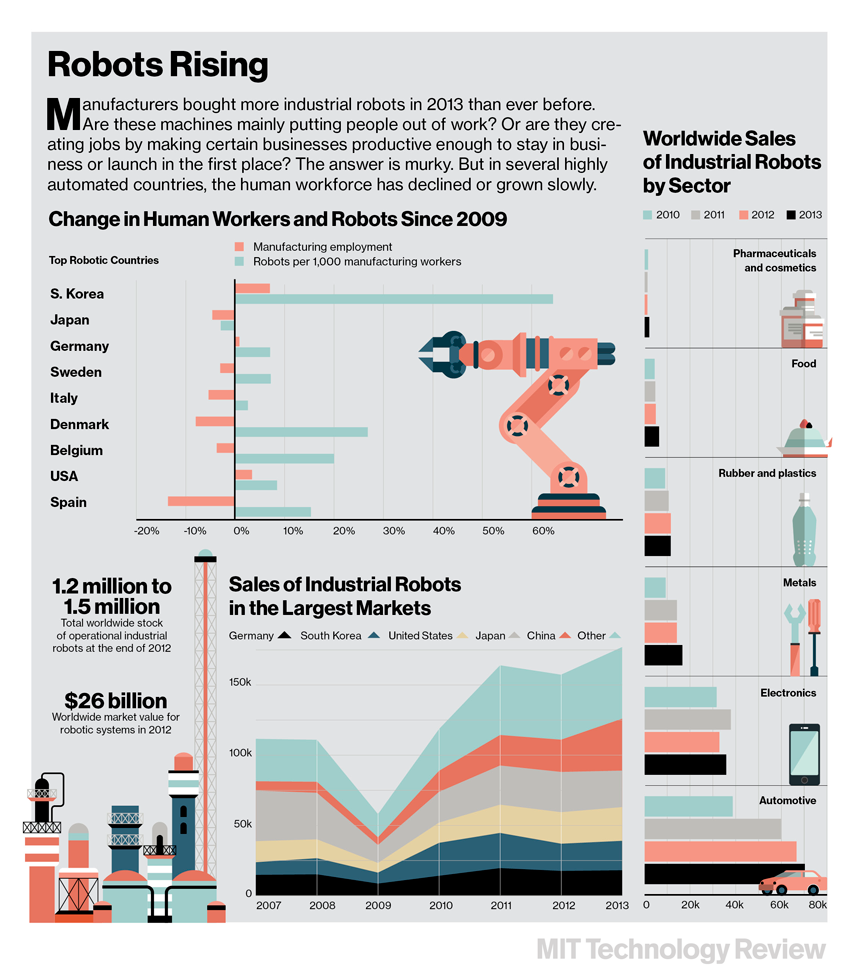
The rise of the robots! In the movies the heroes usually win that battle. How will the Labor Markets fair?
A nice graphic from MIT Technology Review on the rise in the use of robotics in manufacturing versus the change in manufacturing employment. It certainly is a mixed bag in terms of the relationship (as they note in the graphic).
There is no question that the two will be co-joined in the short and long(er) term as the workplace changes and labor adapts to new technology, and vice versa.

Thursday, August 21, 2014
Primer on how the Unemployment Rate is Calculated..
If you are a student or teacher of economics here is a terrific primer on how the Dept of Labor's Bureau of Labor Statistics collects information and calculates the Unemployment/Employment rate.
A great resource for your class.
HT: The Conversable Economist.
A great resource for your class.
HT: The Conversable Economist.
Economic vs Accounting Profit: Corn or Soybean? That is the question--answered here.
Using data from the US Dept of Agriculture Economic Research Service (USDA-ERS) I made the following two charts (I am in the infant stages of learning Excel, excuse the poor formatting!).
They show the "Accounting Profit"(RED) and "Economic Profit" (BLUE) for Corn and Soybeans in 2013. The distinction between the two is important in AP Microeconomics.
When tallying costs, accountants only care about explicit money costs paid for resources. When calculating economic costs, economists include implicit Opportunity Costs in addition to money costs.
Economic costs are ALWAYS going to be more than accounting costs, hence economic profits are ALWAYS going to be less than accounting profits. Repeat that until it clicks!
As a recent transplant to the mid-West (Illinois, now Ohio) I have quickly learned that Corn and Soybean require very similar resources to grow---the Opportunity Cost of switching from one to the other is apparently quite low.
Simple observation: Growing Corn in the "Northern Great Plains" does not seem like a good idea. Soybean returns a higher accounting and economic profit. Growing Soybean in the "Heartland" seems like a GREAT idea--accounting AND economic profits are high.
Note this data are for 2013. I drive around Central Ohio quite a bit. I notice many more fields that had corn last year are now teeming with soybean. Why?
Economic theory (and apparently practice if I can believe my lying eyes!) suggests in a "perfectly competitive" market, the presence of economic profit(s) induces producers to enter that market.
Use these graphs as you wish. Hope it helps with the concept.
Here are the agricultural regions (SOURCE USDA-ERS):
They show the "Accounting Profit"(RED) and "Economic Profit" (BLUE) for Corn and Soybeans in 2013. The distinction between the two is important in AP Microeconomics.
When tallying costs, accountants only care about explicit money costs paid for resources. When calculating economic costs, economists include implicit Opportunity Costs in addition to money costs.
Economic costs are ALWAYS going to be more than accounting costs, hence economic profits are ALWAYS going to be less than accounting profits. Repeat that until it clicks!
As a recent transplant to the mid-West (Illinois, now Ohio) I have quickly learned that Corn and Soybean require very similar resources to grow---the Opportunity Cost of switching from one to the other is apparently quite low.
Simple observation: Growing Corn in the "Northern Great Plains" does not seem like a good idea. Soybean returns a higher accounting and economic profit. Growing Soybean in the "Heartland" seems like a GREAT idea--accounting AND economic profits are high.
Note this data are for 2013. I drive around Central Ohio quite a bit. I notice many more fields that had corn last year are now teeming with soybean. Why?
Economic theory (and apparently practice if I can believe my lying eyes!) suggests in a "perfectly competitive" market, the presence of economic profit(s) induces producers to enter that market.
Use these graphs as you wish. Hope it helps with the concept.
Here are the agricultural regions (SOURCE USDA-ERS):
Wednesday, August 20, 2014
One Million Deaths caused by these 3 things we take for granted everyday.
Saw this link by way of Hans Rosling and this passage made me pause:
Clean water, functioning indoor toilets and proper hand hygiene. Ordinary for us, extraordinary for many others.
Drink some water, flush your toilet and wash your hands---next time stop and celebrate it. Pass it on! :)
Burden of disease from inadequate water, sanitation and hygiene in low- and middle-income settings: a retrospective analysis of data from 145 countries
In 2012, 502 000 diarrhoea deaths were estimated to be caused by inadequate drinking water and 280 000 deaths by inadequate sanitation. The most likely estimate of disease burden from inadequate hand hygiene amounts to 297 000 deaths. In total, 842 000 diarrhoea deaths are estimated to be caused by this cluster of risk factors, which amounts to 1.5% of the total disease burden and 58% of diarrhoeal diseases. In children under 5 years old, 361 000 deaths could be prevented, representing 5.5% of deaths in that age group.Those of us who live in developed countries do not give these things a second thought when we use them--except when they do not work on immediate demand.
Clean water, functioning indoor toilets and proper hand hygiene. Ordinary for us, extraordinary for many others.
Drink some water, flush your toilet and wash your hands---next time stop and celebrate it. Pass it on! :)
Monday, August 18, 2014
Here is the BEST answer to every job interview question---Economist-style.
What happens when you ask someone with an excellent grasp of economics to be honest in a job interview (SMBC).
Made me laugh. Thought of something like this a couple of weeks ago in a job interview when asked "Why do you want to work for _____School District?"....Ummm, you have an opening and I need a job. :)
| SMBC |
Teaching (or learning) Interest Group Politics? You need this App!
Ran into this site, SpendConsciously ,while trolling the Internet. If you are teaching (or learning) about interest group politics this site has a REALLY fun and interesting App. It is called "BuyPartisan". I downloaded on my Smartphone for "free".
Using your phone you can scan the bar code on a product, and if they have the company in their database, it will return to you the proportion of dollars this company donates to the major political parties (and "others").
Spent some time doing this to items in my pantry.
I think it might slow down my shopping trips as I use this in stores. Knowledge is power, or so I have heard.
Using your phone you can scan the bar code on a product, and if they have the company in their database, it will return to you the proportion of dollars this company donates to the major political parties (and "others").
Spent some time doing this to items in my pantry.
I think it might slow down my shopping trips as I use this in stores. Knowledge is power, or so I have heard.
Saturday, August 16, 2014
Back to the Future: Russia threatens price controls in the face of Economic Sanctions. We know how this will work out.
Predictable consequences are playing out in the economic sanctions world---with more to come:.
Russians already hurt by Western food import ban
Russians are already paying a price — literally — for the ban on food imports from Europe and the United States that Russia imposed last week to retaliate for American and European economic sanctions.
Suppliers and consumers are facing shortages and price hikes on staples such as fish and fruit, as well as gourmet items such as Italian Parmesan and French Brie cheese.
Suppliers have raised prices for some fish by 20-36%, one of Russia's biggest retailers, X5 Retail Group, complained to Russia's government, the Kommersantbusiness daily reported on Wednesday. Suppliers reported shortages and higher prices for fruit, retailers braced for milk prices to go up, and some meat suppliers were engaging in price speculation, Kommersant reported.
Russia's Central Bank warned last week that the sanctions are likely to increase an already rising inflation rate. Even so, Russia's government has pledged that prices will not go up as a result of the import ban, promising that the Federal Anti-Monopoly Service will check reports of suppliers raising prices.
In the worst case, the government could resort to price controls, Kommersantreported.
Should Russia enforce price controls one unintended BUT predictable consequence would be the rise of Black Market activity. Russians are used to this--they just need to brush off the rust from the old Communist days.
Below I explain the economic theory/rationale behind the rise of Black Market activity in face of Government policy to control prices. Let me know what you think. Thanks.
Friday, August 15, 2014
George Soros is "short selling" the US market. A quick Lesson on "Short Selling"
There is an article in Business Insider today on Billionaire George Soros and how he is "short selling" a collection of stocks in the US market.
Most people buy stock in a company with the expectation the price will increase, or appreciate, in value. This is called "going long" on a stock. Buy Low, Sell High.
However, there is a stock trading technique call "going SHORT" on a stock. Also known as "Short Selling". This means you anticipate the price of the stock will go DOWN. Buy High, Sell Low. The defintion of "Buy" in short selling is misleading at best. But it is a way of making money when the price of a stock goes down.
Go here for a more technical explanation of Short Selling. Below I give a most elementary, non-technical explanation of how this works. If you are not familar with the trading technique it might help you when you start looking into the complexities of short selling. Gotta walk before you can run!
Short Selling a stock:
You might be wondering: "What if the price did not go down but went up instead?"
Then I am in a bit of trouble. My prediction that the price would decrease did not pan out.
If the price went up to $15.00 per share then the total value of the 100 shares is $1,500. You want your 100 shares back so you can take the profit!
I now MUST go out and purchase those 100 shares for $15.00 each. I only have $1,000 in my account from the original transaction so I have to deposit another $500.00 in order for my check to you to clear.
I lose $500.00 (plus the $50 fee) and you gain $500.00 (plus the $50 dollar fee) on the investment.
Crazy system, right?
Most people buy stock in a company with the expectation the price will increase, or appreciate, in value. This is called "going long" on a stock. Buy Low, Sell High.
However, there is a stock trading technique call "going SHORT" on a stock. Also known as "Short Selling". This means you anticipate the price of the stock will go DOWN. Buy High, Sell Low. The defintion of "Buy" in short selling is misleading at best. But it is a way of making money when the price of a stock goes down.
Go here for a more technical explanation of Short Selling. Below I give a most elementary, non-technical explanation of how this works. If you are not familar with the trading technique it might help you when you start looking into the complexities of short selling. Gotta walk before you can run!
Short Selling a stock:
I borrow 100 shares of stock you own in "XYZ Inc". Right now those shares are worth $10.00 each. Let's say I pay you $50.00 up front as a fee to do so AND I PROMISE to return those shares to you whenever you want them back.
I take those shares and immediately turn around and sell them. I now have $1,000 in my bank account.
Let's say the stock price goes down to $5.00. You freak out and want your shares back so you can sell them and take your losses. You come to me and demand your 100 shares back.
Well, I do not have them anymore! So, I have to go out and buy 100 shares at $5.00 per share. I am sure there will be plenty of sellers as the stock price decreases. I need $500.00 to do so. Remember, I have $1,000 in my account for the original sale at $10.00 per share.
I write a check out of this account for $500.00 to buy 100 shares. I still have $500.00 remaining in my account. MAGIC!!! (minus the $50 I paid you up front I "clear" $450.00 in the end and adding the $50 fee I paid you, you lose a total of $450.00).Not bad, eh?
You might be wondering: "What if the price did not go down but went up instead?"
Then I am in a bit of trouble. My prediction that the price would decrease did not pan out.
If the price went up to $15.00 per share then the total value of the 100 shares is $1,500. You want your 100 shares back so you can take the profit!
I now MUST go out and purchase those 100 shares for $15.00 each. I only have $1,000 in my account from the original transaction so I have to deposit another $500.00 in order for my check to you to clear.
I lose $500.00 (plus the $50 fee) and you gain $500.00 (plus the $50 dollar fee) on the investment.
Crazy system, right?
Tuesday, August 12, 2014
Shark Week and the Market for Shark Tacos. Let's go to the graphs.
Shark Week on T.V. has appartently increased the demand for Shark Meat in a variety of forms.
NPR has a story on this:
I think I have this right, but let me know where I might have gone wrong. If you can use this in your class(es) feel free to do so. There is no tragedy in this common(s). :)
It is time for lunch where I am but I am pretty sure a Shark Taco is not on the menu for me. Yuck!
NPR has a story on this:
Discovery Channel set viewership records in 2013 as millions of people tuned in to watch sharks feed, sharks attack, extinct giant sharks and researchers catch and tag sharks. Discovery's "Shark Week" returned on Sunday, and this year, to the dismay of conservationists, restaurants and markets nationwide are feeding the frenzy with a slew of shark meat promotions.This gives me an opportuntity to "go to the graphs" and analyze this development from a basic supply and demand perspective as to what SHOULD happen using the "Market for Shark (Meat) Tacos".
I think I have this right, but let me know where I might have gone wrong. If you can use this in your class(es) feel free to do so. There is no tragedy in this common(s). :)
It is time for lunch where I am but I am pretty sure a Shark Taco is not on the menu for me. Yuck!
Saturday, August 2, 2014
Population Pyramids for Israel and Palestine. Whoa to the policy-maker who ignores this!
Demographics is seldom talked about when it comes to geopolitical issues but it is an important explicit and implicit variable that underlies many conflicts.
Here is what Israel and Palestine look like projected to 2015.
All is not equal in terms the age group 19 and under, especially.
Here is what Israel and Palestine look like projected to 2015.
All is not equal in terms the age group 19 and under, especially.
| Source: HERE |
Friday, August 1, 2014
It takes a nation to stockpile this much ethanol. No lie. It literally takes a nation. Find out which one here.
US ethanol stocks soar to 16-month high: EIA
US ethanol stocks rose 647,000 barrels to a 16-month high of 18.587 million barrels in the week that ended July 25 despite a slight decline in US ethanol production, which dipped 5,000 b/d to 954,000 b/d, US Energy Information Administration data showed Wednesday.As I like to do, I will put this into some perspective.
18.587 million barrels of ethanol equals 780,654,000 gallons of ethanol (42 gallons in a barrel).
One bushel of corn (56 pounds) produces 2.8 gallons of ethanol.
So, it took 278,805,000 bushels of corn (780,654,000/2.8) to produce the 18.587 million barrels of ethanol the US has in stock.
The stock of ethanol was produced from multiple corn plantings over time, so in many cases the same acreage was used to produce multiple harvests of corn.
In 2013, the average yield of corn per acre was 158 bushels.
This means, in the aggregate, the number of acres of corn needed to produce the current stock of ethanol was 1,764,588 (278,805,000/158).
How much is that? The total acreage of the US is 1,875,714. Virtually the whole US minus a couple of counties.
How many people could that feed? Just askin'...
Note: Please remember my caveat---the same land would have to be used multiple times to get this amount of ethanol over time. I am not saying it literally takes the whole country. Thanks!
Corn killed Bubba Gump Shrimp. "That's all I have to say about that". See how here.
| Source: Big Picture Agriculture |
Kay MacDonald over at Big Picture Agriculture has this graphic showing the "Dead Zone" in the Gulf of Mexico just off the coasts of Texas and Louisiana and the following comment:
"This year’s Deadzone in our Gulf of Mexico waters will be about the size of Connecticut. It is estimated that the Dead Zone causes losses of $82 million per year to the seafood and tourism industries.
Much of it is caused by corn cropland fertilizer runoff that ends up going down the Mississippi River. Corn used to fuel cars – cropland used to feed cars, not people. In contrast, a healthy Gulf of Mexico sans Dead Zone would be capable of growing more shrimp, crabs, clams, and fish which humans love to eat."This clearly illustrates an important concept in AP Microeconomics: Negative Externality.
Negative externalities occur when the production of a good imposes a cost (or costs) on third parties not involved in producing or consuming the good.
Farmers grow corn. The fertilizer used in the process becomes part of the run-off from irrigation and/or rains that make their way to streams and rivers then eventually the Gulf of Mexico in this instance. The chemicals in the fertilizer destroy/damage the aquatic ecosystem that allow shrimp and other sea creatures to thrive.
Each farmers contribution to the problem is small but in the aggregate all farmers along the waterways that feed the Gulf of Mexico cause approximately $82 million dollars in lost revenues to fisherman of all types along the Gulf Coast.
This loss in revenue (a cost) is borne by the fisherman ("Third Parties") and not by the farmers and/or consumers of corn.
There are potentially 3 solutions to this problem:
(1) tax the producers and/or consumers of corn up to at least the amount of the damage--$82 million.
(2) impose a regulation forcing farmers to prevent the run-off hence the damage to the Gulf
(3) Farmers collectively agree to pay the fisherman $82 million for the damage they cause ("Coase" solution).
All 3 of these "internalize" the monetary value of externality and require the parties to the actual transaction to bear the full cost of the damage they impose.
Seems fair, doesn't it?
Thursday, July 31, 2014
World-wide Car sales from 1990 to Present. You are not going to believe these numbers.
This chart amazed me. Note the years along the horizontal axis. The first two bars represent two DECADES worth of car sales worldwide. The other four represent single year sales (the last bar for 2014 is a projection).
The total number of cars sold in 2011 and half of 2012 EQUALED the total amount sold in the 20 year time span from 1990 to 2010.
Ponder that for a moment when it comes to energy and environmental issues.
The total number of cars sold in 2011 and half of 2012 EQUALED the total amount sold in the 20 year time span from 1990 to 2010.
Ponder that for a moment when it comes to energy and environmental issues.
Find more statistics at Statista
Subscribe to:
Posts (Atom)