Tuesday, October 1, 2013

Top 10 Ranking of Car/Truck Sales for September. One country produces Trucks. One country produces Cars. Comparative Advantage in one easy lesson...

The US makes and sells Trucks best. The Japanese make and sell cars best.  Comparative Advantage...Any questions??

#10 Nissan Altima

#10 Nissan Altima
AP
September sales: 21,221
Percent change from a year ago: -13.2%
Sticker Price: $21,860


Read more: http://www.businessinsider.com/best-selling-cars-in-september-2013-10?op=1#ixzz2gWDRi76f

#9 Honda CR-V

#9 Honda CR-V
Honda
September sales: 21,439
Percent change from a year ago: -3.7%
Sticker Price: $22,945


Read more: http://www.businessinsider.com/best-selling-cars-in-september-2013-10?op=1#ixzz2gWDawZX0

#8 Ford Escape

#8 Ford Escape
AP
September sales: 22,607
Percent change from a year ago: -2.3%
Sticker Price: $22,700
Source: Ford


Read more: http://www.businessinsider.com/best-selling-cars-in-september-2013-10?op=1#ixzz2gWDeu08I

#7 Honda Civic

#7 Honda Civic
Honda
September sales: 22,983
Percent change from a year ago: 6.7%
Sticker Price: $18,165


Read more: http://www.businessinsider.com/best-selling-cars-in-september-2013-10?op=1#ixzz2gWDi8nJt

#6 Toyota Corolla

#6 Toyota Corolla
Toyota
September sales: 23,251
Percent change from a year ago: 1%
Sticker Price: $16,800


Read more: http://www.businessinsider.com/best-selling-cars-in-september-2013-10?op=1#ixzz2gWDlolYV

#5 Honda Accord

#5 Honda Accord
REUTERS/Paul Vernon
September sales: 25,176
Percent change from a year ago: -13.7%
Sticker Price: $21,955


Read more: http://www.businessinsider.com/best-selling-cars-in-september-2013-10?op=1#ixzz2gWDqJsrt

#4 Dodge Ram

#4 Dodge Ram
AP
September sales: 28,145
Percent change from a year ago: 8%
Sticker Price: $23,600


Read more: http://www.businessinsider.com/best-selling-cars-in-september-2013-10?op=1#ixzz2gWDtCKDp

#3 Toyota Camry

#3 Toyota Camry
Toyota
September sales: 31,871
Percent change from a year ago: -7%
Sticker Price: $22,235
Source: Toyota


Read more: http://www.businessinsider.com/best-selling-cars-in-september-2013-10?op=1#ixzz2gWE12OcR

#2 Chevy Silverado

#2 Chevy Silverado
Chevrolet
September sales: 32,506
Percent change from a year ago: -10.8%
Sticker Price: $23,590 (2014 Silverado 1500)


Read more: http://www.businessinsider.com/best-selling-cars-in-september-2013-10?op=1#ixzz2gWE4NVlU

#1 Ford F-Series

#1 Ford F-Series
Ford
September sales: 60,456
Percent change from a year ago: 9.8%
Sticker Price: $24,070 (2013 F-150)


Read more: http://www.businessinsider.com/best-selling-cars-in-september-2013-10?op=1#ixzz2gWE7P5Ee

Sunday, September 29, 2013

Some Chinese are willing and able to pay $485,000 for a Land Rover SUV. I gotta see how this graphs!!! So can you here... :)

Demand For Luxury SUVs Is Too High For Land Rover To Keep Up
The new Land Rover Ranger Rover and Range Rover Sport SUVs are lighter, higher-tech, and more luxurious than ever--and they're in massive demand. So much so, that even with production running full-blast around the clock, Land Rover simply can't keep up with demand, which is about 40 percent higher than the company predicted. 
 What does that mean for buyers? Right now, there's a six-month wait on new orders of the Range Rover, and a nine-month wait for the Range Rover Sport, reportsAutomotive News Europe (subscription required). 
China is the main driver behind this demand, according to the report, and buyers are willing to pay premiums of up to $80,000--on top of sticker prices that range as high as $458,000 in the Chinese market.
Considering that in the U.S., the Range Rover Sport starts from just $64,495, and the Range Rover starts from $83,545, it seems that high demand in China is a very good problem for Land Rover to have.
The Quantity Demanded for Land Rover SUV's is greater than the Quantity Supplied at Equilibrium, Point "B" in the graph below.  The market has not cleared to the point where Quantity Supplied equals Quantity Demanded at some equilibrium price, Point "A". We have a shortage of SUVS's (the difference between "Qd" and"Qs") in the worldwide market for them.

Now that we have established one point ("B") that lies to the RIGHT of "Demand*" we can assume that every other price quantity demanded combination will lie to the right of "Demand*" as well.  The market Demand for Land Rover's has shifted to the RIGHT, denoting and INCREASE in Demand:

Assuming the market responds accordingly, the price of Land Rovers will increase as a result of the shortage.  When the Price increases we now move ALONG our respective new demand curve ("Demand 1")  up and to the LEFT and ALONG our existing supply curve ("Supply*) up and to the RIGHT until we reach a new market equilibrium Price and Quantity at Point "C":
BUT where are those additional Land Rover's coming from to sell at the higher price? It was stated in article that Land Rover was at full production and working around the clock and still not meeting demand.  Any additional SUV's they produce are going to cost more than the previous ones. The cost of purchasing additional inputs and labor (overtime, extra crew) are going increase the Marginal Cost of producing those SUV's, hence they will require a higher price in return.


I contend that some of the SUV's bought at the "Pe" and the original market quantity will be resold in China either in the formal legal resale market OR in an informal (Black Market) setting. In other words, the additional Land Rovers supplied to the market between Point "A" and Point "C" on Supply* will be resales at the higher price in conjunction with any additional production Land Rover might be able to squeeze out.

One last point---$485,000 for this vehicle in China! Really?

Too much money chasing too little common sense, to coin a phrase...

Friday, September 27, 2013

21 Scams Used By Devious Car Dealers — And How To Avoid Them....Here is my finance lesson of the day for students.

When I bought my first car(s) on my own I made a TON of mistakes that cost me dearly.  If you are young person and don't have someone with experience to help you, my first recommendation is to find someone who can.  It can be treacherous!

Absent that this article has some very good advice. Probably the best tidbits are the ones that suggest you "unbundle" and treat separately all parts of the transaction, i.e. car price, interest rate, trade-in allowance and other extras you might consider.  

It is a REALLY difficult thing to do and the car dealer will resist you every step of the way.  They are not your friend. Be very deliberate in negotiating each transaction and be prepared to walk away. There is always another car to fall in love with at a place that will accommodate you.  

It is worth the time to go through these items and save your hard earned money. 

21 Scams Used By Devious Car Dealers — And How To Avoid Them

Read more: http://www.businessinsider.com/how-to-avoid-21-car-dealer-scams-tricks-2013-9?op=1#ixzz2g5MBnBS0

Tuesday, September 24, 2013

King Dollar still reigns. It will be awhile before it is dethroned. Nice graphic showing the "lead" it has on the next most desirable currency...

The US dollar is the preferred "medium of exchange" in conducting physical and financial transactions internationally.  It lost some of its shine during the recession (the Euro was the default currency, and the Pound and Swiss Franc to a lesser extent--you can tell by the height of the red bar relative to the blue one).

The dollar is used in approx. 44% of international transactions. This helps maintain the value and importance of the dollar around the globe.  Long live The King...

Source: NPR
Currency Trades For Top Currencies

Saturday, September 21, 2013

Terrific document showing the changes in the components of "The Dow" over time. Makes me feel old...

The companies that comprise the "Dow Jones Industrial Average" (DJIA), or "The Dow", changes over time to reflect the changing nature of the US economy.

This is a neat lesson in "Creative Destruction" that takes place over time and how the rise of one industry can precipitate the fall of another (and vice versa, I suppose).  What is important in one era is a footnote in another.  BUT without the former it is not likely the latter would exist.  It is an interesting discussion to have.

If you are an old-time like me it is amazing to see some of the names that were eminent in my day are either gone of much less significant.

HT: The Big Picture

Friday, September 20, 2013

Textile manufacturing returns to the US! Good for workers, right? The "Rise of the Machine" begs to differ...

This graphic is included in a NYTIMES article on the nascent revival of textile manufacturing in the US, an industry decimated in the 1990's from factories moving to low wage countries.

The article is mostly about the increase in manufacturing facilities BUT not so much the increase in manufacturing JOBS.  Technology and automation are the culprits in the movement back to the US from the likes of Mexico and China.

The largest cost differential you see below is relative wages paid to Asian based workers and US workers.

However, the difference is tempered when you replace Capital (machines) for Labor in the US.
"Where Mr. Winthrop relies on labor — the cutting and sewing of the sweatshirts, which he does in five factories in California and North Carolina — is where the costs jump up. That costs his company around $17 for a given sweatshirt; overseas, he says, it would cost $5.50. 
But truth be told, labor is not a big ingredient in the manufacturing uptick in the United States, textiles or otherwise. Indeed, the absence of high-paid American workers in the new factories has made the revival possible. 
“Most of our costs are power-related,” said Dan Nation, a senior Parkdale executive."

Source: NYTIMES

Nice set of maps (and article) illustrating where job growth in the US has occurred and the shifting of the Economic Center of Gravity

Here are 3 maps that show Job-Growth Change from 2009 to present (HT: EMSI).

They are from a TERRIFIC article you will find HERE by economist Richard Florida.  I highly recommend reading this to deepen your knowledge/awareness of the national employment situation.

It is non-political and shows how the economic center of gravity is moving from production of physical goods to the production of energy (an input) and knowledge/ideas.

The crux of the article states that this has been an Energy and Knowledge/Idea based economic recovery. It suggest these separate and distinct industries are more complementary to each other rather than substitutes and that there is a multiplier effect on job creation (my words, not his) in some areas where these two converge.


\High wage jobs are considered any wage over $21.00 per hour.


 Low wage jobs are ones that pay below $14.00 per hour.


Wednesday, September 18, 2013

In Egypt bread is cheap but there is none to buy. See here how subsidies without resources created this situation that has the potential for creating civil unrest.

What Egypt Wants: Cheaper Bread  Demand for Subsidized Food Vexed Ousted President and Pressures Interim Government

"...Egypt's Islamist government, during its brief reign, couldn't satisfy public demand for subsidized food and fuel—spurring discontent that helped the military drive it from power. 
The military-backed leadership that took over this summer is now wrestling with the same challenge, trying to make sure there is enough cheap bread for the country's poor..."
The purpose of a subsidy is to lower the price of a good so people can buy more of it AND to give producers an incentive to produce more.  The implication is the market place is under-producing the good and charging too high a price for the intended consumer.  However, to make it work, the resources needed to produce the extra units of the good need to be available for conversion.

In Egypt the subsidy along with the lack of available resources, in this case wheat, are wreaking havoc on the domestic economy.

Let's look at it in graphs!

Here is the Market for Bread in Egypt at some equilibrium "A" with a Price of $1.00.  Any number you see I made up for simplicity.  Insert the equivalent in Egyptian currency and it still works the same way.  
If a subsidy is offered to consumers to buy bread at a lower price than the current market price, then consumers will want to buy more bread.  The Demand for Bread will increase and the Demand Curve will shift to the Right:
Notice that the Price increased to $1.50 (Point "B"). Producers responded to the increase in demand by increasing the QUANTITY SUPPLIED (movement ALONG "S*), assuming the availability of wheat, because of  the change in price driven by the demand side.

But hold on! Remember Demand only increased because of the presence of a subsidy.  Assume that subsidy is $1.00.  So, we have to subtract $1.00 from our market price (Point "B" to Point "C"):
The Price of Bread to the consumer is now $.50, $.50 LESS than before the subsidy (HAPPY CONSUMER!). The producer receives $1.50, $.50 MORE than before the subsidy (Happy Producer!).  While the TOTAL subsidy is $1.00, because of relative elasticities (another lesson) the subsidy is split between the consumer and the producer.

The end result is the consumer gets bread for less than what they know is the true market price, thanks to the government.

However...All is not well with this arrangement. Remember I said this hinged on resources being available to increase the market quantity supplied? This is the problem in Egypt:
Since the military-backed interim government took over, it has focused on maintaining supplies of wheat. Egypt's own farms can't meet demand; governments have imported wheat for years, and the country remains the world's No. 1 importer, according to the U.S. Department of Agriculture. 
Egypt's government says it has enough wheat to last until the end of the year. Yet each month, frustrated families who rely on subsidized goods say the state-owned shops that provide basic items for cheap prices often run out of food.
So, local producers do not have the resource/input, wheat, most needed for making bread. This messes up the "increase in Quantity Supplied in response to a higher  price" formula.

Instead of moving up and to the right on "S*" producers are moving down and to the left!  See point "D" in this graph:
At Point "D" at $.50 the Quantity Supplied is "Q supplied" BUT at $.50 the Quantity Demanded is "Qdemanded".  We have a shortage of bread.
Over the past four months, when Mrs. Ibrahim's state-run bakery runs out of bread—which happens often, she said—her only choices are to buy bread at a private bakery where each loaf costs three times as much, at 0.75 piasters (11 cents), or not to buy at all.
 Private bakeries are adequately stocked—but increasingly unaffordable. 
That last sentence is an interesting one. How do private bakeries have bread (unsubsidized and more expensive) and the State owned bakeries have none (subsidized and less expensive)?

Extra credit for giving the right answer.

I hope this helped you understand, using a real life example, how subsidies without adequate resources can distort the marketplace in very harmful ways.

The NFL is doubling ticket prices for some seats to Super Bowl 2014. Economists would say yes. Public Relations experts would say no. What do you think?

The National Football League (NFL) has announced the ticket prices for seats to the 2014 Super Bowl taking place in New Jersey:
Super Bowl fans can prepare to pay double for the best seats. The NFL expects the most expensive tickets for its championship game will be about $2,600 each for 9,000 premium seats for the Feb. 2 game at MetLife Stadium in East Rutherford, N.J.  
That's more than twice the $1,250 cost for similar tickets at last season's Super Bowl in New Orleans. 
According to the BLS the "Admission price to Sporting Events" increased by only 2.6% in the last year. The NFL is more than doubling the price to its marquee game for these premium seats. What is going on?
"We are looking to close the gap between the face value of the ticket and its true value as reflected on the secondary market," NFL spokesman Brian McCarthy said Tuesday.
Now it makes sense. The NFL is incensed that "secondary sellers" like StubHub or individuals on E-Bay are buying tickets AT THE PRICE the NFL offered for sale ("Face Value") to the public and then reselling them at a higher price to someone "willing and able" to purchase them at a higher price ("Secondary Market").

Using a basic Supply and Demand graphs, we can easily illustrate what is going on:
There are only 9,000 premium seats available in the stadium. This number is fixed regardless of the price of the ticket.  The market supply curve will be vertical ("Inelastic") at 9,000.

We can insert a market demand curve to establish an equilibrium price for the tickets and the price the NFL is expected to charge for the premium seats.
How did they arrive at this price?  They learned from last years Super Bowl in New Orleans.  The price of a premium ticket on the Secondary Market last year ended up around $2,600 (could have been less, or more).  The NFL representative suggests that THIS was should have been the actual price of the ticket.

The NFL offered those tickets for sale at a Face Value of $1,250.  In the graph below, you can see $1,250 is much less than the scalped price.  This suggests that at $1,250 the "Quantity Demanded" (12,000) for the tickets was greater than the "Quantity Supplied" (9,000).  I just made up the number (12,000) to use as a reference.
So, 9,000 people were able to get tickets for $1,250 and 3,000 fans were left without.  Because the market did not "clear" at 9,000 there will be some fans, not all, willing and able to purchase tickets at a higher price. This is where the Stub Hub's of the world take over.
Recognizing there is a shortage of tickets to meet demand an exchange is set up to entice at least 3,000 of the people that bought tickets at $1,250 to resell them.  Let the bidding begin.
The the scalped price, and ultimately the "true value as reflected in the secondary market", emerges from the scrum.

The NFL's pricing strategy is to side-swipe the secondary market and reap windfall from what they project will be the true price for a premium ticket to the Super Bowl.

When this becomes more widely publicized, the NFL will come under lots of criticism for charging such a high price.

According to Economics 101 they are doing the right thing. According to Public Relations 101 they are probably doing the wrong thing.

What do you think???

Tuesday, September 17, 2013

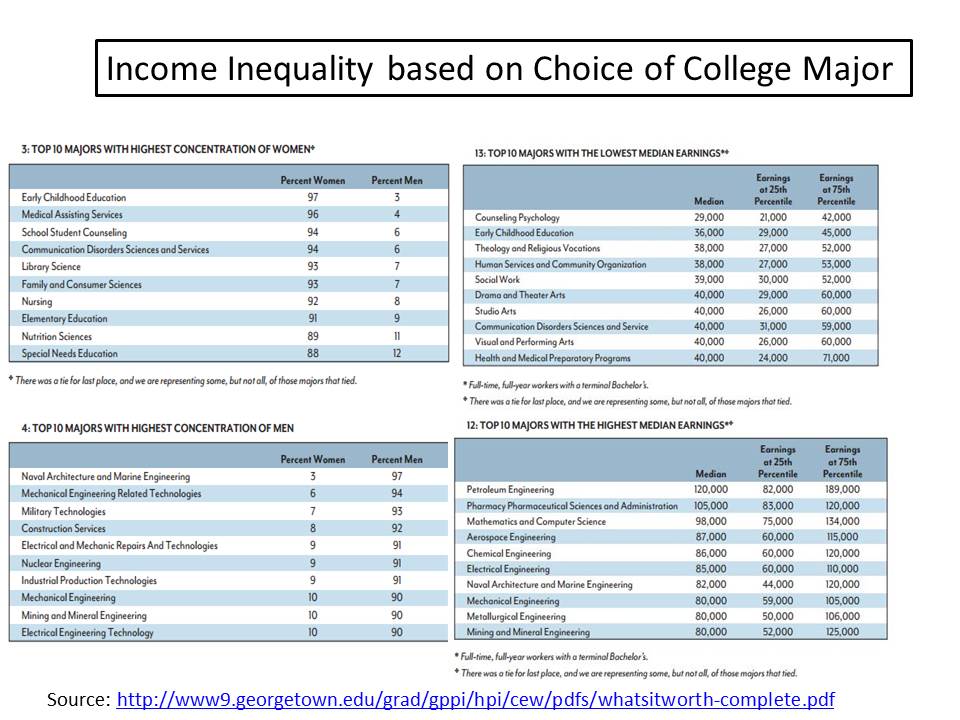
"Men are from Hard Sciences, Women are from Soft Sciences". How the differences show up in level of compensation...

There is a lot of interesting data on the demographics of college degree holders in this study found HERE.

There is much discussion on wage inequality between men and women.  While this does not settle the issue of the source any inequality, it does help point us in the right direction.  See the graphic below.

Choice of college major and its earning power in the marketplace are linked.  I say its "earning power" and not real or perceived "social value".  Two different things for the most part.

Correlate the data on the left with the data on the right.

The marketplace values "hard sciences", i.e. engineers and math degree holders much more than the "softer science" degree holders.  That is not controversial.  What actually surprised me (a bit) was the imbalance between men and women who hold those respective degrees.  I really had no idea it was that vast.

Saturday, September 14, 2013

Has "King Dollar" been demoted to a Prince? Nice chart showing all major currencies and their ranking in terms of use in international transactions....

Here is a chart showing a list of currencies and their ranking in terms of use to facilitate a whole host of international transactions, such as the buying and selling of goods and services, or physical and/or financial assets. (The chart is from HERE with a HT from The Conversable Economist.)

The US dollar is still by far the most desired "medium of exchange" for engaging in international trade.

With most major commodities such as oil and agricultural products, US dollars are used to between the countries trading, even if the countries themselves do not use the US dollar as the currency of record.

In other words, if Russia sells oil to China the transaction is conducted in US dollars, not Rubles or Renminbi.

One interesting note from the chart is since 2001 the share of US dollars used in international transactions has decreased a bit but the use of the Chinese Renminbi has increased dramatically, moving from 35th place to 9th place in a relatively short period of time.

Source: TriennialCentral Bank Survey Foreign exchange turnover in April 2013: preliminary global results 

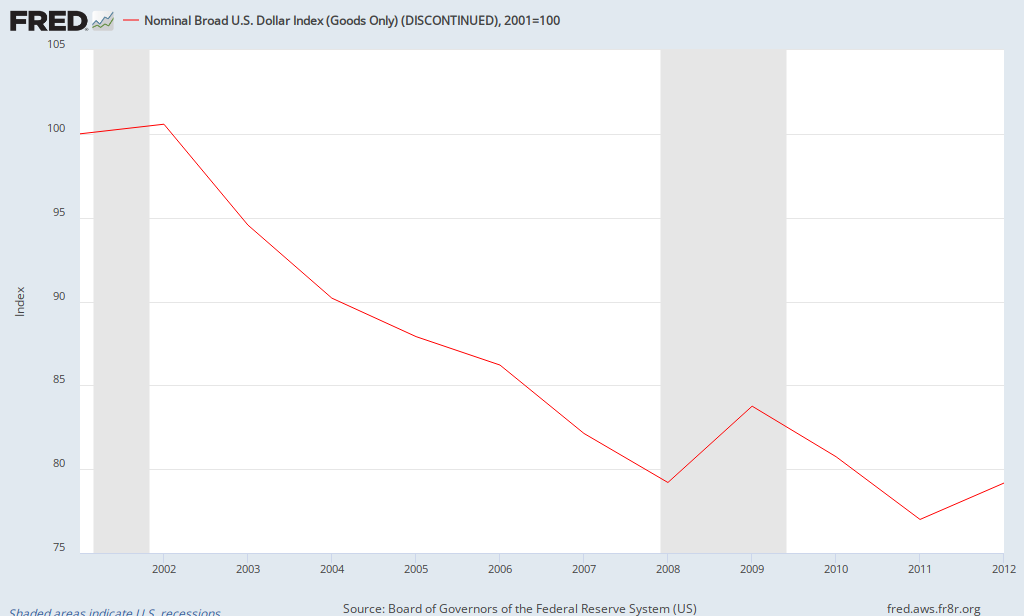
If the use of the US dollar in international transactions has declined since 2001, we might expect the value of the dollar to fall as well.  Not to imply correlation is causation, but the graph below shows how the value of the US dollar has changed compared to a "basket of other major currencies".

Using 2001 as a base year, the dollar has declined in value roughly 21%.

Has "King Dollar" been demoted to "Prince"? Not yet, but he should be looking over his shoulder.

FRED Graph


Monday, September 9, 2013

Nice graph showing the change over time in High, Medium and Low Skilled employment in the US. I see a major reason for income inequality. What do you see?

There are lots of reasons stated for income inequality in the US, and for that matter, around the world (it is not a problem solely with the US)---greed, unbalanced tax code, globalization, etc.

The one that does not get enough serious attention is the argument that the returns from education and high skills acquisition by INDIVIDUALS is a significant culprit.

I copied and pasted and modified a couple of graphics from HERE that show in the US the change, in millions, the number of workers engaged in either "High Skilled", "Medium Skilled" or "Low Skilled" employment.  Below the graph I calculated the percentage change in each category since 1995 to 2008.
(I left off 2009 for the calculation to leave out one year of the recession).

If we believe that "Education = Earning Power" then this seems to be some supporting evidence for increasing income inequality.

High Skilled employment increased 36% from 1995 to 2008.  Medium Skill employment edged up 6.10%. Low Skilled employment actually DECREASED by 4.20%.

The number of total net jobs created over that time is 17.7 million (151.7-134.0), or an increase of 13%.  So, a preponderance of those those jobs have gone to the High Skilled workers---13.3 million  (50.7-37.4) of the 17.3 million!
Source: www.KNOEMA.com

From 1995 to 2009 who Internationally is winning the "High Skilled Worker War" compared to the US? Looks like just about everyone. See the graphic here...

In the first days of introductory Economics we discuss the resources a society has available to combine to create goods and services that contribute to  a high standard of living.  I emphasize the phrase "Quantity and Quality" in regards to these resources.

One of the vital resources is "Labor".  Investment in "Human Capital" is vital to maintaining or moving to a high standard of living.

Here are a couple of graphics I combined from HERE that illustrate the change in High Skilled Employment in 13 countries (see more countries at the site) that results from investment in human capital.

The graphic on the left shows the number of people, in millions, engaged in high skilled labor in 1995.  The one on the right shows the number in 2009.  I calculated the percentage change for each country on the far right (the percentage change corresponds to the country listed on the right (2009).  China has increased the number of high skilled workers by 222%, the US by 34%, India by 92%, Brazil by 96% and so on...

Are we (the US) behind? About right? Or OK?  What am I leaving out in looking at these numbers that might mitigate (lessen) the impact of seemingly slow growth in the number of high skilled workers in the US?


Friday, September 6, 2013

Where did the missing 312,000 people from the Labor Force go last month? I know where 80,000 of them went but not the rest. I am worried about them. See here why.

In July and August the latest jobs report shows 312,000 FEWER people counted as a part of the labor force (either were working and retired or were not working and exited the labor force, or became "disabled" and started collecting benefits).  The number is highlighted in yellow.

Much has been made of the fact that this is due to demographic trends---aging baby boom population retiring in large numbers and as that same group gets older they are susceptible to work related injuries. 

I have not doubt this is true. Just wondered how many of those 312,000 were a part of this demographic group?

Took a screenshot of the data from the Social Security Online database of the data isolated just for people who officially retired or started collecting disability benefits.

Look at the highlighted numbers for July and August. Subtract the two and you get 79,813. Subtract that from 312,000 and you have 232,187 people who exited the workforce for reasons OTHER than the ones stated above.

That's a lot of people.  Why did they exit and where did they go?  Have not seem any solid  analysis from real economist yet on that question.  

Wednesday, August 14, 2013

The Sales Tax Holiday for back to school shopping is nice, but the real money is in tariffs levied on imported back to school items. How about a "Tariff Holiday". See here how much that adds up to.

Here is a nice graphic showing common back to school items parents purchase and the tariffs, in percent, that are embedded in the price you pay for these items.

A tariff is the same thing as a tax and is levied on an item when it is imported into the US.  The over-all goal of a tariff is increase the price of the imported good in order to make it more comparable to the price of the same (or similar) domestically produced good.  The assumption is the price of the imported good is too low for domestic producers to match.

While the State you live in might give you a break during the Sales Tax Holiday, the Federal government keeps on charging you.  A "Tariff Holiday" would REALLY help low income parents buy what they need for their kids.  How about it, Congress?

It really adds up, doesn't it?
Source: The Foundry (Heritage Foundation)

Note: Tariffs are applied to the cost of the good at the time of import, not on the retail price.

Example: Tennis shoes.  If the import price of the shoes is $10 then the 20% tariff is applied on the $10 not, say, a $20 retail price at Payless Shoes.
View My Stats