I was just admiring my Smartphone this morning (Samsung Galaxy 3).
It reminds me that it is not only a labor saving device for me but an EXTREMELY environmentally friendly one as well.
With just a cursory look I found pictures of the various separate and distinct devices, products and services that are on the phone that I hold in the palm of my hand. This is only a start. With a little more thought and exploration of the phone I am sure I can add many more. And I consider myself a light user of all its capabilities.
I am sure you have MANY more uses/applications on your phone. Think of all the physical resources that are NOT being employed to make this short list of devices and products.
Yes, other resources are being used to produce the things/apps that go into your phone. But I would have to say that the net benefits to reduces resource use have to be postive. Right???
Look at you! You, You, You accidental environmentalist, You. Now, good make the world a better place---send a text instead of a letter---without the paper, a pen, a stamp, planes, trains and automobiles to get it to its destination. How wasteful is that!!
Economics, civics, constitutional law, Supreme Court cases, AP Economics teaching resources, and classroom lessons by a retired social studies teacher.
Wednesday, May 1, 2013
Tuesday, April 30, 2013
Nice (but HORRIBLE) graphic showing the trade-off that results from using food-for-fuel. 440 million MORE people (primarily the most vulnerable around the world) could be fed if we stopped this insane policy.
As seen at The Big Picture Agriculture....Here are a couple of graphics from THIS report by a private food id organization in Great Britain. I am sure they are biased BUT if even if these numbers 50% of the real impact, it is significant.
Using food for fuel is harmful in many ways, but the most harmful impact is no the food supply for the least of us in the world. Support for corn-based bio-fuels is support for starvation at the margin (a quite a bit inside that margin).
See here how Mark Cuban's brillant play in the Foreign Exchange currency market is going to make the Mavericks a better team. The rich get richer, but this guy is CLEVER!!
Billionaire Mark Cuban is doing something interesting that makes a nice lesson in the Foreign Exchange Market. See article HERE. He is converting his US debt held in US dollars to debt held in Japanese Yen:
Let's say I have $1 million US dollars of credit card debt. That is a lot of debt, but assume my credit is excellent.
Today the Exchange Rate between the US Dollar and Japanese Yen is $1= 100. ($1.00 "buy" 100 Yen). The reciprocal of this is the 1 Yen = $.01 (one cent). In other words, 1 Yen "buys" one US Cent.
I go to my favorite Japanese bank and borrow the Yen equivalent of $1M US dollars. That would be 100,000,000 (100 million) Yen.
I take that 100M Yen and exchange it for $1M US dollars (remember the exchange rate I put above)and pay off my loan.
So far so good. I now have no debt in dollars BUT I have a big debt in Yen...
Assume that because of other things going on in the Japanese economy the exchange rate changes to $1.00 = 125 Yen overnight. The reciprocal is 1 Yen "buys" $.008 cents (fraction of a penny).
This means the Yen has DEPRECIATED relative to the US Dollar. It now takes FEWER dollars to buy Yen. More Yen to buy a US dollar.
Assume also the Japanese bank I borrowed the 100M Yen from wants me to pay it back NOW!
At the new exchange rate of $1.00 US dollar exchanging for 125 Yen, I have to come up with "only" $800,000 US dollars to pay back the loan I took out in Yen. ($800,000 X 125 Yen = 100M Yen)
While I put $800,000 back on my "credit card" notice it is $200,000 LESS than it was before. I hve no more debt in Yen and considerably less in US dollars.
Mark Cuban is betting that the Yen is going to DEPRECIATE relative to the US dollar and is using it as an opportunity to reduce his outstanding debt.
This may translate into more financial capital to improve the Dallas Mavericks, the team he owns.
The rich get richer...
""...in early December, I went and took every penny of debt that I had – with the Mavericks, and personal debt, and everything – and converted it to a yen loan, when I think [the yen] was in the mid 80s [against the dollar]. So, I've been really happy with it.""WHY would he do this?? Here is as easy an explanation as I can give...
Let's say I have $1 million US dollars of credit card debt. That is a lot of debt, but assume my credit is excellent.
Today the Exchange Rate between the US Dollar and Japanese Yen is $1= 100. ($1.00 "buy" 100 Yen). The reciprocal of this is the 1 Yen = $.01 (one cent). In other words, 1 Yen "buys" one US Cent.
I go to my favorite Japanese bank and borrow the Yen equivalent of $1M US dollars. That would be 100,000,000 (100 million) Yen.
I take that 100M Yen and exchange it for $1M US dollars (remember the exchange rate I put above)and pay off my loan.
So far so good. I now have no debt in dollars BUT I have a big debt in Yen...
Assume that because of other things going on in the Japanese economy the exchange rate changes to $1.00 = 125 Yen overnight. The reciprocal is 1 Yen "buys" $.008 cents (fraction of a penny).
This means the Yen has DEPRECIATED relative to the US Dollar. It now takes FEWER dollars to buy Yen. More Yen to buy a US dollar.
Assume also the Japanese bank I borrowed the 100M Yen from wants me to pay it back NOW!
At the new exchange rate of $1.00 US dollar exchanging for 125 Yen, I have to come up with "only" $800,000 US dollars to pay back the loan I took out in Yen. ($800,000 X 125 Yen = 100M Yen)
While I put $800,000 back on my "credit card" notice it is $200,000 LESS than it was before. I hve no more debt in Yen and considerably less in US dollars.
Mark Cuban is betting that the Yen is going to DEPRECIATE relative to the US dollar and is using it as an opportunity to reduce his outstanding debt.
This may translate into more financial capital to improve the Dallas Mavericks, the team he owns.
The rich get richer...
Saturday, April 27, 2013
Here is a story about the 90% Debt threshold, a mouse and a dancing elephant. You would think people would be more concerned about the elephant.
This from my cyber-friend "The New Arthurian"
The Blue Line is Total Federal Debt (private and public) as a percent of GDP.
The Green Line is fixed at 90% of GDP. The "alleged" cut-off point that suggests if a nations combined government debt exceeds that threshold it will dampen economic growth.
The Red Line is a line you NEVER/RARELY see inserted into the argument. It represents Total Private Debt (mine and yours and a few of our Wall Street/Corporate friends) as a percent of GDP.
Not to put words into the mouth of The New Arthurian, but I believe he is suggesting we are focused too much on dancing around the mouse in the room (the Green Line) and are not so much on the elephant sashaying behind out collective backs.
I am a terrible dancer, but I know a Two-Stepping Elephant when I see it.
The Blue Line is Total Federal Debt (private and public) as a percent of GDP.
The Green Line is fixed at 90% of GDP. The "alleged" cut-off point that suggests if a nations combined government debt exceeds that threshold it will dampen economic growth.
The Red Line is a line you NEVER/RARELY see inserted into the argument. It represents Total Private Debt (mine and yours and a few of our Wall Street/Corporate friends) as a percent of GDP.
Not to put words into the mouth of The New Arthurian, but I believe he is suggesting we are focused too much on dancing around the mouse in the room (the Green Line) and are not so much on the elephant sashaying behind out collective backs.
I am a terrible dancer, but I know a Two-Stepping Elephant when I see it.
![]() |
| Source: The New Arthurian Economics |
Link to interesting posting on the why software developers better be familiar with psychology. "Do you REALLY want your search for the price of a product to return the fastest result to you?" You might be surprised by the answer...
A bit off topic for me, but I found this posting on "Cognitive Overhead" an interesting merge between technology and human behavior. A tech product/service can fail because it gets ahead of normal human impulses and tendencies. I encourage you to read the whole thing. It is not long
This is one paragraph I found to be true after thinking about it.
Slow down your product.
(Wonder if car dealers employ the same technique---"I will speak to the sales manager" ALWAYS takes way too long. Do I perceive they are in tough negotiations on my behalf and coming back too soon makes me think otherwise?)
Think about this the next time you do a search for a price sensitive good/service. The result is ALREADY in the system, WHY does it take so long to retieve it? Now you know.
Programmers and software developers have to be students of psychology as well.
This is one paragraph I found to be true after thinking about it.
Slow down your product.
We’ve all heard stories of Google’s relentless quest for search-result speed, but sometimes you need to let your user understand and appreciate what your service is doing for them. Studies have shown that intentionally slowing down results on travel search websites can actually increase perceived user value — people realize and appreciate that the service is doing a lot of work searching all the different travel options on their behalf.While I WANT a quick result when I put in a search request for a good or service that has many possible suppliers, if I get it TOO FAST I am naturally suspicious that it was pre-determined and I am being steered.
(Wonder if car dealers employ the same technique---"I will speak to the sales manager" ALWAYS takes way too long. Do I perceive they are in tough negotiations on my behalf and coming back too soon makes me think otherwise?)
Think about this the next time you do a search for a price sensitive good/service. The result is ALREADY in the system, WHY does it take so long to retieve it? Now you know.
Programmers and software developers have to be students of psychology as well.
Friday, April 26, 2013
US economy Trivial Pursuit. Trivia about something not so, well, trivial...
HT: The Big Picture Blog.
These very informative slides are courtesy of the Bureau of Economic Analysis (BEA), a part of the Department of Labor.
They give an overview of various sectors of the economy. My favorites are the ones on manufacturing. One of the most misunderstood industries in the US.
Which one(s) is/are your favorites?
Cspan Slides Myths and Misperceptions
These very informative slides are courtesy of the Bureau of Economic Analysis (BEA), a part of the Department of Labor.
They give an overview of various sectors of the economy. My favorites are the ones on manufacturing. One of the most misunderstood industries in the US.
Which one(s) is/are your favorites?
Cspan Slides Myths and Misperceptions
Thursday, April 25, 2013
If US manufacturing was its own country, it would rank 10th in the world in terms of dollar value of output. See the stunning chart HERE!!
This chart is interesting for a couple of reasons. (From Mark Perry at Carpe Diem)
1. It shows how much of an economic powerhouse the US STILL is in terms of the dollar value of the production of Goods and Services in a given year. We produce more than China and Japan together PLUS about half of Germany's production.
2. US manufacturing is ALIVE (although US manufacturing EMPLOYMENT has devolved). In fact, if you take the dollar value of US manufacturing production and compare it to total dollar value of production in the rest of the industrialized world, it ranks 10th in the world if it was its own separate country.
1. It shows how much of an economic powerhouse the US STILL is in terms of the dollar value of the production of Goods and Services in a given year. We produce more than China and Japan together PLUS about half of Germany's production.
2. US manufacturing is ALIVE (although US manufacturing EMPLOYMENT has devolved). In fact, if you take the dollar value of US manufacturing production and compare it to total dollar value of production in the rest of the industrialized world, it ranks 10th in the world if it was its own separate country.
| Source: Carpe Diem |
Starwood Hotels (Westin, Sheraton, Aloft) have an interesting Microeconomics experiment going on---Buy one night at the regular price and get 2 more nights at the dollar equivalent of your birth year.
Just saw this at Freakonomics. Starwood Hotels (Westin, Sheraton, Aloft) has a unique promotion going on.
If you pay the Regular Rate for the first night, you the second and third nights at the dollar equivalent of the last two digits of your birth year.
For instance, I would pay $235 + 60 + 60 = $355.00 or $118.33 per night. Not bad for a Westin hotel!
Interesting strategy. The older you are the less you pay. A form of discrimination that only an economist/economics teacher could love.
Here is an example from the Dallas area. Go HERE to find a hotel in your area.
If you pay the Regular Rate for the first night, you the second and third nights at the dollar equivalent of the last two digits of your birth year.
For instance, I would pay $235 + 60 + 60 = $355.00 or $118.33 per night. Not bad for a Westin hotel!
Interesting strategy. The older you are the less you pay. A form of discrimination that only an economist/economics teacher could love.
Here is an example from the Dallas area. Go HERE to find a hotel in your area.
Monday, April 22, 2013
The growth in the printing of $100 bills has increased 500% in 20 years. Where are those Benjamins going? See here for the answer...
The number of $100 dollar bills in circulation has increase dramatically relative to the other US currency denominations in the last 20 years, as you can see from the graph below.
Where are those Benjamins going? A good number are going "off-shore". Seems the $100 is a nice "Store of Value" for foreigners who want to hold there money wealth in US dollars instead of their own currency. Nice mattress stuffers!!
Oh, and it also is probably circulating among drug dealer and other nefarious underworld activities. Gotta love the CASH!!

| Source: NPR Planet Money |
Where are those Benjamins going? A good number are going "off-shore". Seems the $100 is a nice "Store of Value" for foreigners who want to hold there money wealth in US dollars instead of their own currency. Nice mattress stuffers!!
Oh, and it also is probably circulating among drug dealer and other nefarious underworld activities. Gotta love the CASH!!
Friday, April 19, 2013
Reason 1,001 why immigration is good for the US. Nice graph showing the incidence of entrepreneurship in the US. Immigrants carry the load in starting businesses. We need more of this, not less...
This graphic comes from a recent study (found HERE) on the state of entrepreneuship in the US. There are MANY other interesting graphs and data in the study, but this one interested me because I believe it is important element in the movement to reform our immigration policies.
It shows the incidence of entrepreneurship between native born Americans and Immigrants. The gray line represent immigrants, the blue line "native borns". Look at the trend over time.
Immigration = Entrepreneurship = Economic activity = Jobs. We need to be mindful of this when we formulate policy.
Something about babies and bath water, if I recall.
HT: New York Times for the link to this study
It shows the incidence of entrepreneurship between native born Americans and Immigrants. The gray line represent immigrants, the blue line "native borns". Look at the trend over time.
Immigration = Entrepreneurship = Economic activity = Jobs. We need to be mindful of this when we formulate policy.
Something about babies and bath water, if I recall.
HT: New York Times for the link to this study
Thursday, April 18, 2013
What can a new Kubota production plant in the US tell us about manufacturing and employment in the US? You will need i-pad skills to work there, not welding or assembly skills..
Kubota, a Japanese maker of heavy equipment/smallish tractors, just opened a new manufacturing facility in Georgia. This is a nice example of state of manufacturing and manufacturing employment in the world today. Here is the operative paragraph from an article about the grand opening:"Efficiency is a watchword in every aspect at the plant. Robots do 70% of the welds. Workers with iPads do quality checks and wirelessly send reports to large monitors so supervisors can follow progress every step of the way. If automated sensors on parts of the line detect a bolt is not tightened to specifications, the line shuts down.
The 522,000-square-foot plant is up and running. But more work is needed before it produces its capacity of up to 22,000 tractors annually. Another 100 workers will soon join the current 100 employees. Expansion space is available."200 or so workers to produce 1,000's of tractors. The line workers carrying i-Pads instead of welding torches. Robots doing most of the skilled labor and heavy lifting.
Manufacturing revival without the revival in the employment of traditional manufacturing labor skills.
Politicians and policymakers want to make industrial policy with the notion that these two are still directly linked in the 21st century.
We need a better plan...
HT: Big Picture Agriculture for link to article
Nice graph showing the dramatic reduction in Extreme Poverty world-wide since 1981. THIS is a good thing!!
From The World Bank in a report on the reduction of "extreme poverty" (subsisting on less than $1.25 per day):
Open markets, the Asian supply line, and free(er) trade have lifted 100's of millions out of extreme poverty. This is a good thing.
Extreme poverty in the world has decreased considerably in the past three decades (figure 1). In 1981, more than half of citizens in the developing world lived on less than $1.25 a day.
This rate has dropped dramatically to 21 percent in 2010. Moreover, despite a 59 percent increase in the developing world’s population, there were significantly fewer people living on less than $1.25 a day in 2010 (1.2 billion) than there were three decades ago (1.9 billion).
But 1.2 billion people living in extreme poverty is still a extremely high figure, so the task ahead of us remains herculean.---The World BankThe fact that the reduction comes in spite of a 59% INCREASE in population in developing countries over this time is stunning to me. Greater Asia and India account for a disproportionate amount of the reduction.
Open markets, the Asian supply line, and free(er) trade have lifted 100's of millions out of extreme poverty. This is a good thing.
Wednesday, April 17, 2013
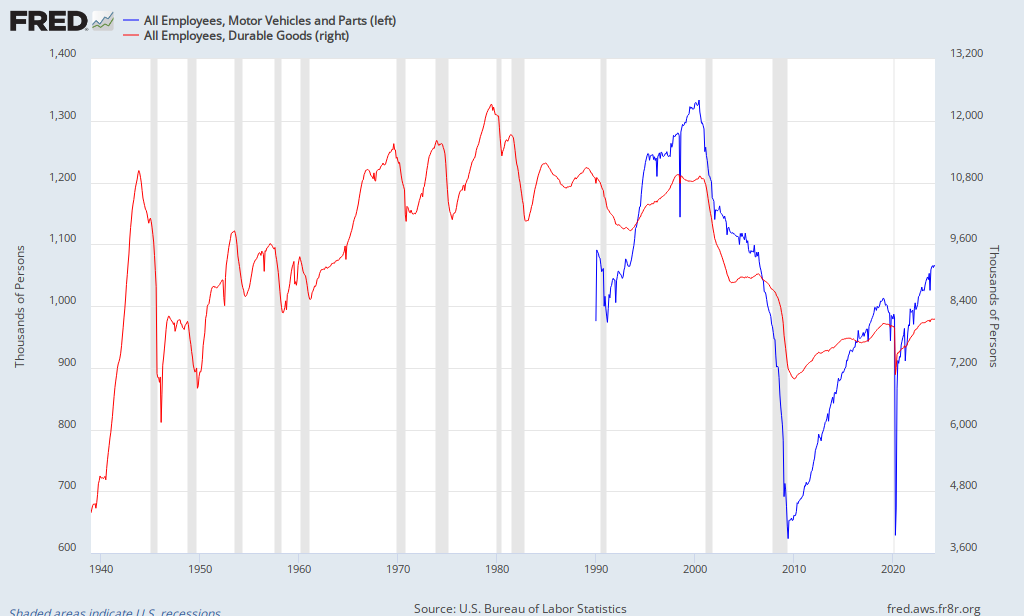
Manufacturing Output and Manufacturing Employment. Never shall the two meet again...See graphs here...
Mark Perry at AEI (Carpe Diem) has this graph showing the state of manufacturing in the US to date. Specifically, Industrial Production of Durable Goods and Motor Vehicles and Parts.
He puts the scale in an index form. Look at the line labeled "100" and move straight across. Manufacturing OUTPUT is back to pre-recession levels. Nice! However, what has this done for EMPLOYMENT in the manufacturing sector? See the next graph below.
The lines are colored coded to represent the same industries in both graphs. The employment graph is scaled in "thousands or persons", so add 3 zeroes to the numbers you see below.
Employment pre and post recession has not made the same gains as output. The question of the day is WHY do you think that is so? It is getting better, but the separation between output and employment continues. Look at the time period between the last recession in 2001-2002 and the one we just went through. What do you notice? Is employment in this sector EVER going to return to that level? The problem is not as easy to identify as it is portrayed in the media and by politicians.
He puts the scale in an index form. Look at the line labeled "100" and move straight across. Manufacturing OUTPUT is back to pre-recession levels. Nice! However, what has this done for EMPLOYMENT in the manufacturing sector? See the next graph below.
| Source: Carpe Diem |
Employment pre and post recession has not made the same gains as output. The question of the day is WHY do you think that is so? It is getting better, but the separation between output and employment continues. Look at the time period between the last recession in 2001-2002 and the one we just went through. What do you notice? Is employment in this sector EVER going to return to that level? The problem is not as easy to identify as it is portrayed in the media and by politicians.
Monday, April 15, 2013
Want to know where your Federal Tax dollars go? Nice interactive shows you in detail based on a programs percentage of the budget.
Here is a cool interactive ("cool" is a relative term when speaking of taxes) that allows you to input how much in Federal Taxes you actually paid (Income, Social Security, Medicare) and displays the specific programs (based on percent of the Federal Budget) your money was spent on.
If you are not sure, input $10,000 just to get an idea. Be sure to choose the "Expand All" button to ge the full effect.
CLICK HERE FOR THE LINK.
If you are not sure, input $10,000 just to get an idea. Be sure to choose the "Expand All" button to ge the full effect.
CLICK HERE FOR THE LINK.
Saturday, April 13, 2013
My Texas Billboard Story. A lawyer advertising "Gun Trusts". What is a Gun Trust? Find out here. FASCINATING!!!
In December of 2011 I move from Texas (after living there for 27 years) to Illinois.
This weekend I am visiting Texas A&M in College Station.
On the drive from Houston along FM 105 I saw this sign (don't remember the town). I have never heard of, or seen advertised, legal services to establish a "Gun Trust".
Of course, I was curious and had to find out what it was all about.
A trust is a legal entity where someone can place physical and/or financial assets and it (1) ensures continuity of ownership of the assets by the trust (not the "real owner" of the assets) and (2) keeps the assets from being subjected to the estate tax OR seizure from the government for tax purposes---the trust never dies!
But a trust confers some addtional benefits that will delight gun owners and irritate gun control proponents.
The National Firearms Act ("NFA") requires purchasers of certain categories of weapons (i.e. machine guns) to register them with the Bureal of Alcohol, Tobacco and Firearms ("BATF").
Now you will know the story of this billboard as well. If you see it you can dazzle your friends with your new found knowledge.
You are welcome... :)
This weekend I am visiting Texas A&M in College Station.
On the drive from Houston along FM 105 I saw this sign (don't remember the town). I have never heard of, or seen advertised, legal services to establish a "Gun Trust".
Of course, I was curious and had to find out what it was all about.
A trust is a legal entity where someone can place physical and/or financial assets and it (1) ensures continuity of ownership of the assets by the trust (not the "real owner" of the assets) and (2) keeps the assets from being subjected to the estate tax OR seizure from the government for tax purposes---the trust never dies!
But a trust confers some addtional benefits that will delight gun owners and irritate gun control proponents.
The National Firearms Act ("NFA") requires purchasers of certain categories of weapons (i.e. machine guns) to register them with the Bureal of Alcohol, Tobacco and Firearms ("BATF").
"All NFA items must be registered with the Bureau of Alcohol, Tobacco, , and Explosives (ATF). Private owners wishing to purchase an NFA item must obtain approval from the ATF, obtain a signature from the Chief Law Enforcement Officer (CLEO) who is the county sheriff or city or town chief of police (not necessarily permission), pass an extensive background check to include submitting a photograph and fingerprints, fully register the firearm, receive ATF written permission before moving the firearm across state lines, and pay a tax"---WikipediaDon't want to do that? Too intrusive? Then establish a "Gun Trust" and place ownership of them in it. Note the significant reporting requirement changes:
"NFA items may also be transferred to corporations (or other legal entities such as a trust). When the paperwork to request transfer of an NFA item is initiated by an officer of a corporation, a signature from local law enforcement is not required, and fingerprint cards and photographs do not need to be submitted with the transfer request. Therefore, an individual who lives in a location where the chief law enforcement officer will not sign a transfer form can still own an NFA item if he or she owns a corporation("trust")"---Wikipedia.So, a Gun Trust helps one shelter their weapons (specific ones) from taxation and seizure AND registration/scrutiny.
Now you will know the story of this billboard as well. If you see it you can dazzle your friends with your new found knowledge.
You are welcome... :)
Subscribe to:
Posts (Atom)