Saturday, February 23, 2013

One easy graph that illustrates all you need to know about the future of Retail Stores and Employment in that sector.

Here is a bar chart showing the decline in jobs in various "brick and mortar" retail stores.  "Brick and mortar" is a metaphor for physical stores that you can walk into and buy stuff.

Keep in mind, this is the decrease JUST SINCE 2001!

Source: EMSI
What is the cause of this decline?

Almost everything sold in a physcal stores represented by the above retail categories (some more than others) can be found in one of these devices you can hold in the palm of your hand.

Take a moment to look at your phone and list the things it can do (while in the palm of your hand) that in a prior and relatively recent time you had to have a separate and distinct device to perform that same task.

This is an example of an economic game-changer that is the result of "distruptive technology" (also known as disruptive innovation):
""A disruptive innovation is an innovation that helps create a new market and value network, and eventually goes on to disrupt an existing market and value network (over a few years or decades), displacing an earlier technology. The term is used in business and technology literature to describe innovations that improve a product or service in ways that the market does not expect, typically first by designing for a different set of consumers in the new market and later by lowering prices in the existing market.""
This comes at a cost.  "Brick and Mortar" stores produce jobs locally.  The Smartphones produce DIFFERENT jobs and don't have the local, physical retail impact that the Best Buys, Barnes and Nobles, Office Depots, Virgin Record Stores, of the world do.

Luddites of the World are weeping...

Saturday, February 16, 2013

My defense for an increase in the Minimum Wage to $9.00. I speak of one element of the labor market I don't hear ANYONE refer to and I think it is important to understand...

There is lots of talk, for and against, regarding the recent proposal by the President to increase the minimum wage from $7.25 to $9.00 per hour.

Economic theory suggest that when you increase the price of something (wages) the quantity demanded (workers) decreases, hence unemployment increases and if the price (wages) decreases the quantity demanded (workers) increases, hence unemployment decreases. 

Even with an increase in the minimum wage I believe I can make the case that employment will INCREASE rather than decrease using the principles of Price Elasticity of Demand and the Total Revenue (Income) Test for Elasticity of Demand.

It might be a "stretch" but I think Elasticity of Demand for Labor factors into the equation.
I will use a series of graphs to illustrate my case.
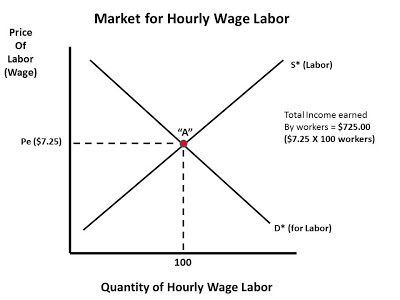
The first graph shows a labor market in equilibrium at an hourly wage of $7.25 and the current level of employment at that wage 100 workers (obviously a made up number for simplicity).  $7.25 is the current minimum wage in the US. I will use this wage rate as my base and compare it to the new minimum wage of $9.00 proposed by President Obama in his State of the Union Address.  It also shows the TOTAL amount of income earned by these workers at that wage rate--$725.00 PER HOUR
Graph #2 shows the imposition of a new $9.00 per hour minimum wage ABOVE the current wage.  This would establish a new PRICE FLOOR. This is a 24% increase in the wage rate. The quantity demanded for labor DECREASED to 75 workers. This is a 25% decrease in Quantity Demand for Labor.  Using our formula for Price Elasticity of Demand (%chg in Qd/%chg in P) this suggests the Demand for Labor in this market is slightly ELASTIC, just over 1.  If we apply the Total Revenue Test (in this case Total Income), we find that as the wage increased the Total Revenue (Income) DECREASED to $675.00. This suggests the Elasticity of Demand is ELASTIC—as the price increases the Quantity Demanded decreases by a greater amount.

The policy implication of this increase in the minimum wage is we have REDUCED the income of these workers overall.  Less income, less spending in the economy overall, less GDP, hence less employment.
However, I think we have to look closer at the Elasticity of Demand (even for low income workers) in the SHORT RUN. The Short Run is the operative 2 words.  
I don’t believe businesses will significantly change their hiring or lay-off decisions in the immediate after-math of the increase in the minimum wage.  They must serve current customers and fill current and future orders.
Given this condition, In Graph #3 I suggest the Demand for Labor is relatively INELASTIC.  Business will NOT reduce their Quantity Demanded for Labor by more than the Increase in the Price of Labor. 


If Demand for Labor is relatively INELASTIC, then an increase in the Minimum Wage (+24%) will reduce employment to 90 workers from 100, or 10% LESS than before.  Using the formula for Price Elasticity of Demand (%chgQd/%chgP)  will yield a number LESS than 1 (-10%/+24%= -.41).  Performing the Total Revenue (Income) test, we find total income earned by these workers is $810.00, $85.00 MORE than before.  Fewer workers, higher overall income, in spite of the decrease in employment.

Assuming Demand for Labor is relatively INELASTIC, even for low skilled workers in the short run, by increasing the minimum wage will increase total income earned by these workers.

If total income increases these workers have more money to spend.  An increase in income will tend to move them to buy more “normal” goods and fewer “inferior” goods.  Normal goods tend to be higher value goods purchased as income increases.  Spending more money will create an increase in demand for new “normal” goods and services.  Hence, businesses will sell and produce more goods and services.  They will likely need to hire additional workers (at the margins) to produce and sell those additional goods and services.

As illustrated in the graph below, the Demand for Labor will INCREASE. The Demand Curve (D2 for Labor) will shift to the RIGHT.  As represented by Point “D”, at $9.00 the Quantity Demanded for Labor is 110 workers, a level of employment HIGHER than before.

Elasticity of Demand for low-skilled minimum wage workers seems to me mirrors the condition of the economy.  If the economy is doing well and unemployment is relatively low, then an increase in the minimum wage may actually be productive for the economy, as the demand for that labor will be relatively inelastic.

However, in an economic downturn it seems to me the demand for low-skilled labor becomes relatively elastic and an increase in the wage rate will have a higher negative impact on employment.

Bottom line for me:  Gotta pay attention to Elasticities and less to politics when it comes to this issue.

Friday, February 15, 2013

Price Floor Powerpoint---You can bet the Farm on this one!!!

Price Floors are another example of government intervention into the "free" market. It is an effort to set a price for a good or service ABOVE what the marketplace dictates/suggests the price should be.

The two prominent examples are the Minimum Wage and prices received by farmers for their commodity in the market. 

Here is my Powerpoint presentation trying to illustrate this concept in the simplest terms possible.

I use an agricultural commodity as an example---Corn.

Let me know what you think, and more importantly, any egregious errors I might have made. THANKS!

Price Ceilings explained as simply as possible. Must know info for when the Mayhem Guy from AllState comes to visit your community...

When disaster looms or when it strikes there can be a significant disruption in the delivery of goods to that area.  We have learned about this from the recent natural disasters in the Northeast US (Hurricane in the Summer and Snow just recently).

When this happens there are usually price increases on vital goods, such as water, basic food staples, gasoline, batteries, etc.  When the prices rise there is the inevitable cry of "PRICE GOUGING!!" and people demand the government do something about it.

The obvious action would be for the government to impose Price Ceilings.  A Price Ceiling prevents sellers of goods from raising prices above "reasonable" levels---whatever that means exactly.

The imposition of Price Ceilings do have consequences.  I put this powerpoint presentation to help you (or your students) understand how they work to serve AND under serve the marketplace.

Let me know what you think. Thanks!

Thursday, February 14, 2013

My Powerpoints to teach the Foreign Exchange Market in AP Macroeconomics.

My Powerpoints to teach the Foreign Exchange Market in AP Macroeconomics.

The first one is a long version to teach the "nuts and bolts". The second is a quick(er) review of the first.  The third is an explanation of the Interest Rate Effect on in the FOREX (very important for the AP Macroeconomics test).

Tuesday, February 12, 2013

Can you see me (Powerpoint) now?

My detailed powerpoint on curve shifting in a Basic Supply and Demand graph.  This is a test to see if it embeds properly and people can see it without having to sign up at the site where it is posted.

Let me know in the comments if you can view it freely. Thanks!
 

Sunday, February 10, 2013

Nice Infographic showing why Chinese consumers pay more for imports of certain foreign goods. See here how I link it to the Foreign Exchange Market. Gives an interesting perspective.

Here is a comparison of the price differential of certain "luxury goods" sold in China and the US.

The items below give the prices in the Chinese currency Yuan.  This shows, at the prevailing exchange rate (more on that a minute) how much the good is locally in China and how much that same good would cost the Chinese if they could exchange their currency and buy it in the US. In other words, how much Yuan are they giving up to buy the good in each place.

The current exchange rate between the US Dollar and the Yuan (CNY) is $1.00 = 6.23 CNY or the reciprocal 1 CNY = $.16.  ($1.00 "buys" 6.23 CNY or 1 CNY "buys" $.16).

To put each of the CNY numbers below in perspective, divided each of the numbers you see below by 6.23 CNY. This will give you the US Dollar equivalent.   Note: you can also multiply 22 CNY by $.16 and get the same result.

Example: In China 22 CNY for a Starbucks coffee would be (22CNY/6.23CNY) $3.53. In the US it would be (12 CNY/6.23 CNY)  $1.95.

Do the same math for the other goods to get a dollar to dollar comparison.  This is too much fun not to share! Hope you liked it.  :)
Infographic: Why are prices for Western consumer prices so high in China?
[Infographic by East-West-Connect.com] [Original Chinese version by Sohu.com]

Saturday, February 9, 2013

Nice and Concise article on the concept of Opportunity Cost. I encourage you to read it. Besides, what else do you have to do today?

See what I did there??? :)

Thinking in terms of Opportunity Cost can change how you make decisions.  I believe for the better.  It provides a framework to filter your choices through and may (or may not) help you arrive at a more beneficial outcome.  If nothing else, it causes you to pause and think about a decision from many angles and prevents rash decisions you might regret later.

Here is an excellent (and short) article on this important but lightly stressed concept in Economics by are "real" economist, Emily Oster.

She suggests understanding Opportunity Cost will help you not just in personal decision making, but in how others make decisions regarding THIER opportunity costs relative to YOURS.

""Applying opportunity-cost theory won’t always change your behavior but can simply be a useful tool to understand why things are the way they are. When I was pregnant and visiting my OB every few weeks, I waited for the doctor every single time. Sometimes for as long as an hour. I was furious. Didn’t they know my time was valuable? But consider this: Because of the way appointments like this work—because they are unpredictable in length—someone will have to wait. Either the doctor schedules long appointments and sometimes she waits for you, or she schedules short appointments and sometimes you wait for her. Doctors are very highly paid, and, therefore their opportunity cost is very high. For most of the rest of us, our opportunity cost is lower. If someone has to wait, it’s efficient for it to be the person with the lower opportunity cost. In other words, you.""


 The article has several other example of Opportuntiy Cost(s).  I encourage you to read the whole thing. 


Monday, February 4, 2013

Nice, short video primer on what the Debt Ceiling is. An informed citizenry is, well, rare...

If you are not sure what the Debt Ceiling is all about, here is a good place to start.  As always, the devil is in the details and the issue gets way more complicated.  However, this will give you a jumping off point (by that I don't mean the nearest bridge) to learn more. :) 

David Wessel, Wall Street Journal


Thursday, January 31, 2013

Interesting chart showing the Gender Gap in obtaining College Degrees and the disciplines those degrees are in. Eye-opening!!

Numerically, women earn significantly more college degrees than men do.  However, there is some disparity in the nature of those degrees.  Below this graphic is a brief analysis from Mark Perry at Carpe Diem.


From Carpe Diem:

The table above is based on the most recent data from the Department of Education on bachelor’s degrees by academic discipline and the sex of the graduating students for the college class of 2011 (most recent year available). Here are some observations:


1. Women earned 57.2% of all bachelor’s degrees in 2011, which also means that there were almost 134 women in that year’s graduating class for every 100 men.

2. For the College Class of 2011, women significantly outnumbered men in 15 academic disciplines, men outnumbered women in nine academic fields, and there was approximate gender parity in five disciplines.

3. For bachelor’s degrees in health professions (primarily registered nursing), 566 women graduated in 2011 for every 100 men, for public administration there were 446 female graduates for every 100 men, for education there were 391 women for every 100 men, and for psychology there were 334 women for every 100 men.

4. In the most unbalanced academic fields favoring males, 481 men graduated in 2011 with a bachelor’s degree in engineering for every 100 female graduates, and 467 men earned a degree in computer science for every 100 women.

5. As much as we hear about female under-representation in STEM (science, technology, engineering and math), women outnumbered men for bachelor’s degrees in biological and biomedical sciences by a ratio of 144 females for every 100 males. Women also earned more than 43% of all bachelor’s degrees awarded in mathematics in 2011, and more than 44% of the degrees in general mathematics (the most popular of the 12 sub-disciplines in math). For general chemistry (another STEM field), women earned almost half (48.8%) of the bachelor’s degrees awarded in 2011.

Wednesday, January 30, 2013

Is student debt a new form of birth control? Maybe this is the only one that is truely effective!!


Behind the falling US birthrate: too much student debt to afford kids?
Karen Hu of Oakton, Va., is 28, married, graduated from law school – and thinking about babies. But that's as far as she and her husband, a software programmer, have gotten: just thinking. What's holding them back?

For one, Ms. Hu is finding it a challenge to land a good job in the post-recession economy.

For another, her student debt – some $164,000, with a monthly payment of $818 – is forcing the couple to think hard about taking on the additional expenses that come with having a child. "Children just don't fit into that scenario," Hu says.


I am feeling a little put upon by NPR. My first name is not valid in their eyes..

This was a what the heck moment for me.  I tried to sign up on National Public Radio so I could comment on an article on their website, but got into this loop.

Is "Gene" such an outmoded name?

 I just googled "famous people named Gene" and got THIS list.  Most are dead. 

Nevermind.  My comment was going to be lame anyway... 

Who knew? Manti Teo's fake girlfriend had a fake father who was a fake economist. (Is that last comparison redundant?)


The Fake Economist Who Conned A Nation
""As an ex-presidential consultant, a former adviser to the World Bank, a financial researcher for the United Nations and a professor in the US, Artur Baptista da Silva's outspoken attacks on Portugal's austerity cuts made the bespectacled 61-year-old one of the country's leading media pundits last year.
The only problem was that Mr Baptista da Silva is none of the above. He turned out to be a convicted forger with fake credentials and, following his spectacular hoodwinking of Portuguese society, he could soon face fraud charges.
Mr Baptista da Silva's comeuppance began when the UN confirmed to a Portuguese TV station last month that he did not work for the organisation, not even as a volunteer, as he later alleged. Further media investigations uncovered his prison record and fake university titles...""

Tuesday, January 29, 2013

"French and Malian Forces Retake Timbuktu"--I never thought I would live long enough to see this headline. See here a photo of a cherished possession I received while serving there and my own short personal comment on the situation


French and Malian Forces Retake Timbuktu

In the early 1980's I served as a Marine Security Guard at the US Embassy in Bamako, Mali. I visited several areas in Mali, including Timbuktu.  It was like stepping back in time.  It truly is a sad thing that buildings, structures and a unique culture that have been in place for centuries are under attack, physically and spiritually, by outsiders with an radical agenda.

Have you EVER ever heard of Mali before?  Probably not. The Mailian people are generally the most kind, polite, sincere and peaceful people on the planet and I was the recipient of those virtues in large doses on many occasions in the time I spent there.  Malians find ways to thrive in conditions that make subsistence an everyday challenge. 

The photo above is a cherished possession of mine. It is a decorative bag that local workers in the Embassy motor pool chipped in to purchase for me as a going away gift when my tour of duty was over.  I remember to this day (31 years ago) the feeling I got when they presented it to me.  They could not afford to do this, but they did it anyway. 

This generosity is typical of Malians. They don't deserve the tribulations that are being visited upon them.  I pray it stops soon before before a full scale humanitarian disater occurs.

The time I spent there STILL pays dividends for me as a citizen and as a teacher.  The lessons of hope amidst extreme poverty I learned so long ago are not lost on me to this day.  I never would have known that if I had not served there.

God Bless the people of The Republic of Mali. 


View My Stats