Friday, June 22, 2012

The Obama Gift Registry to raise funds---Does this mean "Julia" is getting married?

I thought this was from the minds of the people at The Onion, but it is real.  I found it funny and wonder when the "Gravy Bowl" lobbyists will be out in force. 

Gravy Bowls are a consumption expenditure and is that not what we are tying to jumpstart?

So, the campaign is asking people to forego current consumption ("Gravy Bowl Stimulus") so they can (1) take a tax deductable donation (a dreaded "Tax Expenditure") that only higher income people normally take, and (2) make a speculative investment that has a 50-50 chance (according to polls) of success at this time.

Does anyone else see the irony here?  (Not being political, just cynical)...
Source: BarackObama.com
Here is the link to the video of "Julia" I mentioned in the title. It is a presentation of how a fictitious person grew up with the help of government benefits/programs....

Nice graphic showing the connection between Education and Inter-generational income mobility. Get into school kids, any school!!

The US Dept of Treasury just published a paper (HERE) and it included this graphic.  I modified it a little to explain/illustrate specifically the effect education has on children from the lowest income brackets and how it promotes upward intergenerational income mobility.  If you read and understand what is in the boxes you can figure out what is going on in the other income quintiles as well.
Note: It should be "45%" in the box on the left.

Source for this posting; The Economix

Nice graphic showing world-wide energy consumption by source. You "Greenies" are going to pass out, so pull your bike over to the side of the road before looking...

This graph (HT: The Conversable Economist) shows world consumption of energy by source since 1986.  There is good news and bad news and good news and bad news.

Oil consumption has been relatively level even though population and economic growth in developing countries have increased (good news).  However, the consumption of coal has increased (bad news), most likely in response to the population and economic growth increase. Natural gas, a cleaner fossil fuel, has come on line lately (good news). 

Look closely at the Orange area. That is for "renewables"--wind, solar, etc.  Increasing, but still a very small part of the overall energy picture. 

Like it or not, we are going to be dependent on dirty fuels for a significantly long time. If our policies don't reflect that then we are going to be in an economic funk for a long time as well. 

Monday, June 18, 2012

If you are young and looking for a place to settle where the economy is likely to thrive in the future, you need to look at these rankings...

Where is the economy doing well now and potentially in the medium and long term?  The rankings below are enlightening.  Take note of the States that appear several times across the measure.  Those are the places to be.

""And here are the top 10 future boom states, with some awfully familiar names at the top. For this category, the authors looked at different types of job growth, the education level of each state’s young workforce (25-44 years old), the median income for a household of four adjusted for cost of living, as well as a few secondary data elements.""--Source: Economic Modeling Specialists International


Below are rankings of States by various measures of what would be called factors condusive to doing business/promoting commerce. 

Saturday, June 16, 2012

Nice video showing advancement in Robotics. How many jobs is this GOING to eliminate OR (gasp!) create?

Below is an awesome video (HT: Carpe Diem) illustrating an advancement in robotics and its potential application to everyday life---industrial and personal. What will be the effect on employment when this technology becomes routine in daily life? I see the potential for creating instances of "structural unemployment" in the marketplace---people losing jobs to machines that can perform the same tasks as a worker. It is easy to see the jobs that might be lost and other costs this technology might impose on society. However, what about the "unseen" benefits of this technology on society and even on employment? Extra credit for good answers.

Friday, June 15, 2012

A quick reference visual of Federal Govt spending. Another reminder of the failure of the political class and the public that enables them...

Easy reference visual that shows current Federal governement spending in the broad budget categories.  Healthcare (includes Medicare, Medicaid), Social Security, and Interest on the National Debt are areas of mandatory spending---must be carried out regardless, whether the govt has the money or not. Some would say that Defense should be in that category as well.  The "Safety Net" contains unemployment compensation, food assistance and other income support programs.  This is considered (for the most part) a Mandatory part of the budge too.

The Mandatory items mentioned above are the "biggies" in terms of serious budget issues, but are "smalls" in terms of political emphasis.  The powers that be are feasting on the "everything else" in the budget in which each item represents a tiny part of the whole. 
Source: Christian Science Monitor

Wednesday, June 13, 2012

Update to my graph on Federal Employment...See what those people were hired to do during the recession. Surprising results...

I did not want to appear flippant in my last post on Federal Employment suggesting that additional Federal employees added to the Federal payroll were "Zero Marginal Product" employees. 

Using Census data I found the general categories of  employment for Federal employees and the change in employment from December 2007 (start of recession) to March 2010 (the latest data available).  These numbers are for FULL-TIME employees. There are substantial numbers of part-time workers but I choose to leave those out for now.

In the far right column I calculated the change in employment for each category.  I put an asterisk next to the numbers that stuck out from the rest.


Observation: "Health and Hospitals" added a combined 43,000+ jobs and "National Defense/International Relations" added 72,000+.  Together these two categories account for 115,000 full-time positions, or 62% (est.) of the total jobs "created" in the Federal Govt during this time span. Were these areas in such deficit that they needed this type of "pumping up"?  I honestly don't know.

The relatively large number of new Federal "Police" is curious to me. I am no conspiracy theorist, so don't go there, please. 


How about your observations.  What do you see?

Tuesday, June 12, 2012

Fact: Federal Govt employment has increased 125,000 since Inaguration Day. Allegation: Federal spending has remained almost flat since Inaguration Day. Question: What are those 125,000 people doing? See graph here...

Below is a graph that measures the change in Federal employees (NOT counting Postal employees) since 2007 (Pre-Recession).  The gray area represents the the time span of the recession.  The vertical Red Line shows when Pres Obama took office (Jan 2009).

At Point "A"  when the Pres took office the number of Federal employees was 2.075 million.

The big spike in 2010 represents massive, temporary hiring to do the Constitutionally mandated Census that occurs every 10 years. Ignore this spike.

Point "B" represents the number of Federal employees, 2.2 million, in May 2012 (latest measure).

The difference between "A" and "B" is the increase in the number of Federal employees since the Pres took office. This number is approx. 125,000.

If you want to extend the timeline back a bit to the beginning of the recession (left edge of the gray area) you will see that Federal govt employment increased 100,000 from that point to Inauguration Day 2009.  The total change in Federal employees since the beginning of the recession is 225,000

Just ball-parking AVERAGE Federal employee TOTAL compensation (wages + benefits) of $80,000 that is an INCREASE in the Federal Payroll of at least $18 billion dollars each fiscal year

If government spending is relatively flat and there are 225,000 additional employees added to the payroll since 2008, my question is "What are these people doing?"--- More payroll  means less spending on programs those employees are hired to administer...I THINK that is a fair question, isn't it?

Tell me where I am going wrong. Thanks!

Nice graphics showing the change in prices in the last 30 years of foods we commonly purchase. Do you think it is more or less today?

Here are some quick to read graphics (ALL from NPR) that will give you "food for thought" when, well, you have thoughts for food. 

The first one compares the percentage of money the average household spent on the various major food categories in 1982 and 2012. Amazingly consistent EXCEPT for we spend 31% LESS on meats (driven by subsidies?) and slightly MORE  than 100% on processed foods/sweets (driven by technology?).


In regards to the category "Meats" this does not mean that we eat less meat. The next chart shows we can consume more of it because a broad range of meats are significantly  CHEAPER today relative to 1982 (Prices are adjusted for inflation).  The same can be said for many other food items as well.


Here is the same data in bar graph format.


Lots of foods considered healthy have become less expensive over time. However, they have to compete with the category "processed foods/sweets"---tastes good, more filling... 

I can tell you from personal experience, the latter category wins every time over the former.

Monday, June 11, 2012

Will Tacos be delivered by flying Drones in the near future? If so, I know who is ready to be the first delivery driver. He is a purrrfect fit for the job


Here is an idea that will probably never take-off, figuratively and literally---Tacos delivered by a flying drone (like the military uses to kill terrorists or patrol the border or....).  If is does work, I know who can be the first delivery driver---he even has his own built-in transportation (see video below)...

Tacocopter Aims To Deliver Tacos Using Unmanned Drone Helicopters
""It's an unmanned drone helicopter shooting a taco from space down at you and your colleagues during lunchtime!
The Internet is going wild for Tacocopter, perhaps the next great startup out of Silicon Valley, which boasts a business plan that combines four of the most prominent touchstones of modern America: tacos, helicopters, robots and laziness.
Indeed, the concept behind Tacocopter is very simple, and very American: You order tacos on your smartphone and also beam in your GPS location information. Your order -- and your location -- are transmitted to an unmanned drone helicopter (grounded, near the kitchen where the tacos are made), and the tacocopter is then sent out with your food to find you and deliver your tacos to wherever you're standing.
You pay online, so the tacos are simply dropped off at your feet by the drone helicopter, which then flies back to the restaurant to pick up its next order....""

Sunday, June 10, 2012

Nice graphic showing the powerhouse that is Amazon.com. Why is the 'Gumment' not all up in their grill? (which you can buy at amazon.com, by the way)...

How does Amazon reach this level of market penetration without raising the hackles of federal regulators?  Seems like their time will come in the House and/or Senate hotseat to answer for their success ( I know, that sentence seems a little strange to me too)...


Source: The Big Picture

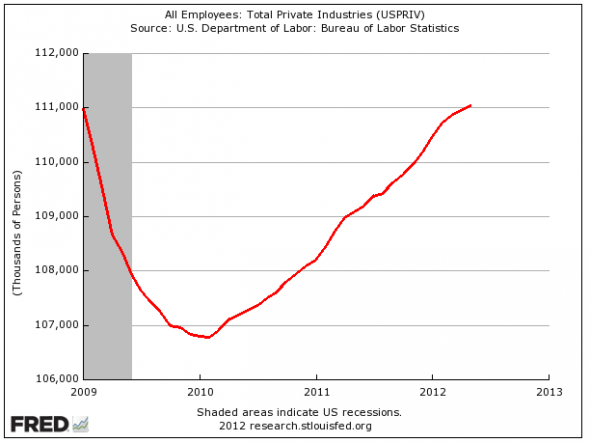
Obama claims 4.3 million jobs created. Romney claims no new jobs created. Who is right? Well, both are correct. See graph here as to why.

The first graph shows what has happened to PRIVATE sector employment (number of people WITH jobs) since Pres. Obama took office (Jan 2009). 

The gray area represents the period of official recession. I included a second graph that extends the time period back to 2001 so you can get some perspective.

Here is where the politics of this first graph comes in.

When the President states, as he did this week, that we have "created" 4.3 million jobs in the last 27 months he is starting at the lowest  point of the graph, conveniently ignoring the time in office before the low point.

Candidate Romney looks at this graph and sees no new "net" job creation since the Pres. took office---the line ends where it started at about 111,000 jobs.  We lost 4.3 million jobs then gained them back, conveniently ignoring the accelerating rate of job loss that started before Obama officially took office.

This begs the question: What does it mean to "create a job"?  The answer is not as easy as it sounds.

Seems like BOTH are correct in their assertions.  It is just how you look at the data and how it fits into your own political narrative.   Don't you love economics---"On the one hand..."


Tuesday, June 5, 2012

See my question to the author of "Garbology: Our Dirty Love Affair with Trash" and his response. His answer was more than I could hope for!

At the Freakonmics blog they asked people to submit questions for Edward Humes the author of Garbology: Our Dirty Love Affair with Trash.  Go here to see all the questions and his answers.  My question was one of many he answered (I edited my question here to correct for bad grammar in the original question):


Q. In your opinion, what (if anything) do we recycle now that after all the costs and benefits are weighed we would be better off just putting in a landfill and be done with it? -Gene Hayward 

A. Your question turns reality on its head. We don’t recycle anything where the costs outweigh the immediate profitability of the reclaimed material — that’s the problem! The manufacturers of wasteful products get a free ride — the cost of the waste they create is born by taxpayers and consumers (junk mailers are the obvious example here, subsidized at every turn, yet freed of having to deal with the tidal wave of waste they create). If the makers of wasteful products had to share in the costs of cleaning and recycling the waste they create, they would begin to make less wasteful products, and the economics of recycling would shift in a more favorable direction. 

Meanwhile, I would argue that we are putting things in landfills that should not be there, such as:

  • Items that are still useful, such as furniture, construction materials, clothing, all sorts of durable and still useful intact products. You’d be shocked if you spent time at a landfill, as I did to write Garbology, or see the masterpieces produced by the artists in residence at San Francisco’s dump, who find treasures every day in the trash.
    • Immense amounts of edible food that could have gone to food banks, and food scraps that could be composted
    • Plastics and paper that could be recycled or used as fuel in waste-to-energy plants.
His answer to my question helps explain an important AP Microeconomic concept---"Negative Externalies".  Negative Externalities occur when the production of a good imposes an explicit (regardless of how remote) cost on a third party that the producer and/or consumer of the good DONT pay for in the market price charged for the good. 

He uses the example of junk mail.  When businesses have junk mail printed up and mailed they are only paying for the productive resources and profit that go into making the mailer (land/natural resources, labor, capital and entrepreneurship) and the postage paid to send it out.  Once it hits my maibox, they are done with it.

The costs of the junk mail have stopped for the producer and consumer BUT have they stopped for "society" (the Third Parties in our story)? No!

Worst case scenario, the paper goes into the trash and to the landfill.  Are there costs associated with this? Yes! Who pays those costs? We can start a list BUT we know for sure it is not the producer of the mailer or even the business that sent it out--they are no where to be found at this point!

Humes suggests that the total cost of the mailer from creation to destruction/disposal should be borne by the producer and consumer--the two most interested parties to the transaction. In other words, the negative external costs created by junk mail need to be internalized (included in the market price) between the producer and consumer. 

One way to internalize (between producer and consumer) this external cost is to impose a tax equal to the cost of disposing junk mail. So the true cost of the mailer will include the cost of the private resources used AND the compensation for the social costs imposed on society by the mailer.

What do you think. Would a tax be beneficial? Detrimental? Can you think of other third parties who would benefit and ones that would be hurt?


Sunday, June 3, 2012

Hardball politics in Wisconsin. How would YOU like to receive this in your mailbox?

I don't live in Wisconsin, but I think I would really be bothered to get a mailer like this, REGARDLESS of which side of the issue I was on. 

It lists your name, address and whether you voted or not in the last two elections.  It shows what your  neighbors did as well.  It also leaves a blank for the next election on Tuesday .  The red circle is mine for emphasis.  The tone of this line bothers me.

Info like this should be public knowledge but it makes me queasy in the way it is used in this case.  What do you think?

Source: Milwaukee Sentinel Journal

"Paving" our way into the future. Is this the answer to our unemployment problem? Only "concrete" answers, please.

Robert Frank of the NYTIMES offers this commentary on the benefits of "infrastructure refurbishment".  Fancy way of saying if we are not going to embark of full-fledged new public works projects then perhaps a little maintenance around the edges will do. 

Whether you agree or disagree with his message/policy prescription, he DOES mention "Capital Stock", which is key vocabulary in AP Economics.  Might help put some context to the concept for students.

Source: NY TIMES:
DEMOCRATS and Republicans share less common ground than at any point in living memory, and they are especially divided about our still-ailing economy. When Democrats propose additional economic stimulus, Republicans call for more cuts in government spending and regulation. And even though the effects of the Great Recession are still with us, political gridlock seems set to continue.
Yet recent public statements by both President Obama and his probable Republican challenger, Mitt Romney, suggest a way forward. The president has long advocated infrastructure investment as a way to put Americans back to work. For his part, Mr. Romney recently warned that government spending cuts would “slow down the economy,” so he, too, has acknowledged the clear link between spending and employment.       
Both men should thus be willing to take the one politically feasible step that could help mend the economy quickly: an accelerated program of infrastructure repairs. People in both parties already agree that these improvements are needed — even apart from their impact on employment.       
In its 2009 assessment of the nation’s roads, bridges and other infrastructure, the American Society of Civil Engineers identified more than $2 trillion in long-overdue repairs. Of course, when maintenance is postponed, its cost rises rapidly. If Interstate highway repairs are delayed even briefly, damage from heavy trucks and winter weather can cause costs to rise several fold. According to the American Association of State Highway and Transportation Officials, substandard roads also cause $335 in annual damage per vehicle on the road. Still more troubling, those roads cause many easily preventable deaths and injuries. What could possibly justify further delay?       

View My Stats