Friday, May 4, 2012

Nice graphic showing the Generational Divide in Jobs. This is an underlying "problem" in the labor markets that can't be solved by policy--only mortality....

Macabre, I know....This chart uses the "Employment-to-Population" ratio for select age groups to illustrate the change in work status for these age groups since the start of The Great Recession.  It is simply the number of workers employed in the age group divided by the total population of the US (multiplied by 100). 

Notice the baseline "0%".  The employment-to-population ratio for workers aged 55 and up has remained remarkably steady. The drop in the other two age groups has been rather dramatic. 


Source: Investor Daily
One explanation is older people are holding onto their jobs longer because a portion of their retirement savings was wiped out in 2007-08.  The longer they work passed traditional retirement age fewer jobs open up for the age group behind them.  Another explanation is the 55 and over demographic is growing and the mid-point for the other two age groups actually shows a decline in numbers (see link article HERE for more on this). 

There certainly are other explanations I have not covered.  Can you think of any?  Suggestions welcome.

Secretary of Agriculture makes statement on Ethanol. See here how I edited it to reflect the bankrupt thinking on this issue...

Approximately 40% of our domestic corn production goes to the production of ethanol, primarily a gasoline additive.  The most recent Farm Bill calls for an increase in the amount of ethanol MANDATED/Required to be produced and used in this manner.  Using food for fuel is universally condemned by those on the Left AND Right of the political spectrum. The only ones who love it are the Farm Lobby, The Ethanol Lobby and the Senators from the farm belt States. 

Below is a quote from the head of the Agriculture Department. I cross out some of his words and insert my own in parenthesis to show this policy can work just as well in the inverse.

Vilsack Makes the Case for Renewable Energy

"When we get to 36 billion gallons (of ethanol), that's going to be mean that we will be importing exporting fewer barrels bushels of oil corn ," says Vilsack. "That means that the wealth that we are currently transferring into from those countries that don't necessarily agree with us and are from an unstable part of the world are our friends/allies/customers can  cannot be redirected into creating rural opportunities and jobs."

It is all perspective....

Latest jobs report just out! A quick look as to where the jobs were gained/lost last month


Click on image to see it more clearly or go HERE for the actual report just released.  Total jobs created in April (far right column) was 115,000 (Total Nonfarm).  This number is derived from taking Total Private (130,000) minus Government (at bottom -15,000). 

Looking through the numbers, the I continue to see an education gap.  "Professional and Business Services" and "Health care and Social Assistance" are the job growth leaders. These categories generally contain people with advanced education beyond High School and  have shown the most strength since last April 2011 (left-most column). 

Government employment--this is at local, state and federal level, clearly is a drag on the overall number over time. 

(Add 3 Zeroes to the end of the numbers you see to get the proper scope---"in thousands")

Tuesday, May 1, 2012

Chinese Tire Tariffs (2009) re-visited...Policy success or failure? More Unseen here than Seen--F. Bastiat lives....

This analysis by The Conversable Economist of tariffs imposed on Chinese-made tires (2009) should be required reading for populist politicians who cater to narrow special interests AND want appear to be a champion of workers and "American Jobs".  It is not long and you will learn A LOT about basic economic principles within the context of "the seen and the unseen".  Most excellent.

Tire Tariffs: Saving Jobs at $900,000 Apiece
In September 2009, President Obama approved a special tariff on imports of tires from China. In his 2012 State of the Union address, he stated that the policy had saved "over a thousand" jobs. Gary Clyde Hufbauer and Sean Lowry look at what happened in "US Tire Tariffs: Saving Few Jobs at High Cost," written as an April 2012 "Policy Brief" for the Peterson Institute for International Economics.
The basic economic lessons here are the same as ever. There's never been any question that imposing tariffs on foreign competition could dissuade imports, and thus allow U.S. manufacturers to keep production and prices higher than they would otherwise be. As a result, U.S. consumers pay more, the firms make higher profits--and workers for those firms get some crumbs from the table. In this case, Hufbauer and Lowry estimate that consumers paid $1.1 billion in higher prices for tires in 2011. This saved a maximum of 1,200 jobs, so the average cost of the tariff was $900,000 per job saved. But of course, the worker didn't receive that $900,000; instead, most of it went to the tire companies. And in an especially odd twist, most of it contributed to profits earned by non-U.S. producers.

Sunday, April 29, 2012

You can't escape it--Wind Farms contribute to global warming by warming the air around them...TANSTAAFL


Large Wind Farms Increase Temperatures Near Ground
Large wind farms slightly increase temperatures near the ground as the turbines' rotor blades pull down warm air, according to researchers who analyzed nine years of satellite readings around four of the world's biggest wind farms.
The study showed for the first time that wind farms of a certain scale, while producing clean, renewable energy, do have some long-term effect on the immediate environment.
Using sensors aboard a NASA satellite, researchers at the University at Albany-State University of New York, and the University of Illinois systematically tracked a cluster of wind farms in central Texas as the installations grew from a few dozen turbines in 2003 to more than 2,350 by 2011.
On average, the nighttime air around the wind farms became about 0.72 degree Celsius warmer over that time, compared with the surrounding area, the scientists reported Sunday in the peer-reviewed journal Nature Climate Change.

I finally put into words my 3 "easy" steps to reduce the cost of college. YES, they do (ok, CAN) apply to you!

Here are my suggestions for cutting college costs while you wait (forever) for politicians to "do something" about the cost of college.  This advice is not for everyone (actually it is, but some of you will find reasons why it does not apply to you or think it "unrealistic").  I think taken together it is pretty solid advice.

1.  Take AP classes and AP tests at the end of the year.  If in your high school career you take and pass just 5 tests in core subjects you will have 1 semesters worth of classes out of the way.  Additional savings come in the form of no college textbooks to purchase and ONE LESS SEMESTER of living expenses.  You get to be employed (hopefully) 1 semester earlier.  You become a net earner as opposed to net spender (debtor) sooner. I wrote more about the value of AP Credits HERE.

(Note: you can take CLEP tests and accomplish the same objective above.  I know, those tests are HARD, but so is paying back thousands in student loans!)

2.  Use the community college system intelligently.  Take classes at your local C.C that DO NOT directly impact your intended major, i.e. if you are a math major take your basic English or Social Studies classes at a Community College.  Vice versa if you are an English major.  Would it be nice and convenient to take all your classes at "Full-Price University" so you get to have the full campus experience? Yes, but if you, or your parents, need to worry about cost it is SMART to strategically plan where to take your classes.  Swallow your pride and be financially responsible!

3.  Apply for scholarships and keep the following in mind.  How long does it take to apply for the average scholarship from start to finish--including writing the essay?  Let's assume 5 hours (reasonable?). 

If you apply for a $1,000 scholarship and it takes you 5 hours of "labor" to fill out the application.  Assume you get said scholarship. This means on an hourly basis your "earned" $200.00 per hour ($1,000/5hrs).  Where can you get that kind of part-time pay with your present skills?

OK, so you don't get first one.  Say you apply for a second $1,000 scholarship and it takes you 5 hours to apply for that one. Total so far you have spent 10 hrs maximum on applications for a $1,000 scholarship.  Assume you get this one.  You will have spent 10 hours to get $1,000.  That's $100.00 per hour for your time filling out applications.  Again, I ask the same question that ended the last paragraph.

How many applications do you have to fill out until you get to an hourly wage that you could reasonably expect to get paid in a "real" part-time job? Fill out applications at least until that point (MB=MC!).  The odds are in your favor! 

If you are waiting around for the powers that be to generate the inertia to decrease the cost of college for you, then you will be in debt up to your ears before you know it. 

These relatively simple steps can save you thousands (10's of thousands?).  Where am I going wrong, if I am?  Please think before responding and be constructive.  Thank you.

Saturday, April 28, 2012

Do Americans REALLY buy the "Buy American" mantra or has globalization said bye-bye to that notion? The survey SAYS....

Nice example of looking at what what people DO instead of what they SAY. 

According to the survey below, Americans care much more about the price, quality and ease of purchase of a good oppose to where it is made. 

Look at the first column where people express the strongest positive feeling for the question.

How about you?  If you honestly assess yourself, does this jive with your behavior?

Source: The Economist/YouGov
HT: Marginal Revolution

Kidney Disease does not kill people, government policies on the sale of kidneys kills people....

Ok, maybe my rhetoric is a little harsh---or is it?

Nice example of how a price ceiling imposed by law creates a shortage of a good. Federal Law sets a price of $0 dollars for the price paid to the donor of a kidney.  Hence, the quantity supplied is going to be much less than it otherwise might/would be. 

The graph below shows the quantity demanded for kidneys is much greater than the quantity supplied at a price of $0.  I have a more detailed posting (with Supply and Demand graphs!) HERE.

If people were allowed  compensation for kidney donations would the quantity supplied increase? Would this be a more socially desirable outcome? What are some additional positive and negative implications of allowing the sale of kidneys? 

Keep in mind, the gap between the lines represent people NOT getting a transplant. 
Source: Carpe Diem

Thursday, April 26, 2012

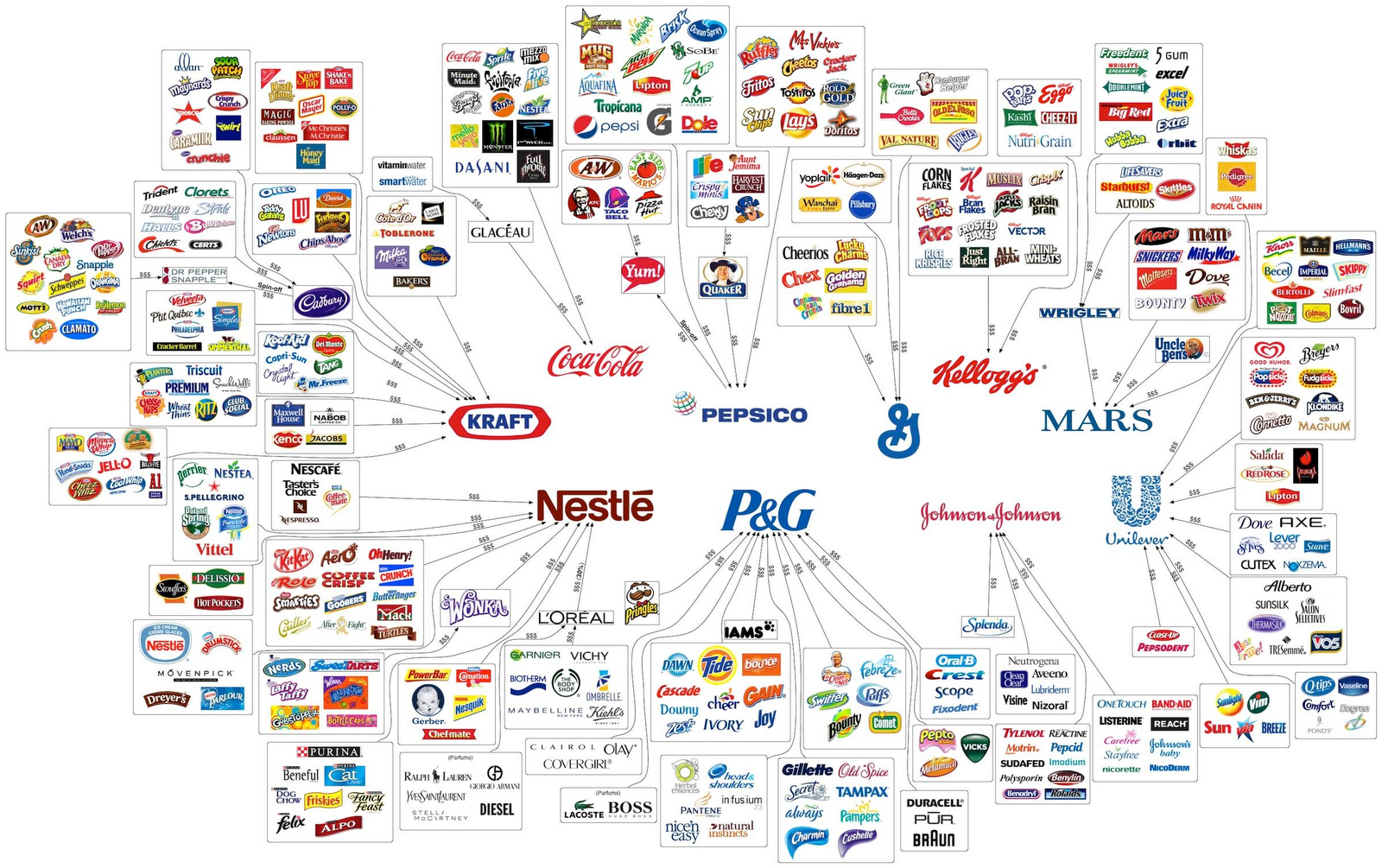
Nice graphic illustrating the web of firms in a Monopolistically Competitive Market. Look for your favorite brand(s)...

In AP Microeconomics we study market structures.  The graphic below is a nice illustration of firms that compete in a Monopolistically Competitive market, or as I like to call it "The NASCAR Market"---look at a NASCAR race car (and the driver) and you will see most of the logos below.

Monopolistically competitive firms MUST advertise heavily and differentiate their products in order to gain/maintain market share.  While the firms are relatively few in number they are highly competitive and have to offer a quality product at a competitive price. 
Source: Chart Porn

Only two industries are back at pre-recesssion employment levels. See them and the laggards here...


Only two industries have fully regained the jobs (and then some) lost during the recent recession.  Leisure and Hospitality has 4.2% more jobs and Mining has more than doubled the number of jobs that existed at the beginning of the recession.  Professional Services is the next closest to being back at 100%, but it is still 17.4% below pre-recession employment levels.  Food for thought...

Source: Business Insider

Saturday, April 21, 2012

Non-Traditional Economic Indicator---Y'all to U-Haul...

The always insightful Carpe Diem offers underlying evidence for larger trends in the economy.  Just everyday transactions that send signals as to what is happening on a larger scale.  U-haul rental rates are one such example.  They can be a signal of migration patterns.

U-Haul has to make sure they have trucks in stock at their retail outlets around the country to meet local demand.  If people are moving from Point A to Point B in larger numbers then from Point B to Point A  there is going to be an imbalance of trucks available.  How does U-Haul resolve this?  With pricing, of course. 

Look at the following example Mark Perry uses to illustrate what is happening between California and Texas.

From Sacramento to Houston: $2,370

From Houston to Sacramento: $1,007

From San Francisco to San Antonio: $2,214

From San Antonio to San Francisco: $1,069

It is twice as expensive to move from California to Texas than vice versa---same truck, same distance.  Lots of Californians want to move to Texas but not as many want to move from Texas to California. 

This is a nice illustration of movement along the market demand curve for Rental Trucks.  In order to decrease the quantity demanded for trucks in California they increase the price. In order to increase the quantity demanded for Rental Trucks in Texas they decrease the price.  This helps keep the right number of trucks available in BOTH California and Texas.

For my new Illinois friends---here is the pricing to move from Illinois to Texas (Dallas/Ft Worth).  What does this tell you about migration patterns between the two states?

Above From Illinois TO Texas
Above From Texas TO Illinois


A humorous look at the various economic systems and corporate models in existence. Economics CAN BE funny, once in a while...

A humorous, yet insightful, look at the various economic and corporate models that can be observed in the world.  Surrealism is my favorite. Which one is yours?
21 Economic Models Explained (Source: Organizations and Markets)

SOCIALISMYou have 2 cows.
You give one to your neighbour.

COMMUNISMYou have 2 cows.
The State takes both and gives you some milk.

FASCISMYou have 2 cows.
The State takes both and sells you some milk.

NAZISMYou have 2 cows.
The State takes both and shoots you.

BUREAUCRATISMYou have 2 cows.
The State takes both, shoots one, milks the other, and then throws the milk away.


Tuesday, April 17, 2012

On an hourly basis, which College Major Pays the BEST? See the list here. Guess which is Number 1 before looking.

I see alot of these salary surveys, but this one comes from the latest Census data so it promotes no particular agenda.  The math and sciences always show near the top, but economics also is constantly present at the top of the wage scale.  Click on the link and you can sort through the categories and get different perspectives....


Which College Majors Pay Best?

Source: Wall Street Journal

Sunday, April 8, 2012

Are we in the midst of an overt Positive Aggregate Supply Shock in Manufacturing? A rare sighting indeed.

We can have all the demand for goods and services in the aggregate in the short run but occassionally, or in tandem, we need an increase in our ability to produce goods and services to feed that demand.

This is known as a Positive Supply Shock, which can be temporary or permanent. Trends are emerging that suggest we might be in the midst of a short run postive supply shock. If the short run increase in the economys potential to supply "stuff" leads to a permanent ability to produce goods and services, then we will have economic growth in the true sense of the term.

Two of the three points excerpted below address specific supply-side requirements---lower wages and lower energy costs. These are two important inputs that go into making finished goods/services.  The second point, depreciating of the dollar will help on the demand side for finished goods, but can hurt on the supply side for inputs/raw materials that are imported.
""Three trends suggest America's "manufacturing renaissance" is just getting started, says Neil Dutta, U.S. economist at Bank of America Merrill Lynch. First, the cost advantages of outsourcing factory work are narrowing. Emerging market wages, while still much lower than U.S. wages, are rising, and high oil prices have made shipping more expensive. That is expanding the range of goods U.S. factories can produce at competitive prices (think sophisticated machines, not toys).
Second, a weakening dollar makes U.S. goods more attractive to foreign buyers. The dollar has fallen by nearly one-third over the past decade against a basket of currencies including the euro, British pound and yen.
Third, energy production is booming in the U.S., and domestic natural-gas prices have recently plunged. That gives an edge to U.S. producers of fabricated steel, transportation equipment, machinery and chemicals, which use natural gas extensively, according to a recent report from Citigroup (Source of article: The Great Reversal: Playing the U.S. Manufacturing Boom)

Extra Credit: Draw an AD/AS Model of the economy showing it in recession.  Show and explain (using the context of this article) in the absence of government policy how the economy can return to full employment ON ITS OWN (Self-Correcting).

Saturday, April 7, 2012

There IS a bright-side to high gas prices. (I am just the messenger, but I understand if you want to shoot me)...Read why here...

The fuel efficiency of vehicles SOLD in the US has increased in the last few years (Chart below).  However, the change in the last couple of months has been rather dramatic. 

This is a nice illustration of how the marketplace responds to changes in prices without a law or regulation.  As people purchase new vehicles, they are taking into consideration the high price of gasoline and buying more fuel efficient cars and trucks:


""Replacing a used vehicle getting 20 mpg with a new vehicle getting 24 mpg would completely offset an increase in the price of gas going from $3.33 per gallon to $4 per gallon, on an annual basis.""---Mark Perry at Carpe Diem
 

As the price of gas increases consumers are substituting low gas mileage vehicles for high gas mileage vehicles.  The market works---if given time.  This helps reduce the demand for oil and at the margins helps to clean the air. Win-Win----WINNNING!!

 March U.S. Light Vehicles Raise Fuel-Efficiency Bar

Source: WardsAuto
View My Stats