|
| Source: The Conversable Economist |
Friday, March 30, 2012
Nice graph showing dollar amount of currencies traded in the Foreign Exchange Market---Impress your econ teacher or your Professor!!
I knew lots of currencies are traded in the Foreign Exchange Market on a daily basis, but I did not know how much in dollar terms. This graph (HT: The Conversable Economist) gives a pretty good idea--in the $4 Trillion dollar range. Nice for teachers to show students and great for students who want to impress their economics teacher!! :
Wednesday, March 28, 2012
China is now our 3rd largest EXPORT market. Nice interactive graphic showing each US States share of those exports. This is a growing market for US goods and services. We can either fight it or benefit from it.
If economic expansion does not cause China's political system to implode, the opportunities to do business there are in their infant stages. US companies and entrepreneurs must get on board with looking to "The East" for opportunities. Students should also be aware of this and figure out how to take advantage of it as well. It is a growth area where there seem to be few.
Go HERE to the US China Business Council website and you will see the interactive graphic below. Click on your state and see an overview of exports to China from that state.
Keep in mind the percentage change will be dramatic because exports to China started at a low base number---exports to China on a larger scale are a relativly new thing. None the less, China is now are 3rd largest export market, behind Canada and Mexico.
Go HERE to the US China Business Council website and you will see the interactive graphic below. Click on your state and see an overview of exports to China from that state.
Keep in mind the percentage change will be dramatic because exports to China started at a low base number---exports to China on a larger scale are a relativly new thing. None the less, China is now are 3rd largest export market, behind Canada and Mexico.
 |
| Source: USCHINA Business Council HT: Carpe Diem for link |
Tuesday, March 27, 2012
The "Opportunity Cost" of getting rid of "Pink Slime"---No one seems to be defending this product. Guess I will give it a shot...

One persons gross Pink Slime is another persons paycheck...It is worth noting that at least 650 jobs have been lost in the near term and I am sure more will happen down the supply chain. Not sure where those people will end up, other than the unemployment line. That is one big negative created by this issue.
It is also interesting to note another side effect. The filler will presumably have to be replaced by "real meat". The article notes that an additional 1.5 million head of cattle PER YEAR will be needed fill the gap that Pink Slime filled. That is quite a short term increase in demand that cannot be filled in the near term---the cows gotta be born and grow up!!.
This will create conditions for higher beef prices, higher cattle feed prices, more food commodities diverted to beef production resulting in higher prices for OTHER foods, environmental problems (more water and other resources consumed) with that much increase in beef production, etc, etc, etc. I am SURE I am missing some other "unintended consequences". Are we ready for higher prices in the food supply?
Weighing the costs (there are no known health problems associated with "Pink Slime"--other than the "gives me the willies" feeling) and benefits of Pink Slime, it is worth it to get this product off the market? What do you think?
Below is the article I base the above comments on. Worth a read...
Pink Slime Production is Suspended at Plants
A major producer of a ground-beef additive said it is closing three plants after a growing number of supermarkets dropped the product in recent weeks.
Beef Products Inc. said Monday its decision to suspend production of a ground-beef filler at plants in Amarillo, Texas; Garden City, Kan.; and Waterloo, Iowa, would affect more than 650 employees. Its plant in Dakota Dunes, S.D., where the filler is also produced, will continue operating.
The decision came as social networks teemed with concerns about the product, nicknamed "pink slime" because of its appearance.
"The derogatory term has trumped all science, all facts, all history," said Rich Jochum, corporate administrator for Beef Products, which took out a full-page advertisement last week in The Wall Street Journal defending its product. The company didn't indicate for how long production of the filler would be suspended.
Sunday, March 25, 2012
When oil prices rise the first cry from politicians and other scoundrels is "IT'S THE SPECULATORS!!". But is it TRUE?
This research paper surveys published papers on the topic of speculation in the oil trading commodity markets. Speculation is the "knee-jerk" response of politicians when it comes to increases in oil prices. (Is it not funny that speculation does not get blamed for LOWER oil prices??) Here is the Abstract from the paper:
http://www-personal.umich.edu/~lkilian/milan030612.pdf
"A popular view is that the surge in the price of oil during 2003-08 cannot be explained by economic fundamentals, but was caused by the increased financialization of oil futures markets, which in turn allowed speculation to become a major determinant of the spot price of oil. This interpretation has been driving policy efforts to regulate oil futures markets. This survey reviews the evidence supporting this view. We identify six strands in the literature corresponding to different empirical methodologies and discuss to what extent each approach sheds light on the role of speculation. We find that the existing evidence is not supportive of an important role of speculation in driving the spot price of oil after 2003. Instead, there is strong evidence that the co-movement between spot and futures prices reflects common economic fundamentals rather than the financialization of oil futures markets."Find paper HERE. (HT: Econobrowser for link)
http://www-personal.umich.edu/~lkilian/milan030612.pdf
Rock meet Hard Place: If young adults left home the economy would get better. Can't leave home because the economy is not better. How do we break this deadlock??
The number of "children" (young adults) living with their parents for longer periods of time has increased in the last 10 years, and has accelerated in the last 4 years. Certainly understandable with the severity of the recent recession.
However, surveys from The Pew Center showed an increasing number of these young adults (and I assume the parents) are ok with this trend:
This puts our recovery in between a rock and a hard place. If a good portion of these young adults were to leave home and form their own households it would create demand for lots of goods and services. That would be good for the economy.
But, presumably, they are not leaving
Leave home and the economy will get better faster. Can't leave home because the economy is not producing jobs in the quantity and quality needed.
Rock meet Hard Place....
""This generation of young adults has sometimes been labeled the “boomerang generation” for its proclivity to move out of the family home for a time and then boomerang right back. The Great Recession seems to have accelerated this tendency. The Pew Research survey found that among all adults ages 18 to 34, 24% moved back in with their parents in recent years after living on their own because of economic conditions."" (Pew Research)
 |
| Source: The Economix |
78%: Percent of 25-34 year olds who have lived with their parents and are satisfied with the arrangement.
This puts our recovery in between a rock and a hard place. If a good portion of these young adults were to leave home and form their own households it would create demand for lots of goods and services. That would be good for the economy. But, presumably, they are not leaving
Leave home and the economy will get better faster. Can't leave home because the economy is not producing jobs in the quantity and quality needed.
Rock meet Hard Place....
Baseball Fans: A little on the business side of the game---Nice chart showing each teams Debt to Equity Ratio. Easy question: Who has the most equity and smallest debt? Hint, it is the same team.
Notice the Key: The BLUE bar is the teams Debt. The RED bar is Equity, or in laymans terms, the portion that is "Free and Clear" owership of the team for the franchise owners.
Notice the tiny sliver of Blue and the large chunk of Red for the Yankees. Very unbalanced and gives the Yankees a competitive edge over just about everyone else. Very little debt to finance and lots of equity they can leverage to "buy" the best talent on a consistent basis.
Does this guarantee a "winner"? No, but it certainly gives them a better chance to win every year, whereas many other teams have a "one and done" (sometimes for decades) shot at winning a World Series.
Notice the tiny sliver of Blue and the large chunk of Red for the Yankees. Very unbalanced and gives the Yankees a competitive edge over just about everyone else. Very little debt to finance and lots of equity they can leverage to "buy" the best talent on a consistent basis.
Does this guarantee a "winner"? No, but it certainly gives them a better chance to win every year, whereas many other teams have a "one and done" (sometimes for decades) shot at winning a World Series.
 |
| Source: EconPic |
Nice example of Entreprenuership and using technology to solve a market problem. See a need, meet that need.
Nice example of how entrepreneurship can create an opportunity for one person to solve a problem for another. However, it is not enough just to come up with the idea or solution. You must doggedly pursue it, as long as it has merits.
"“energy and persistence conquers all things”--Ben Franklin
This Man Turned Small Business Headaches Into An Opportunity
"“energy and persistence conquers all things”--Ben Franklin
This Man Turned Small Business Headaches Into An Opportunity
Nearly a decade ago, Eric Remer had a big idea for a new business.
He noticed that small businesses were suffering because they simply couldn't efficiently get their customers to pay them on time. Most of the existing payment processing options were geared toward larger businesses and the small, family-owned ones couldn't keep track of everyone who owed them money.
"Small business owners don't typically have the time or the resources to follow up with unpaid invoices," Remer told us. "Maybe a while ago that would be okay, but in today's economy, it's definitely not."
So Remer decided to launch PaySimple. It would be a platform that included features, such as recurring billing, electronic invoicing and telephone payments. And customers would be able to choose what payment option works best for them, whether that be auto-recurring billing, electronic check processing or direct debit. If the business didn't have a web site—and they often did not— PaySimple would create one for them.
Saturday, March 24, 2012
Nice map of Oil and Gas Pipeline Infrastructure in the US. They are EVERYWHERE! Is there room for one more??
Here is a map and key for existing pipeline infrastructure in the US. The debate over the Keystone pipeline makes it sound like this is a new development breaking new ground and territory. I look at this map and ask "Where is there NOT a pipline already?"...
 |
 |
| Source: Econbrowser |
How much water does it take to produce some of your favorite foods/drinks? You will be shocked!
For my US readers---to get an estimate in gallons take the number of liters and divide it by "4" (1 liter = 0.264 gallons, so there are approx 4 liters to a gallon) (HT: Big Picture Agriculture)
Cereal, 1 cup = 130 liters (example: 130L divided by 4 = 32.5 gallons)
Orange Juice, 1 cup =170 L
Coffee, 1 cup = 140 L
Cheese, 1 portion = 250 L
Rice, 100 g = 140 L
Milk, 1 glass = 200 L
Tea, 1 cup = 35 L
Sugar, 1 piece = 10.5 L
Lettuce, 1 kg = 130 L
Apple/Pear, 1, 70= L
Chicken meat, 150 g = 615 L
Pork meat, 150 g, 690 L
Egg, 1, 135 L
Banana, 1, 70 L
Olives, 100 g = 250 L
Oats, 100g = 237 L
Onions, 100g = 17 L
Soybeans, 100g, = 275 L
Pineapple, 100g = 42 L
Chocolate, 100g = 2,400 L
Cucumber, 100 g = 24 L
Source HERE
Cereal, 1 cup = 130 liters (example: 130L divided by 4 = 32.5 gallons)
Orange Juice, 1 cup =170 L
Coffee, 1 cup = 140 L
Cheese, 1 portion = 250 L
Rice, 100 g = 140 L
Milk, 1 glass = 200 L
Tea, 1 cup = 35 L
Sugar, 1 piece = 10.5 L
Lettuce, 1 kg = 130 L
Apple/Pear, 1, 70= L
Chicken meat, 150 g = 615 L
Pork meat, 150 g, 690 L
Egg, 1, 135 L
Banana, 1, 70 L
Olives, 100 g = 250 L
Oats, 100g = 237 L
Onions, 100g = 17 L
Soybeans, 100g, = 275 L
Pineapple, 100g = 42 L
Chocolate, 100g = 2,400 L
Cucumber, 100 g = 24 L
Source HERE
Nice Graphic on the Top 10 Tax Deductions individuals can take. I am STILL bothered by one I benefit from but find least justifiable...
Here is a chart showing the Top 10 tax deductions/tax credits individuals are eligible to take how much they "cost" the government in terms of foregone tax revenue. This chart comes for a VERY easy to read report (HERE) from the Congressional Research Council. If you want to learn more about this important issue I encourage you to look at it.
Of all these deductions/credits the one I find LEAST justifiable (it is relative and I understand if there is disagreement) is the Mortgage Interest Deduction. I have written about this before HERE. I say this even though I am a beneficiary of this break.
I am allowed to reduce the amount of income tax I pay by deducting from my taxable income the amount of interest (in a year) I pay on the loan I recieved to buy my house. I do understand the benefits and costs of this deduction. I just don't see the compellling reason for it. Someone, please educate me on an objective basis, not a personal one.
Of all these deductions/credits the one I find LEAST justifiable (it is relative and I understand if there is disagreement) is the Mortgage Interest Deduction. I have written about this before HERE. I say this even though I am a beneficiary of this break.
I am allowed to reduce the amount of income tax I pay by deducting from my taxable income the amount of interest (in a year) I pay on the loan I recieved to buy my house. I do understand the benefits and costs of this deduction. I just don't see the compellling reason for it. Someone, please educate me on an objective basis, not a personal one.
 |
| Source: Wall Street Journal |
Friday, March 23, 2012
Wednesday, March 21, 2012
Attention Steve Patty and Will Johnson: Nice graphic showing the amount and cost of food we throw away every year..
With Food Prices High, There's Guilt About Waste But Dread of the Reheated Dinner
The average U.S. family of four spends from $500 to $2,000 a year on food they never eat, according to researchers' estimates.
Food is the second-largest component in the U.S. solid waste stream, after paper and paperboard. Once paper and paperboard are removed for recycling, food ends up as the largest component in U.S. landfills and incinerators, weighing in at 33 million tons in 2010, according to the Environmental Protection Agency.
 |
| Source: Wall Street Journal |
China is poised to be the largest new car market for years to come. Let's have trade peace and not a trade war...
China WILL be a major destination for new cars in the coming years/decades. Smart companies (and forward thinking students) will be laying the groundwork for exploiting this huge market.
From the Financial Times:
Carmakers: it’s all about China
""Three bits of proof on Wednesday, if more were needed, that for most carmakers China is crucial to survival – let alone success.
First, Jaguar Land Rover announced a joint venture with Chinese manufacturer Chery. Then BMW and Volkswagen took hits to their share prices on negative comments about their China sales. And finally, Skoda (a VW unit) announced a boost in profits, driven by Russia and India – and China.
The JLR tie-up with Chery is good news for Indian parent Tata Motors. According to the FT’s John Reed, the UK brands sold 42,000 cars in China in 2011, a 60 per cent rise on 2010 and equivalent to 17 per cent of the group’s global sales, up from just 1 per cent in 2005.
The joint venture allows the company to make cars in China – most JLR cars are made in the UK and Land Rover 4x4s are proving very popular with Chinese customers.
Skoda’s sales in China show a similar pattern. They increased by 21.9 per cent last year from 2010. China now represents over a quarter of Skoda’s sales with 220,000 units, nearly 100,000 more than Germany, its next biggest market.
Skoda, which is the Czech unit of Volkswagen, also saw high growth in Russia and India – 62.5 and 49.9 per cent, respectively, but this from a much lower starting point than in China. Overall, the company saw a 66 per cent rise in operating profit last year.
And yet it was a bad news day for Volkswagen. The company and BMW were the biggest fallers on the FTSE Eurofirst 300 after worries that their sales in China would struggle to meet forecasts – news that knocked the entire automotive sector.
From the FT:
The rise in China’s auto industry tells the story. Gomes points out that in 2000, China produced 2m cars. In 2011, that figure had risen to around 19m.
For carmakers, China simply can’t be ignored.""
From the Financial Times:
Carmakers: it’s all about China
""Three bits of proof on Wednesday, if more were needed, that for most carmakers China is crucial to survival – let alone success.
First, Jaguar Land Rover announced a joint venture with Chinese manufacturer Chery. Then BMW and Volkswagen took hits to their share prices on negative comments about their China sales. And finally, Skoda (a VW unit) announced a boost in profits, driven by Russia and India – and China.
The JLR tie-up with Chery is good news for Indian parent Tata Motors. According to the FT’s John Reed, the UK brands sold 42,000 cars in China in 2011, a 60 per cent rise on 2010 and equivalent to 17 per cent of the group’s global sales, up from just 1 per cent in 2005.
The joint venture allows the company to make cars in China – most JLR cars are made in the UK and Land Rover 4x4s are proving very popular with Chinese customers.
Skoda’s sales in China show a similar pattern. They increased by 21.9 per cent last year from 2010. China now represents over a quarter of Skoda’s sales with 220,000 units, nearly 100,000 more than Germany, its next biggest market.
Skoda, which is the Czech unit of Volkswagen, also saw high growth in Russia and India – 62.5 and 49.9 per cent, respectively, but this from a much lower starting point than in China. Overall, the company saw a 66 per cent rise in operating profit last year.
And yet it was a bad news day for Volkswagen. The company and BMW were the biggest fallers on the FTSE Eurofirst 300 after worries that their sales in China would struggle to meet forecasts – news that knocked the entire automotive sector.
From the FT:
The German carmakers sank after an official from the China Association of Automobile Manufacturers admitted that sales growth in China might fail to reach forecasts. Volkswagen closed the session down 4.4 per cent at €133.05, while BMW shed 5 per cent to €68.22.Carlos Gomes, auto analyst at ScotiaBank, told beyondbrics that even with a slowdown, China would remain the driver of growth in the market for the next decade. “In China, there are around 58 vehicles per 1,000 people. In the G7, the average is around 600. There is still a huge rise in incomes occuring where people can now afford their first car.”
The rise in China’s auto industry tells the story. Gomes points out that in 2000, China produced 2m cars. In 2011, that figure had risen to around 19m.
For carmakers, China simply can’t be ignored.""
Are gas prices on their way DOWN? I guess there IS a world leader who can control the price, but not the one you think...
Saudi Arabia moves to calm oil market (HT: Moneybox)
''Saudi Arabia is taking steps to calm the oil market, boosting exports, filling up strategic oil stocks overseas and tapping oilfields to expand production capacity.
The moves by the world’s largest oil producer would be welcomed by the White House as it battles the negative impact of rapidly rising fuel prices. They come as oil prices surge above $125 a barrel, the highest since the crisis of 2008, and set record highs in a number of currencies, including the euro and sterling.
The Saudi measures include a sharp boost in exports to the US for April and May. Vela, the shipping arm of the state-owned Saudi Aramco, has hired the largest number of supertankers in years to move oil from the Gulf to the US.
Omar Nokta, of Dalham Rose & Co, a specialist investment bank in the energy sector, said that so far this month Vela had hired 11 very large crude oil carriers, each capable of shipping 2m barrels, to deliver oil to US-based refiners.''
“In 2011, Vela fixed one VLCC to the US every other month,” he said in a note to clients. “This is the first time in several years for Vela to hit the market with such volume – and in such a short timeframe,” he added.
Tuesday, March 20, 2012
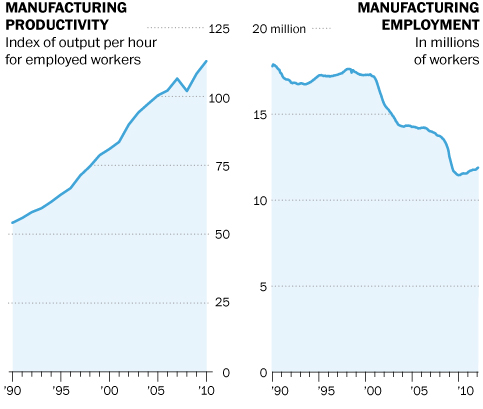
The state of US manufacturing in one easy chart...The Blue Collar Blues just keep getting bluer...
The state of US manufacturing in one easy chart...Productivity (output per labor hour) soaring but employment in that sector falling dramatically. However, it appears to have bottomed out (right side of chart). The use of technology in the workplace has eliminated a lot of these jobs. Many of the jobs are performed by skilled workers with advanced education. The traditional blue collar "works down at the plant" job is rapidly disappearing. Another source of inequality.
 |
| Source: The Big Picture |
Subscribe to:
Posts (Atom)
 View My Stats