For my US readers---to get an estimate in gallons take the number of liters and divide it by "4" (1 liter = 0.264 gallons, so there are approx 4 liters to a gallon) (HT: Big Picture Agriculture)
Cereal, 1 cup = 130 liters (example: 130L divided by 4 = 32.5 gallons)
Orange Juice, 1 cup =170 L
Coffee, 1 cup = 140 L
Cheese, 1 portion = 250 L
Rice, 100 g = 140 L
Milk, 1 glass = 200 L
Tea, 1 cup = 35 L
Sugar, 1 piece = 10.5 L
Lettuce, 1 kg = 130 L
Apple/Pear, 1, 70= L
Chicken meat, 150 g = 615 L
Pork meat, 150 g, 690 L
Egg, 1, 135 L
Banana, 1, 70 L
Olives, 100 g = 250 L
Oats, 100g = 237 L
Onions, 100g = 17 L
Soybeans, 100g, = 275 L
Pineapple, 100g = 42 L
Chocolate, 100g = 2,400 L
Cucumber, 100 g = 24 L
Source HERE
Saturday, March 24, 2012
Nice Graphic on the Top 10 Tax Deductions individuals can take. I am STILL bothered by one I benefit from but find least justifiable...
Here is a chart showing the Top 10 tax deductions/tax credits individuals are eligible to take how much they "cost" the government in terms of foregone tax revenue. This chart comes for a VERY easy to read report (HERE) from the Congressional Research Council. If you want to learn more about this important issue I encourage you to look at it.
Of all these deductions/credits the one I find LEAST justifiable (it is relative and I understand if there is disagreement) is the Mortgage Interest Deduction. I have written about this before HERE. I say this even though I am a beneficiary of this break.
I am allowed to reduce the amount of income tax I pay by deducting from my taxable income the amount of interest (in a year) I pay on the loan I recieved to buy my house. I do understand the benefits and costs of this deduction. I just don't see the compellling reason for it. Someone, please educate me on an objective basis, not a personal one.
Of all these deductions/credits the one I find LEAST justifiable (it is relative and I understand if there is disagreement) is the Mortgage Interest Deduction. I have written about this before HERE. I say this even though I am a beneficiary of this break.
I am allowed to reduce the amount of income tax I pay by deducting from my taxable income the amount of interest (in a year) I pay on the loan I recieved to buy my house. I do understand the benefits and costs of this deduction. I just don't see the compellling reason for it. Someone, please educate me on an objective basis, not a personal one.
 |
| Source: Wall Street Journal |
Friday, March 23, 2012
Wednesday, March 21, 2012
Attention Steve Patty and Will Johnson: Nice graphic showing the amount and cost of food we throw away every year..
With Food Prices High, There's Guilt About Waste But Dread of the Reheated Dinner
The average U.S. family of four spends from $500 to $2,000 a year on food they never eat, according to researchers' estimates.
Food is the second-largest component in the U.S. solid waste stream, after paper and paperboard. Once paper and paperboard are removed for recycling, food ends up as the largest component in U.S. landfills and incinerators, weighing in at 33 million tons in 2010, according to the Environmental Protection Agency.
 |
| Source: Wall Street Journal |
China is poised to be the largest new car market for years to come. Let's have trade peace and not a trade war...
China WILL be a major destination for new cars in the coming years/decades. Smart companies (and forward thinking students) will be laying the groundwork for exploiting this huge market.
From the Financial Times:
Carmakers: it’s all about China
""Three bits of proof on Wednesday, if more were needed, that for most carmakers China is crucial to survival – let alone success.
First, Jaguar Land Rover announced a joint venture with Chinese manufacturer Chery. Then BMW and Volkswagen took hits to their share prices on negative comments about their China sales. And finally, Skoda (a VW unit) announced a boost in profits, driven by Russia and India – and China.
The JLR tie-up with Chery is good news for Indian parent Tata Motors. According to the FT’s John Reed, the UK brands sold 42,000 cars in China in 2011, a 60 per cent rise on 2010 and equivalent to 17 per cent of the group’s global sales, up from just 1 per cent in 2005.
The joint venture allows the company to make cars in China – most JLR cars are made in the UK and Land Rover 4x4s are proving very popular with Chinese customers.
Skoda’s sales in China show a similar pattern. They increased by 21.9 per cent last year from 2010. China now represents over a quarter of Skoda’s sales with 220,000 units, nearly 100,000 more than Germany, its next biggest market.
Skoda, which is the Czech unit of Volkswagen, also saw high growth in Russia and India – 62.5 and 49.9 per cent, respectively, but this from a much lower starting point than in China. Overall, the company saw a 66 per cent rise in operating profit last year.
And yet it was a bad news day for Volkswagen. The company and BMW were the biggest fallers on the FTSE Eurofirst 300 after worries that their sales in China would struggle to meet forecasts – news that knocked the entire automotive sector.
From the FT:
The rise in China’s auto industry tells the story. Gomes points out that in 2000, China produced 2m cars. In 2011, that figure had risen to around 19m.
For carmakers, China simply can’t be ignored.""
From the Financial Times:
Carmakers: it’s all about China
""Three bits of proof on Wednesday, if more were needed, that for most carmakers China is crucial to survival – let alone success.
First, Jaguar Land Rover announced a joint venture with Chinese manufacturer Chery. Then BMW and Volkswagen took hits to their share prices on negative comments about their China sales. And finally, Skoda (a VW unit) announced a boost in profits, driven by Russia and India – and China.
The JLR tie-up with Chery is good news for Indian parent Tata Motors. According to the FT’s John Reed, the UK brands sold 42,000 cars in China in 2011, a 60 per cent rise on 2010 and equivalent to 17 per cent of the group’s global sales, up from just 1 per cent in 2005.
The joint venture allows the company to make cars in China – most JLR cars are made in the UK and Land Rover 4x4s are proving very popular with Chinese customers.
Skoda’s sales in China show a similar pattern. They increased by 21.9 per cent last year from 2010. China now represents over a quarter of Skoda’s sales with 220,000 units, nearly 100,000 more than Germany, its next biggest market.
Skoda, which is the Czech unit of Volkswagen, also saw high growth in Russia and India – 62.5 and 49.9 per cent, respectively, but this from a much lower starting point than in China. Overall, the company saw a 66 per cent rise in operating profit last year.
And yet it was a bad news day for Volkswagen. The company and BMW were the biggest fallers on the FTSE Eurofirst 300 after worries that their sales in China would struggle to meet forecasts – news that knocked the entire automotive sector.
From the FT:
The German carmakers sank after an official from the China Association of Automobile Manufacturers admitted that sales growth in China might fail to reach forecasts. Volkswagen closed the session down 4.4 per cent at €133.05, while BMW shed 5 per cent to €68.22.Carlos Gomes, auto analyst at ScotiaBank, told beyondbrics that even with a slowdown, China would remain the driver of growth in the market for the next decade. “In China, there are around 58 vehicles per 1,000 people. In the G7, the average is around 600. There is still a huge rise in incomes occuring where people can now afford their first car.”
The rise in China’s auto industry tells the story. Gomes points out that in 2000, China produced 2m cars. In 2011, that figure had risen to around 19m.
For carmakers, China simply can’t be ignored.""
Are gas prices on their way DOWN? I guess there IS a world leader who can control the price, but not the one you think...
Saudi Arabia moves to calm oil market (HT: Moneybox)
''Saudi Arabia is taking steps to calm the oil market, boosting exports, filling up strategic oil stocks overseas and tapping oilfields to expand production capacity.
The moves by the world’s largest oil producer would be welcomed by the White House as it battles the negative impact of rapidly rising fuel prices. They come as oil prices surge above $125 a barrel, the highest since the crisis of 2008, and set record highs in a number of currencies, including the euro and sterling.
The Saudi measures include a sharp boost in exports to the US for April and May. Vela, the shipping arm of the state-owned Saudi Aramco, has hired the largest number of supertankers in years to move oil from the Gulf to the US.
Omar Nokta, of Dalham Rose & Co, a specialist investment bank in the energy sector, said that so far this month Vela had hired 11 very large crude oil carriers, each capable of shipping 2m barrels, to deliver oil to US-based refiners.''
“In 2011, Vela fixed one VLCC to the US every other month,” he said in a note to clients. “This is the first time in several years for Vela to hit the market with such volume – and in such a short timeframe,” he added.
Tuesday, March 20, 2012
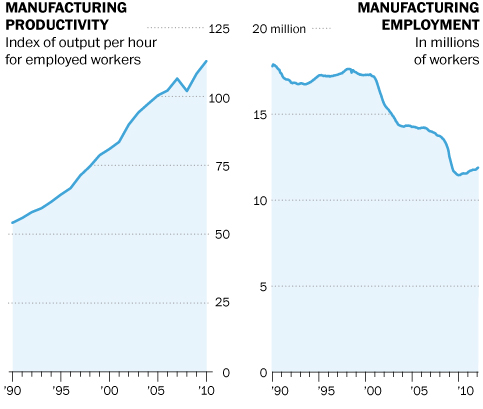
The state of US manufacturing in one easy chart...The Blue Collar Blues just keep getting bluer...
The state of US manufacturing in one easy chart...Productivity (output per labor hour) soaring but employment in that sector falling dramatically. However, it appears to have bottomed out (right side of chart). The use of technology in the workplace has eliminated a lot of these jobs. Many of the jobs are performed by skilled workers with advanced education. The traditional blue collar "works down at the plant" job is rapidly disappearing. Another source of inequality.
 |
| Source: The Big Picture |
Nice graphic showing the Growth of Foreign Ownership of US National Debt...Is this a bad thing?
I lost track of the source for this graphic....It shows the size of the "Public" portion of our national debt in the past 40 years. The other portion is "Private" debt---money borrowed from other US government trust funds (i.e. Social Security, Medicare, etc) and the Federal Reserve.
Public debt is money owed to US citizens, corporations, state/local govts, foreigners, foreign Central banks, and foreign governments.
Foreign holdings of the debt is approaching 50% and roughly half of that is owed to one country, China. Problem?

Sunday, March 18, 2012
Gasoline is consumed locally but priced globally...Nice graph showing the price of gas over time between the US, Britain and France...Very informative!
Gasoline prices tend to move in tandem with each other regardless of the nationality of the gas (yes, that is meant to be funny).
The graph below shows a pretty tight relationship at the retail level. The gap between the lines for Britain/France and the US is the difference in taxes assessed. Factor those out and they pretty much run together over time.
The lesson: Gasoline is consumed locally but priced globally (Hey, I think I just made that up--not bad...)
Note: Yes, I know you can find gasoline in many places MUCH cheaper, but that is because of heavy government subsidies which distort the price at the pump.
The graph below shows a pretty tight relationship at the retail level. The gap between the lines for Britain/France and the US is the difference in taxes assessed. Factor those out and they pretty much run together over time.
The lesson: Gasoline is consumed locally but priced globally (Hey, I think I just made that up--not bad...)
 |
| Source: NYTIMES |
Saturday, March 17, 2012
Here is a list of the Top 10 Corporations that have LARGE cash holdings just "sitting around". Guess numbers 1 thru 4 before looking...
According to The Financial Times, these are the Top 10 corporations with the largest "cash"holdings (either cash or investments that are very liquid and easily converted to cash). Six of the 10 are high tech-type companies (Surprised by that?). Not sure how ANY of these 6 (or the 2 pharmas) could spend that money on operations and create jobs for the mass of unemployed or underemployed. Any ideas?
 |
| Financial Times |
Two nice graphs showing world-wide production of crude oil and the demand for crude oil. Helpful if you WANT to understand more about gasoline prices.
Here is a big piece of the gas price puzzle. This graph shows the annual production of Crude Oil since 2001. Seems to have leveled out since 2005 on the supply-side of the equation. ("mbpd" stands for "Millions of Barrels Per Day")
However, the demand for oil has not been constant since 2005. The graph below shows the change in demand for barrels of oil per day over time. The if you add the total from the blue line (at "Dec") and the total from the red line (at "Dec") you get world wide demand. You can see it meets and exceeds production from the previous graph. Note: the difference between the two points represents demand from developing countries like China, Brazil, India, Russia, and various other rapidly developing areas.
The developed world demand is falling and and the developing world is picking up the slack.
Why is this so hard for people to understand when it comes to gasoline prices?
 |
| Source: Gregor.us |
However, the demand for oil has not been constant since 2005. The graph below shows the change in demand for barrels of oil per day over time. The if you add the total from the blue line (at "Dec") and the total from the red line (at "Dec") you get world wide demand. You can see it meets and exceeds production from the previous graph. Note: the difference between the two points represents demand from developing countries like China, Brazil, India, Russia, and various other rapidly developing areas.
 |
| Source: Business Insider |
Why is this so hard for people to understand when it comes to gasoline prices?
Thursday, March 15, 2012
Robots and Bedpans---the hospital of the future is here now. More low-skilled jobs are about to be eliminated by technology.

The Robots Are Coming to Hospitals: A New Breed of Blue-Collar Robots is Handling the Dirty Work, Transporting Linens and Laundry
""Robots have already staked out a place in the health-care world—from surgical droids that can suture a wound better than the human hand to "nanobots" that can swim in the bloodstream.
But the stage is now set for a different kind of robots, one with a sophisticated brain and an unlimited tolerance for menial tasks.
In the next few years, thousands of "service robots" are expected to enter the health-care sector—picture R2D2 from "Star Wars" carrying a tray of medications or a load of laundry down hospital corridors.
Fewer than 1,000 of these blue-collar robots currently roam about hospitals, but those numbers are expected to grow quickly.
As America's elderly population grows, the country's health-care system is facing cost pressures and a shortage of doctors and nurses. Many administrators are hoping to foist some of the less glamorous work onto robots.
This could create a potential bonanza for software and application developers to write new programs for them, investors and industry watchers say...."" Rest of the story HERE
Wednesday, March 14, 2012
So THIS is how drug dealers "launder" their profits--- Tide laundry detergent is fast becoming a currency in the drug trade. Clever...

It’s a dirty job: Police nationwide take on soaring Tide detergent theft
""Law enforcement officials across the country are puzzled over a crime wave targeting an unlikely item: Tide laundry detergent.
Theft of Tide detergent has become so rampant that authorities from New York to Oregon are keeping tabs on the soap spree, and some cities are setting up special task forces to stop it. And retailers like CVS are taking special security precautions to lock down the liquid.
One Tide taker in West St. Paul, Minn., made off with $25,000 in the product over 15 months before he was busted last year.
“That was unique that he stole so much soap,” said West St. Paul Police Chief Bud Shaver. “The name brand is [all] Tide. Amazing, huh?”
Tide has become a form of currency on the streets. The retail price is steadily high — roughly $10 to $20 a bottle — and it’s a staple in households across socioeconomic classes.
Tide can go for $5 to $10 a bottle on the black market, authorities say. Enterprising laundry soap peddlers even resell bottles to stores.
“There’s no serial numbers and it’s impossible to track,” said Detective Larry Patterson of the Somerset, Ky., Police Department, where authorities have seen a huge spike in Tide theft. “It’s the item to steal.”
Why Tide and not, say, Wisk or All? Police say it’s simply because the Procter & Gamble detergent is the most popular and, with its Day-Glo orange logo, most recognizable of brands.
George Cohen, spokesman for Philadelphia-based Checkpoint Systems, which produces alarms being tested on Tide in CVS stores, said: “Name brands are easier to resell.
“In organized retail crimes they would love to steal the iPad. It’s very easy to sell. Harder to sell the unknown Korean brand."
Most thieves load carts with dozens of bottles, then dash out the door. Many have getaway cars waiting outside.
“These are criminals coming into the store to steal thousands of dollars of merchandise,” said Detective Harrison Sprague of the Prince George’s County, Md., Police Department, where Tide is known as “liquid gold” among officers.
He and other law enforcement officials across the country say Tide theft is connected to the drug trade. In fact, a recent drug sting turned up more Tide that cocaine.
“We sent in an informant to buy drugs. The dealer said, ‘I don’t have drugs, but I could sell you 15 bottles of Tide,’ ” Sprague told The Daily. “Upstairs in the drug dealer’s bedroom was about 14 bottles of Tide laundry soap. We think [users] are trading it for drugs.”
Police in Gresham, Ore., said most Tide theft is perpetrated by “users feeding their habit.”
“They’ll do it right in front of a cop car — buying heroin or methamphetamine with Tide,” said Detective Rick Blake of the Gresham Police Department. “We would see people walking down the road with six, seven bottles of Tide. They were so blatant about it.”
Robyn Cafasso, chief deputy district attorney in Colorado Springs, Colo., said the problem is nothing more than “organized shoplifting” and can be stopped. One method is to toughen punishments for recidivists.
“There’s this old-school thought that this is a shoplift, so it goes into the municipal system,” Cafasso said. “We’re starting to actually get more habitual offenders out of the municipal system and refile charges to make it a more serious offense.”
Cafasso agreed that there’s been a major upswing in Tide theft. “Everybody knows that liquid detergent Tide is an expensive item,” she said.
The pharmacy chain CVS is locking down Tide and other laundry detergents in certain parts of the country alongside flu medication and other commonly stolen items. Joe LaRocca, of the National Retail Federation, said: “It’s a game of cat and mouse. There’s a real balance that takes place between customer service — the product available on the shelf — and securing the merchandise.”
Officials at Tide are trying to keep their hands clean.
“We don’t have any insight as to why the phenomenon is happening, but it is certainly unfortunate,” said Sarah Pasquinucci, a spokeswoman for Procter & Gamble.""
Monday, March 12, 2012
More evidence that we need to see China as an opportunity rather than a problem...
I wish we could be more forward thinking when it comes to China andtheir economy. Businesses are starting to reap the benefit of growing incomes there. We cannot afford to not pay attention to 1.3 billion potential customers. The protectionism is a losing proposition. We can see China as a problem or an opportunity. Even I know which is a better path.
I encourage you to read the full article. If you are looking for a career with growth, connect with an international firm that wants to do business and not politics...
U.S. exports to China boom, despite trade tensions
I encourage you to read the full article. If you are looking for a career with growth, connect with an international firm that wants to do business and not politics...
U.S. exports to China boom, despite trade tensions
'""While the U.S. trade deficit with China continues to soar, a surge in U.S. exports is emerging as a bright spot in the often-troubled trade ties between the world’s largest economy and its largest foreign creditor.
With a richer China showing a growing appetite for U.S. products, the flow of goods includes an increasing volume of American soybeans, cars, airplanes and medicine — and even garbage that can be mined for copper and aluminum. Overall, U.S. exports to China are up nearly 50 percent in value since 2008.
The surge is happening without much change in Chinese government policies and without much specific help from the Obama administration, which has a stated goal of doubling all U.S. exports globally by 2014. Instead, experts say, the main reason for the increase has been a booming China, where wealthier tastes include an increased appetite for meat — and hence for soybeans used as livestock feed....""
Sunday, March 11, 2012
"Cooking Oil Rustlers"---I wonder how that plays out in the prison population. Nice article on substitutes and how markets respond to price signals
When the price of one good increases it can increase the demand for a viable, substitute good. In economics we call these goods, well, substitutes. Easy enough.
It also helps to explain the "Substitute Effect" regarding the downward sloping nature of a demand curve: In the case mentioned below, Crude Oil relative to Cooking Oil: ""Higher Price: An increase in price (of Oil) causes a decrease in the relative prices of substitute goods (Cookiing Oil). Buyers are inclined to buy more of the other substitute goods (Cooking Oil) and less of this good (Oil). The result is a decrease in the quantity demanded (of Crude Oil)"" (Amosweb).
In other words, an increase in the price of oil we move upward and to the left on the oil demand curve--movement ALONG the Demand Curve. Cooking oil becomes relatively cheaper compared to oil, so the quantity demanded for cooking oil at a given price increases compared to before the increase in the price of crude oil. Hence, the demand curve for cooking oil shifts to the right, indicating an increase in Demand for Cooking Oil. Got it??
Rising gas prices create smoking-hot demand for cooking oil
It also helps to explain the "Substitute Effect" regarding the downward sloping nature of a demand curve: In the case mentioned below, Crude Oil relative to Cooking Oil: ""Higher Price: An increase in price (of Oil) causes a decrease in the relative prices of substitute goods (Cookiing Oil). Buyers are inclined to buy more of the other substitute goods (Cooking Oil) and less of this good (Oil). The result is a decrease in the quantity demanded (of Crude Oil)"" (Amosweb).
In other words, an increase in the price of oil we move upward and to the left on the oil demand curve--movement ALONG the Demand Curve. Cooking oil becomes relatively cheaper compared to oil, so the quantity demanded for cooking oil at a given price increases compared to before the increase in the price of crude oil. Hence, the demand curve for cooking oil shifts to the right, indicating an increase in Demand for Cooking Oil. Got it??
Rising gas prices create smoking-hot demand for cooking oil
""From California to Maine, thefts of used cooking oil are on the rise — driven by the rising price of oil that makes biofuels more cost competitive with fossil fuels. Like thieves who ransack foreclosed homes for copper wire, higher prices for used cooking oil can attract people with a hunger for crime as well as dinner.
The old cooking oil, which has been used for decades in the chemical and animal feed industries, is now a hot commodity, as biodiesel manufacturers fight for raw materials . Biodiesel is gaining in popularity as a transportation fuel. The largest consumers are fleet operators, including municipal buses and courier firms like FedEx.""
Subscribe to:
Posts (Atom)
 View My Stats