Wednesday, June 1, 2011

DFW and Houston lead the nation is job growth...WHY is that? See how far above the national average we are...

Star-Telegram

Dallas-Fort Worth again leads nation in job growth

Dallas-Fort Worth and Houston continue to lead the nation's largest metro areas in new jobs and the rate of job growth compared with a year earlier, the Bureau of Labor Statistics said Tuesday.

Total nonfarm employment in the 12-county North Texas area stood at 2,929,700 in April, up 83,100 over April 2010, said the bureau's regional commissioner, Stanley Suchman.

Job growth was up 2.9 percent, compared with 1.1 percent for the U.S.

D-FW and Houston also led the nation's largest metro areas in both categories in March.

North Texas has long been a leader in both job and population growth, and the trend has continued even in the economic downturn. That has helped keep unemployment below national and state averages.

In April, the Fort Worth-Arlington jobless rate dropped to 7.6 percent from 8 percent in March and also a year ago. U.S. unemployment stands at 9 percent.

Employment grew faster in Dallas-Plano-Irving in April, rising 62,900 jobs, or 3.1 percent. Fort Worth-Arlington added 20,200 jobs, up 2.4 percent.

Professional and business services, which were particularly strong in Dallas-Plano-Irving, added 24,700 jobs, up 5.9 percent. That was nearly double the U.S. increase of 3.2 percent.

Education and health services, including private but not public schools, added 19,600 jobs. Fort Worth-Arlington added 6.4 percent more positions in that category, and Dallas-Plano-Irving added 5.2 percent. The U.S. gain was 2.2 percent.

Trade, transportation and utilities in North Texas added 12,600 jobs, up 2.2 percent, compared with 1.2 percent for the U.S. Mining, logging and construction added 10,300 jobs, up 6.6 percent.

Financial activities added 9,600 jobs, up 4.2 percent, compared with a 0.4 percent loss nationally; leisure and hospitality, 7,500, up 2.7 percent, compared with 1.8 percent for the U.S.; and government, 4,000, up 1 percent, compared with a 1.7 percent U.S. drop. Government includes public schools.

Information lost 5,400 jobs, down 6.8 percent, compared with a U.S. loss of 1.2 percent. Fort Worth-Arlington was down 10.8 percent, and Dallas-Plano-Irving, 5.9 percent

A short and easy to understand video explaining the National Debt..

A very short video explaning the national debt. It is very simple and could serve as an introduction to learning about the national debt. (From the Washington Post)

Tuesday, May 31, 2011

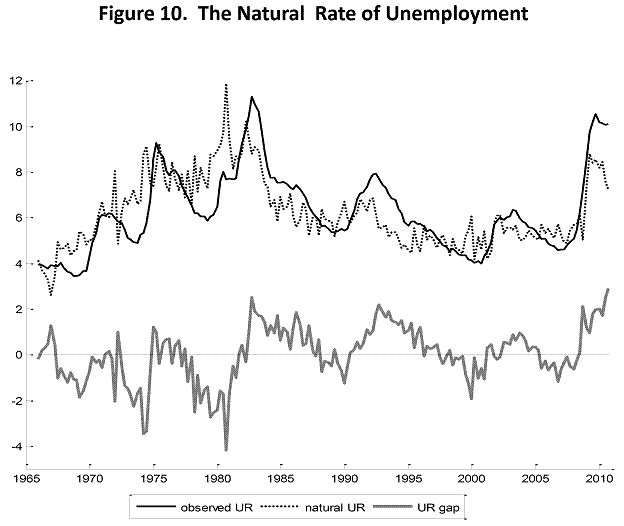
Nice graph showing the difference between the Actual Unemployment Rate and the Natural Rate of Unemployment---Don't fall asleep! This IS important!!!

Here is a graph showing the Actual Unemployment Rate and the Natural Rate of Unemployment (NRU). They are the two upper lines, and the NRU is the dotted line.  The difference between the NRU and the Actual Unemployment Rate is the amount of Cyclical Unemployment present in the economy (the lowest line on the graph).  Cyclical unemployment occurs when there is a down turn in the business cycle and we experience a recession. Businesses are selling/producing fewer goods/services so they need fewer people to sell/produce goods/services.  This creates a downward spiral in the economy as the ring of layoffs/ business closures expands. 

The spread between the actual unemployment rate and the NRU is as large as it has been since the recession of 1982-83.  Too many people sitting idle and work skills eroding.  Gotta get this economy moving again.      
Source: Econbrower


Monday, May 30, 2011

We had a BRIC thrown through our economic window. We need to learn more about BRIC's...

"BRIC" (Brazil, Russia, India, China) is a term that has been used for a few years to refer to this particular block of countries, but I don't think most people know exactly what it refers to.  It is an informal term applied to these 4 rapidly developing nations. Collectively their economies are undergoing vast structural changes that for the most part are lifting their populations out of extreme poverty.  It is a good thing that so many people are moving above subsistence existence and beyond.  Is that not what we in the developed ("rich") world have wanted for 50+years?

The problem this creates in the short term is a tremendous increase in demand for all sorts of resources, primarily energy and food. As the poor gain more purchasing power they want better (and more) food of all types. They want to own a vehicle. They want to plug into the power grid as they gain access to the multitude of gadgets we seem to be able to not get along without. 

Below is a brief description/profile of the BRIC countries.  Go HERE for more in depth info.

Who are the BRICS?

The BRICS countries, five nations grouped together because of their burgeoning economies, are in the spotlight this week as their leaders meet in China. Made up of Brazil, Russia, India, China and, as of this week, South Africa, the BRICS countries are grouped together because while they are not yet economic powerhouses, they have the potential to become the world’s most dominant economies in the next few decades.

Brazil

Although not as talked about as India and China, there’s been no shortage of interest in Brazil’s $2.1 trillion economy. Although it exhibited slightly negative growth in 2009 (still far better than many other economies, whose negative growth was much greater), Brazil’s economy bounced back forcefully in 2010, showing 7.5 percent economic growth. It is the eighth-largest economy in the world, and economists project it will reach the No. 5 spot in the next few years. Years of growth have brought a majority of Brazilians into the middle class.

Brazil’s industrial and agricultural sectors drive much of that growth. Agriculture and agribusiness make up about 25 percent of the country’s gross domestic product and 36 percent of Brazilian exports, while the industrial sector – auto manufacturing, textiles, and machinery, to name a few – drives about a third of the country’s GDP. A privatization campaign and favorable trade policies have made Brazil a huge beneficiary of foreign investment.

Russia

Russia’s transition in the 1990s from a centrally planned economy to a free market was not smooth. Inadequate fiscal reforms and borrowing led to a financial crisis in 1998 that wiped out much of the foreign investment it gained. The situation was exacerbated by dropping prices for its major exports (oil and minerals) and spillover from the Asian financial crisis.

The country bounced back quickly, registering about 7 percent growth for the next several years – until the global financial crisis, which hit Russia hard once again and prompted a stock market collapse. In 2009, economic growth was a whopping negative 7.9 percent. Today, a rapid turnaround has brought growth back up to 3.8 percent in 2010.

Russia’s economy, the world’s tenth largest, is driven by oil and natural gas exports, as well as timber, furs, minerals, and metals.

India

The second most populous country in the world is another one of the world’s emerging economic powerhouses. India is the 12th-largest economy, with a gross domestic product of $1.21 trillion and a growth rate of 6.5 percent in 2009. However, this growth has not been evenly distributed – 700 million Indians live on $2 or less a day and the middle class, while growing, is still only 50 million of its 1.17 billion people. The middle class is expected to expand ten-fold by 2025.

India’s attempts at economic reforms – tariff reductions, financial modernization, and stronger intellectual property rights, to name a few – have been sporadic. Corruption is still a big problem, as are excessive bureaucracy, investment controls, and economic policies that undermine efforts at economic liberalization.

The services industry accounts for 54 percent of GDP, while industry makes up 29 percent and agriculture 18 percent. Outsourcing to India has become common practice in the US. The software sector in particular is booming, generating $35 billion in exports in 2009. The US is India’s largest investment partner.

China

The world’s most populous country recently surpassed Japan as the second-largest economy. Only the US (China’s top trading partner) still comes out ahead of China’s gross domestic product, which totaled $4.814 trillion in 2009 and grew at a rate of 8.7 percent.

China’s economic reforms over the past two decades led to the world’s most drastic reduction in poverty and a corresponding income increase. However, regulation has often not been able to keep pace with the country’s economic growth, leading businesses to cut corners in ways that endanger consumer safety.

Agriculture contributes 11 percent of China’s GDP and industry makes up 48.6 percent in areas such as mining and ore processing, coal, machinery, textiles, and petroleum. Despite its growth, the state-owned sector still makes up about 40 percent of GDP.

A nice side-by-side graphic showing world-wide demand for oil in the last 10 years. Guess which way the demand is tilting...

The graphic below illustrates visually how the demand for oil has increased in the last 10 years and where the demand has shifted geographically--the tilt is towards Asia/Southwest Asia (graph on left is year 2000 and one of the right is year 2009.  Go HERE to see the interactive and change the variables.  The red circles indicates the country is a net importer of oil and the green circles a net exporter of oil. The RED arrow points to China, the PURPLE to India, the BLUE to South Korea (just behind Japan) and the GREEN to Australia.  Quite dramatic, is is not?


Source: DATA DRIVEN (HT:PAUL KEDROSKY)
 

Saturday, May 28, 2011

My back of the envelope analysis of why it makes Sense AND Cents to take AP classes and the AP tests seriously. By my count it is costing you AT THE MINIMUM $25,000 by not doing so! YES, that number is right...See my calculations...

How much is NOT taking AP classes and AP Tests costing you in REAL dollars? The calculation below will give you an idea of how much it costs you to forgo the rigor of Advanced Placement classes.  It is difficult to account for all costs, explicit or implicit.  I believe the bottom line number I arrive at is a LOW figure because of the particular number I use for tuition, room and board.  Read it and let me know of any other "opportunity costs" I have left out that will either INCREASE the difference or DECREASE it.  I am open to revision of these numbers...

Here is my step by step analysis of why you SHOULD take AP classes and the AP test in those subjects:

Skip AP classes in High School---Go directly to college

1. Go to college and take 5 classes, which equals 15 credit hours towards a degree.

2. Estimated  cost of attending a Public University in Texas  $8,000 (room, board, tuition, books,etc) to take 15 credit hours. This is an UNDER ESTIMATION!

3. To put this in perspective, if you had a job earning $8.00 per hour (net after taxes) you would have to work 1,000 hours to earn the money to pay a semesters tuition.  This is probably an OVER ESTIMATION or your net hourly wage.

4. 1000 hours/40 per week = 25 weeks of work (almost 6 months) to earn the money to attend college for 1 semester!!

5.  This assumes ALL your earnings went to pay for college and nothing else.

6. If you have to pay living expenses out of your paycheck, you may have to take out a loan, so add that to the cost of a semester. For simplicity, we will leave that out of the equation.

7. Your total cost for a semester of college for our purposes is $8,000,  and most likely more.

Now assume you took AP classes in High School.

1. Take 5 AP classes in High School. Take 5 AP tests and get a score that your college will take for credit

2. Each AP test costs $56

3. Total cost for AP tests $280.00

4. Assume you study an extra 10 hours a week for AP classes relative to non-AP classes.  We have 36 weeks of school  X  10  hours per week = 360 hours of extra study time

5. Assume we account for the money you “lost” by not working and studying instead---$8.00/hr X 360 = $2,800 (your opportunity cost of not working)

Lets total up what we have so far.

Your total cost of a semester of college WITHOUT AP tests= $8,000

WITH AP tests =$3,080 ($280 AP tests + $2,800 forgone wages)

The difference/savings =$4,920 WITH AP CREDIT

ALSO—you took care of a semester of college while still in high school (where you have to be ANYWAY). You can finish college a semester earlier than normal. You can get a full time job after getting your degree. Assume you get a job paying $40,000 per year (depending on your degree, add some (or a lot) or subtract some. That extra semester in college is costing you about $20,000 in income!! You have to add that into the above calculations.

Lost income by attending an extra semester of college = $20,000

The Total Cost of NOT getting 15 hours (1 Semester) of AP credit = $24,920

ANY QUESTIONS???

A couple of informative graphics on Oil Production and the revival of the Texas oil boom years...WTF! (With The Fracking)...What did you think I meant?

According to the graphic below, countries that are classified as democratic (relatively "free") produce about 16% (US 9%, Canada 4%, Norway 3%) of the world's output of crude oil. Collectively, countries deemed less democratic produce about 54% (rough estimate just eye-balling the graph).


Source: Bloomberg (HT: Carpe Diem)
 Here is a chart showing the country of origin for US imports of crude oil. Several of the same names appear on both illustrations. 

Source: EIA
 I do find it interesting that China is a big producer of oil in the marketplace BUT the US imports virtually no oil from them (only about 2,000 barrels a month according to the IEA).

According to the NYTIMES , in short order, the US could increase  production by 25%, moving the US from 9% to approx 11.25% of world production.
"The Texas field, known as the Eagle Ford, is just one of about 20 new onshore oil fields that advocates say could collectively increase the nation’s oil output by 25 percent within a decade — without the dangers of drilling in the deep waters of the Gulf of Mexico or the delicate coastal areas off Alaska. More than a dozen companies plan to drill up to 3,000 wells there in the next 12 months."
However, this would require "drill baby drill" and all the negatives that brings with it..

""There is only one catch: the oil from the Eagle Ford and similar fields of tightly packed rock can be extracted only by using hydraulic fracturing, a method that uses a high-pressure mix of water, sand and hazardous chemicals to blast through the rocks to release the oil inside.


The technique, also called fracking, has been widely used in the last decade to unlock vast new fields of natural gas, but drillers only recently figured out how to release large quantities of oil, which flows less easily through rock than gas. As evidence mounts that fracking poses risks to water supplies, the federal government and regulators in various states are considering tighter regulations on it.""
That is the bad news.  The good news is that it could bring prosperity to local and state governments...
"...The companies estimate that the boom will create more than two million new jobs, directly or indirectly, and bring tens of billions of dollars to the states where the fields are located, which include traditional oil sites like Texas and Oklahoma, industrial stalwarts like Ohio and Michigan and even farm states like Kansas..."
Opportunity Costs abound! What do states with declining revenues and high unemployment do?  How do local communities balance the need for more local revenue AND retain/maintain their quality of life? 

Bottomline: WE GOTTA GET OFF THIS CRUDE OIL STUFF!


HT: Carpe Diem---How could I live without this blogger!! :)

Sunday, May 22, 2011

Netflix customers collectively consume 30% of US bandwidth. Shouldn't they pay MUCH more for video stream?? See chart here...

I am very ignorant of how the "guts" of information technology works. Sort of like my car--I don't know HOW it works, I just want to turn the key and go.  Is the supply of bandwidth equal to the demand for it? Is supply greater than demand or can the supply be expanded with little extra cost? If I am not mistaken, this is one of the issues with net neutrality.  Can someone give me a middle-school intelligence level explanation of why I should not pay more for my Netflix subscription than I do...   
Source: Business Insider


""Netflix's streaming service is so popular that it's now consuming 30% of peak downstream internet bandwidth in North America, according to data from Sandvine, a broadband equipment company, via TechCrunch.""

Saturday, May 21, 2011

While the giant slept the world moved on to eradicate poverty...We just don't get what is happening in the rest of the world.


Source: CSM
  The world is changing rapidly and is becoming less dependent on the success of the US.  We are still very relevant but, in my opinion, the economic success of the rest/most of the world is eroding our status .  And, I fear, we are letting them.  1.4 Billion  Chinese, 1.3 Billion Indians, 190 million  Brazilians, AND the continent of Africa are rapidly developing middle-classes. These middle-classes are not to be confused with the US middle-class, which in dollar terms is way ahead of the aforementioned countries.  BUT the purchasing power of 100's of millions of people is increasing at an increasing rate.  Rising incomes around the world should not be seen as a problem for us, but an opportunity.  Instead of complaining about the "fairness" of trade with the rest of the world, I would prefer we as a nation welcome them out of poverty and ask if there is anything we can sell them (YES! We do make stuff!) that they would FREELY like to buy from us...THAT is what a competitive country does. 

Surging BRIC middle classes are eclipsing global poverty

The world will, for the first time in history, move from being mostly poor to mostly middle-class by 2022, the Organization for Economic Cooperation and Development projects. Asians, by some predictions, could constitute as much as two-thirds of the global middle class, shifting the balance of economic power from West to East. Already, some analyses of International Monetary Fund data suggest that the size of the Chinese economy could eclipse that of the United States in just five years.


By 2030, the global middle class is widely projected to at least double in size to as many as 5 billion – a surge unseen since the Industrial Revolution. This boom, however, is more global, more rapid, and is likely to have a far different – and perhaps far greater – impact in terms of global power, economics, and environment, say economists and sociologists.

But today's middle-class boom is unlike the Industrial Revolution, in which rising prosperity became a catalyst for increased individual and political freedom. Those in the emerging global middle classes – from an Indian acquiring a flush toilet at home to a Brazilian who can now afford private school to a Chinese lawyer with a new car in the driveway – are likely to redefine their traditional roles, and in doing so, redefine the world itself. 
 "I would expect that as the global middle class gets transformed by the entrance of hundreds of millions of Indian, Brazilian, and Chinese families, the concept of what we see as the middle-class values may change," says Sonalde Desai, a sociologist with the National Council of Applied Economic Research in Delhi (NCAER). "Historically, sociologists have defined 'middle class' as those with salaries…. I think 'middle class' is very much a state of mind."

Friday, May 20, 2011

What are the regrets that the latest college graduates have about their education? This may be of interest to those of you in college or about to start...

This is from a recent survey of college graduates. All of these graduates would have started college before the latest recession.  Interesting how the largest portion would have chosen different majors.  I am assuming this is mainly because of the difficulty in finding employment in the current economic climate.  Perhaps those of you on the journey now can take heed in this surveys findings....

Source: Economix


Train runs through a market!! Not what you expect. The people are ready for it...Amazing video.


HT: Carpe Diem

Thursday, May 19, 2011

Electric Vehicles are NOT the answer to energy independence...Why does this have to be so hard???

Resources are not unlimited---this forms the foundation for the definition of economics.  Essential natural resources ("Rare Earth Minerals") used in the manufacture of electric cars come primarily from mines in China. The more electric vehicles we produce the more dependent we become on China for a critical element.  We move to these vehicles to escape dependency from one commodity (oil) and find ourselves captive to another...How come things cannot be easy...

The Rare-Earth Crisis
"...One argument I’ve heard is “national security,” the idea being that electric vehicles would make the United States less dependent on imported oil. Be careful what you wish for, however, because if electric cars become a mainstay, we may be trading one dependence for another that is even more troubling. Ninety-five percent of the world’s output of rare-earth metals today comes from one country: China. By some estimates, demand will outstrip supply within five years. At least with oil we know there are fifty years of oil reserves readily available. Moreover, oil is produced all over the world, limiting the monopoly power of any one country...." Source: Freakonomics

Thinking about majoring in Economics? NY Times columnist (Nicolas Kristoff) has nice words about the profession and how the the Economic Way of Thinking can help solve poverty...

A nice hommage to the Economics profession...The economic way of thinking can help solve a lot of problems.  Microeconomics is perhaps more effective in producing results that immediately help people but taking solutions to the macro-level is the challenge...

Getting Smart on Aid
""...But, first, a digression: a paean to economists.

When I was in college, I majored in political science. But if I were going through college today, I’d major in economics. It possesses a rigor that other fields in the social sciences don’t — and often greater relevance as well. That’s why economists are shaping national debates about everything from health care to poverty, while political scientists often seem increasingly theoretical and irrelevant.

Economists are successful imperialists of other disciplines because they have better tools. Educators know far more about schools, but economists have used rigorous statistical methods to answer basic questions: Does having a graduate degree make one a better teacher? (Probably not.) Is money better spent on smaller classes or on better teachers? (Probably better teachers.) ""...
Read the whole article below...
 

Correlation vs Causation: Want to be a college graduate AND earn more income? Then you might have to change your religion..Interesting graphic here


Source: AidWatchers

View My Stats