Monday, May 9, 2011

A typical college student graduates with $22,900 in loans...I say this is AWESOME!! Read why here...

The graph below shows the average student debt load over time a student accumulates when they graduate from college---$22,900.  Yes, this is quite a bit of money, but NOT alot.  The income the average college graduate earns over the course of their working life will pay this back and MUCH MORE.  You are more likely to stay employed over time and if not, then more likely to find work sooner.  You are more likely to work in a job you actually like and have a passion for.  This is not to say people without degrees don't experience these things too, but the ODDS are much less then with a degree.  Is this piece of mind worth alittle (alot)?  What else could you spend/invest $22,900 on that will earn you a rate of return that amounts to several multiples of that $22,900.  It is the price of a moderately price car that will last you less than 10 years.   

While I agree that the price of college tuition is too high (whole other discussion), I am not sure so much hand-wringing should surround the level of debt. You get what you pay for, so don't go to school just to get a degree. Go to school to get an education (yes, there IS a difference) that will repay you not only in dollars, but in quality of life and piece of mind.  Where am I going wrong???? Take your shots.
Source: Real Time Economics

""In the long run, the investment is probably worth it. Education is a much better reason to borrow money than buying cars or McMansions, and it endows people with economic advantages that the recession and slow recovery have only accentuated. As of 2009, the annual pre-tax income of households headed by people with at least a college degree exceeded that of less-educated households by 101%, up from 91% in 2006. As of April, the unemployment rate among college graduates stood at 4.5%, compared to 9.7% for those with only a high-school diploma and 14.6% for those who never finished high school.""

Wages paid to Chinese factory workers are increasing rapidly. Does this mean a resurgence in US manufacturing? Does globalization have a natural "self-correcting" mechanism?

The graphic below shows the rise in wages paid to the average Chinese worker in the past year. In dollar terms, the amounts are still small compared to US wages, but they are increasing. China has become the world's manufacturing floor based on its comparative advantage in relative wages paid to workers, but that advantage is slipping.  This bad news for consumers of imported Chinese products because they WILL become more expensive in the near and medium term.  The GOOD news is that the closing of the wage gap will aid US workers in parts of the US where wage rates are generally lower.  Even though the wage differential is still significant, it will become less advantageous for producers to re-locate to China based solely on wages paid to workers.  Once the wage gap between American and Chinese workers closes, the only other significant criteria for locating a business in either place is worker productivity.  Are we ready to match them head to head?

Walmart customers have too much month left over at the end of their money...This may be the most revealing comment on the state of the economy yet...

Opportunity Costs are impacting Walmart.  The effects or rising gas and food prices are hitting other sales departments within Walmart.  People have to make choices about spending their money.  Some goods, like food and gasoline are a relatively inelastic part of people budget, meaning when the price rises it does not severely impact the decrease in quantity demanded for those items. They are "must haves" in the short term.  More money going for one good, means less for others that are not "necessities" or can be done without in the short term. This is what Walmart is experiencing according to this executive:
""Wal-Mart (WMT) CEO Mike Davis has been quoted as saying that the firm’s core customers are “running out of money,” that the end-of-month sales fall-off is becoming more noticeable as high gas prices and increasing food inflation take their toll. But it’s not just a cyclical story.""--SOURCE HERE
Walmart for a long time has benefited from "down-trading" when the economy turns bad. In economic terms, Walmart is an "Inferior Good"--as Income DECREASES the demand for Walmart INCREASES. Walmart is a substitute for higher priced retail stores like J.C. Penny, Sears, Target, Tom Thumb, Albertsons, etc. However, they may have hit a wall and there is no place else for people to down trade to--except perhaps -99 Cent stores or....Goodwill's...

Sunday, May 8, 2011

Is gasoline a substitute or a complement for motorized scooters? Whatever the relationship the demand for them is going through the roof!!

The recent spike in gas prices is benefiting the bicycle and motor-ized scooter industries: 

Bike, scooter sales pick up speed

""Sales of new bikes rose 9% in the first quarter of this year, compared with the same period in 2010, and sales of road bikes — commonly used in commuting — jumped 29%, says Scott Jaeger, senior retail analyst with Leisure Trends Group, a Boulder, Colo.-based retail tracking firm. Sales of gas-powered scooters are up even more: nearly 50% in the first quarter compared with a year ago, says the Motorcycle Industry Council, a trade group. "We see spikes when fuel prices rise," says Ty van Hooydonk, the group's spokesman, noting many scooters average 60 to 80 miles per gallon.  When gas prices last peaked in the summer of 2008, Census data show bike commuting rose 15% nationwide from 2007.""

 Normally we think of gasoline as a complementary good, one that is used with another good such as cars. In this case, as cited in the article gasoline, bicycles and scooters are substitute goods. In economics we define goods as substitutes if the increase in the price of one good increases the demand for another good OR the decrease in the price of one good decreases demand for another good.  The relationship between price and quantity demanded is DIRECT in the case of substitute goods.


The increase in gas prices is increasing the demand for bicycles and gas powered scooters. It is very easy to see that a bicycle is a substitute for gasoline because they are not used together. But it is more difficult to see how a motorized scooter, which uses gasoline is a substitute for, well, gasoline.

I think the easiest way to understand this is to establish the "strength of the connection" between the two goods. Although I use gas in my scooter I am trying to GET AWAY from the high price of gasoline by substituting to a good that will allow me to consume as little gasoline as possible. If gas prices decreased and the demand for, say,  gas-guzzling SUV's increased, then consumers are RUNNING TOWARDS  more gasoline consumption---gasoline and SUV's are Complementary goods--the decrease in the price of gasoline increases the demand for SUV's.  Complements have an INVERSE relationship between price and demand.   

We can extend this to hybrid and other fuel efficient vehicles.  Gas prices increase and the  demand for these categories of cars increases. This meets the definition of Substitute goods.  Gas prices increase and the demand for SUV's deceases. This meets the definition for the goods to be Complements. 

On the AP Microeconomics test, they usually don't divide the line this thin. However, it will be in your interest to deepen your understanding of the differences between Substitutes and Complements.

Should Engineering majors pay more in tuition than English majors? Is this an idea whose time has come??

Below is an article on charging students in certain majors more in tuition based on the earning potential of that major. This is a way of capturing, in the present, some of future value of your degree.  It SEEMS like a good idea.  Engineering, Science and Medical degrees are more "capital intensive", meaning they require more physical facilities than most other degrees.  These are expensive to provide and benefit a smaller part of the student body.  It is fair for latter group to subsidize the former?  I am not sure about this development. I welcome your arguments either way.

UNL tuition may vary by majors

An engineering student likely will make significantly more money after college than an English major.


So the University of Nebraska-Lincoln is proposing a new tuition structure to allow it to charge engineering students significantly more for a bachelor's degree than it charges English majors.

UNL Chancellor Harvey Perlman is scheduled to present a “differential tuition” proposal to the NU Board of Regents Friday.

Specific details are being kept under wraps until Friday's meeting. But the proposal is expected to allow UNL, for the first time, to charge more tuition for some undergraduate programs than for others.

It would be a watershed departure from the concept that all Nebraska resident undergraduates should pay the same tuition for their degrees — currently $198.25 per credit hour — no matter what they study.


EXCELLENT (and entertaining) video on the basics of Keynesian Economics---A vital concept in Macroeconomics

Sunday, May 1, 2011

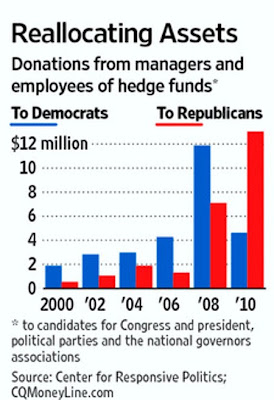
Where Wall Street Money is going this campaign season...Well, Mr President, you did not actually think they would be grateful...did you???


DESCRIPTION
Source: WSJ
 The trend prior to 2010 is interesting and probably not what people would guess. Hedge fund managers and their employees have been relatively more generous to the Democrats than Republicans over time.  Does Wall Street know something we don't?? (Rhetorical question, I already know the answer...)

One look at this graph and you may become (if not already) a Keynesian...Do not turn away!!

LLTUE3.gif
Source: Econbrowser
This graph shows two important categories that economists use to define peoples unemployment status. 

One is cyclical unemployment (Red Bar), which means people lose there jobs because there is a down turn in the business cycle. This is a fancy way of saying there is a lack of demand for the goods and/or services businesses produce so they lay-off workers and/or close the business altogether. The workers skills are still relevant and they want to work, but there is no current demand for the goods or services they produced.

The other is structural/technological unemployment (Blue Bar) which means people have lost their jobs due to changes in technology and work place efficiencies. This is a fancy way of saying you lost your job to a machine, robot, computer, or better processes.  Workers skills have become obsolete and must update their skill-set or learn to do something else altogether.  The longer one is unemployed, the threat of moving from cyclically unemployed to structurally unemployed increases. This is not good for the worker because there can be a significant time lag between getting the re-training and obtaining a new job.  What to do in the meantime? How to support themselves? Their families? How to pay for re-training?

The good news (if there is any) is that while the ranks of the structurally unemployed is growing, the MAIN problem is cyclical unemployment.  This graph shows approx. 60% of unemployment is cyclical.   These workers are, more or less, ready to go back to work, have the relevant skills and can be productive immediately IF THERE WAS DEMAND FOR WHAT THEY CAN PRODUCE. 

So...Does this beg for a Keynesian solution to the problem?  Private sector hiring is not robust.  Could MORE "priming of the pump" by Government be necessary to kick start the economy and get Aggregate Demand increasing?

If not, what is your solution?  Inquiring minds want to know...

At this golf course if you land in a bunker it could contain sand or a machine gun. I wonder if you get a free drop? The rules of golf are different in War-time...

I am assuming this Golf Course is in England or one of the British Isles (notice the date). Under THESE conditions, I think the PGA could set a record television audience...(HT: Coyote Blog)

Source: HERE
 Reminds me of this clip from "Caddy Shack"....

Do you know the difference between Trash and Treasure? Nice example of a good that went from one to the other in the marketplace, and it is found in your kitchen...

What is the difference between trash and treasure in terms of your refuse (fancy word for garbage)?  With trash YOU have to pay someone else to take it away.  With "treasure" someone PAYS YOU to take it away.  It is not a subtle difference.  Here is an example of a commodity that crossed over from the former to the latter:
""...Spent cooking oil. Used to be, restaurants had to pay companies to haul away their used cooking oil. In recent years, selling that yellow grease has become a half-billion dollar a year industry. So companies are now paying restaurants for the stuff. And that's pitting grease collector against grease collector..."" Source NPR
Tell me again, how much money do you RECEIVE from filling your recycling bin and putting it on the curb every week? We pay to have our recyclables picked-up. Do you ever ask yourself why? Seems like at a minimum, recyclers would pick it up for "free" from you if they can profit from it down the supply chain. I am willing to hear counter-points---let me have it.

Wednesday, April 27, 2011

A nice primer on Inflation and who it hurts and who it helps...Yes, inflation can be your friend...

Inflation-talk is the rage right now, domestically and internationally. It is still open to debate whether we are  in the midst of the classic definition of inflation---a general rise in the average price level---or do we just have increasing prices in a limited, but vital, number of commodities (gas and food, primarily). This blog post from "Supply and Demand--In that order" is a nice primer on the topic of the effects of inflation on all the interested parties...

""Normally, inflation is one of the most harmful taxes, but these days inflation may do less harm than good.
During most of our lifetimes, the prices of things we buy have generally increased over time. We can name some exceptions, but most items (even houses) have prices that are higher now than they were 10, 20 or 30 years ago. This general increase in consumer prices is called inflation.
The Federal Reserve is charged with limiting the rate of inflation, which it can do over the long run by limiting the supply of money and similar assets in the hands of the public.
Inflation is widely disliked. A number of economists think that inflation’s bad reputation is undeserved, and that, while people complain that inflation makes things more expensive, they fail to recognize that inflation also raises their wages.

The net result of inflation could be to increase wages and prices in the same proportion, without harming consumer’s purchasing power.

A person on a fixed income, such as a pensioner receiving a specific number of dollars a month – a so-called “defined benefit” pension – does have less purchasing power when prices rise. However, Social Security benefits automatically increase with wages in the economy, and thereby automatically increase with inflation in the long run.

Why a commission to investigate speculation in the oil/gasoline markets will not be productive---We are missing the REAL story---See why in one easy to read graph...

We can appoint 100 commissions to investigate the role of speculators (read that Hedge Funds investing in oil futures) in the rising price of oil, but I would prefer to look at one underlying fundamental that will remain long after these commissions issue their reports (with vague findings, after spending lots of money to do so---mark my words). 

The graphic below speaks volumes and starkly illustrates what I don't think most Americans are aware of, or want to be aware of---there are major emerging economy's with large populations and they are consuming more oil based energy every day. 

Speculation in the oil markets happens (see, I said it!). No reasonable person denies that.  However, it will not be the long term cause of higher oil prices, hence gas prices.  THIS WILL:

Source: WSJ

""The U.S. Energy Department on Wednesday reported a 1.6% decline in a closely watched gauge of gasoline consumption, compared with a year ago. In the past, when U.S. drivers cut back, that has dented global demand for oil and depressed prices. After a lag, the lower prices would help the economy regain its footing—or at least remove a substantial headwind.


But many oil experts believe that scenario won't play out this time, because U.S. drivers are no longer calling the shots. The rapidly industrializing economies of China, India, Brazil and even Saudi Arabia are. A possible result: an extended period of sluggish U.S. growth amid high oil prices.


"It's a new world," said oil economist James D. Hamilton, a professor at the University of California, San Diego. "The growth in newly industrialized countries is the key factor driving oil prices."""

Donald Trump will get tough with China on Trade...Hmmm...then who is going to make his signature shirts and ties?

Donald Trump has said he will get tough with the Chinese on trade. He believes they take advantage of the US and plays us for chumps. Is he going to get tough BEFORE or AFTER they make the shirts with his name on them...just askin'...
Source: HT Carpe Diem

Tuesday, April 26, 2011

Another United Nations "Fail"---How do you become a member of the UN Human Rights Council? If you are Syria you murder protesters in the streets. This is the upside down world of the UN...

Despite Reports of Brutality Toward Civilians, Syria to Join U.N.'s Human Rights Council
The brutal crackdown by Syrian President Bashar Assad may finally be getting the attention of world leaders -- but apparently not enough to stop Syria from becoming the newest member of the U.N. Human Rights Council.


And despite calling for an independent investigation into the crackdown, which has left hundreds dead, U.N. Secretary-General Ban Ki-moon apparently won’t do much about blocking Syria’s path to the human rights group.

"That's not really for the secretary general to suggest to a member state," said Martin Nesirky, a spokesman for the secretary-general, when asked if the U.N. chief would ask Syria to drop out of the running for the post. When asked if Ban had brought up the point during his telephone conversation April 9 with Assad, Nesirsky told Fox News, "that's not really something the secretary general would raise specifically, because it's for other member states to decide on the membership of the Human Rights Council."
View My Stats