 |
| Source: HERE |
|
| Source: HERE |
""...Spent cooking oil. Used to be, restaurants had to pay companies to haul away their used cooking oil. In recent years, selling that yellow grease has become a half-billion dollar a year industry. So companies are now paying restaurants for the stuff. And that's pitting grease collector against grease collector..."" Source NPRTell me again, how much money do you RECEIVE from filling your recycling bin and putting it on the curb every week? We pay to have our recyclables picked-up. Do you ever ask yourself why? Seems like at a minimum, recyclers would pick it up for "free" from you if they can profit from it down the supply chain. I am willing to hear counter-points---let me have it.
""Normally, inflation is one of the most harmful taxes, but these days inflation may do less harm than good.
During most of our lifetimes, the prices of things we buy have generally increased over time. We can name some exceptions, but most items (even houses) have prices that are higher now than they were 10, 20 or 30 years ago. This general increase in consumer prices is called inflation.
The Federal Reserve is charged with limiting the rate of inflation, which it can do over the long run by limiting the supply of money and similar assets in the hands of the public.
Inflation is widely disliked. A number of economists think that inflation’s bad reputation is undeserved, and that, while people complain that inflation makes things more expensive, they fail to recognize that inflation also raises their wages.
The net result of inflation could be to increase wages and prices in the same proportion, without harming consumer’s purchasing power.
A person on a fixed income, such as a pensioner receiving a specific number of dollars a month – a so-called “defined benefit” pension – does have less purchasing power when prices rise. However, Social Security benefits automatically increase with wages in the economy, and thereby automatically increase with inflation in the long run.
 |
| Source: WSJ |
 |
| Source: HT Carpe Diem |
The brutal crackdown by Syrian President Bashar Assad may finally be getting the attention of world leaders -- but apparently not enough to stop Syria from becoming the newest member of the U.N. Human Rights Council.
And despite calling for an independent investigation into the crackdown, which has left hundreds dead, U.N. Secretary-General Ban Ki-moon apparently won’t do much about blocking Syria’s path to the human rights group.
"That's not really for the secretary general to suggest to a member state," said Martin Nesirky, a spokesman for the secretary-general, when asked if the U.N. chief would ask Syria to drop out of the running for the post. When asked if Ban had brought up the point during his telephone conversation April 9 with Assad, Nesirsky told Fox News, "that's not really something the secretary general would raise specifically, because it's for other member states to decide on the membership of the Human Rights Council."
...That story can be repeated for any number of consumer goods, of course. But what’s interesting about beer is that the trend is not likely to last. A paper by two economists at the University of Leuven, in beer-loving Belgium, finds that people drink more beer as their incomes rise, until they make about $22,000 a year.An income of $22,000 seems to be the breaking point where beer crosses over from a normal good to an inferior good. If income increases and the demand for a good increases then it is considered a normal good. If income increases and the demand for a good decreases then it is considered an inferior good--people substitute away from the inferior good to a normal good as income increases. In this case, the study finds wine becomes the normal good as income goes over $22,000.
Then they start drinking less beer.
The paper, brought to my attention by the Reuters blogger Felix Salmon, doesn’t offer much in the way of explanations, but perhaps the most obvious one is something many Americans personally experience in their 20s. As you start making more money, and assuming more responsibility, there is less opportunity to drink -– and the potential consequences become more costly.

""Drivers of electric cars may have left the gas pump behind, but there's one expense they may not be able to shake: paying to maintain the roads.State lawmakers grappling with a $5 billion deficit are facing declining gas tax revenue, which means less money to maintain or improve roads.
After years of urging residents to buy fuel-efficient cars and giving them tax breaks to do it, Washington state lawmakers are considering a measure to charge them a $100 annual fee — what would be the nation's first electric car fee.
"Electric vehicles put just as much wear and tear on our roads as gas vehicles," said Democratic state Sen. Mary Margaret Haugen, the bill's lead sponsor. "This simply ensures that they contribute their fair share to the upkeep of our roads."
 |
| Wall Street Journal |
As it turns out, quite a lot. A non-scientific study of Commerce Department data suggests that in February, U.S. consumers spent an annualized $1.2 trillion on non-essential stuff including pleasure boats, jewelry, booze, gambling and candy. That’s 11.2% of total consumer spending, up from 9.3% a decade earlier and only 4% in 1959, adjusted for inflation. In February, spending on non-essential stuff was up an inflation-adjusted 3.3% from a year earlier, compared to 2.4% for essential stuff such as food, housing and medicine.
To be sure, different people can have different ideas of what should be considered essential. Still, the estimate is probably low. It doesn’t, for example, account for the added cost of certain luxury items such as superfast cars and big houses.
Interestingly, people who spend more on luxuries have experienced less inflation. As of February, the weighted average price of non-essential goods and services was up only 0.2% from a year earlier and 82% from January 1959, according to the Commerce Department. By contrast, the cost of all consumer goods was up 1.6% from a year earlier and 520% from January 1959.
The sheer volume of non-essential spending offers fodder for various conclusions. For one, it could be seen as evidence of the triumph of modern capitalism in raising living standards. We enjoy so much leisure and consume so much extra stuff that even a deep depression wouldn’t – in aggregate — cut into the basics.
Alternately, it could be read as a sign that U.S. economic growth relies too heavily on stimulating demand for stuff people don’t really need, to the detriment of public goods such as health and education. By that logic, a consumption tax – like the value-added taxes common throughout Europe—could go a long way toward restoring balance.

“For the past 33 years I have looked in the mirror every morning and asked myself: “If today were the last day of my life, would I want to do what I am about to do today?” And whenever the answer has been “No” too many days in a row, I know I need to change something.”--Steve Jobs
“Unlucky people miss chance opportunities because they are too focused on looking for something else. They go to parties intent on finding their perfect partner, and so miss opportunities to make good friends. They look through the newspaper determined to find certain job advertisements and, as a result, miss other types of jobs. Lucky people are more relaxed and open, and therefore see what is there, rather than just what they are looking for.”
“Reed College at the time offered perhaps the best calligraphy instruction in the country. Throughout the campus every poster, every label on every drawer, was beautifully hand calligraphed. Because I had dropped out and didn’t have to take the normal classes, I decided to take a calligraphy class and learn how to do this. I learned about serif and san serif typefaces, and about varying the amount of space between different letter combinations, about what makes great typography great.”--Steve Jobs
Here’s the kicker:
“If I had never dropped in on that single course in college, “ Jobs explained, “the Mac would have never had multiple typefaces or proportionately spaced ones. And since Windows just copied the Mac, it’s likely that no personal computer would have them.”
He added,
“Of course it was impossible to connect the dots looking forward when I was in college. But it was very, very clear looking backwards ten years later. Again, you can’t connect the dots looking forward; you can only connect them looking backwards. So you have to trust that the dots will somehow connect in your future. You have to trust in something—your gut, destiny, life, karma, whatever. This approach has never let me down, and it has made all the difference in my life.”
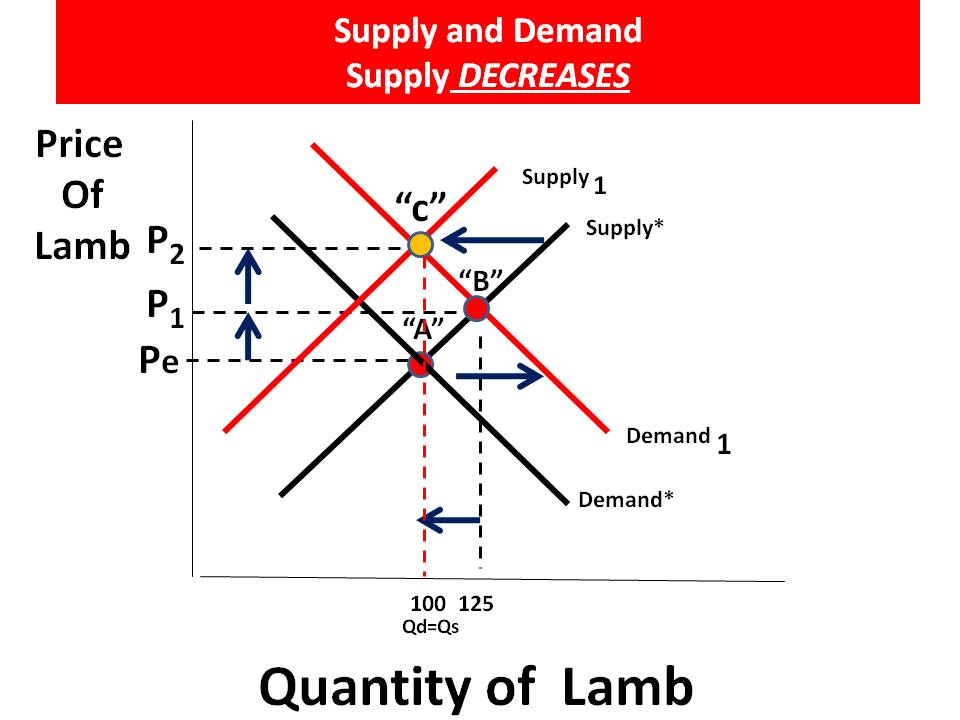
Demand by U.S. consumers is up, imports are down and prices have soared. “You have almost what you can call a perfect storm,” said Fisher, 64, who has about 3,100 animals on his acreage near Sonora. “The great part is we have record prices for lambs — the highest ever by a whole lot.” Last year’s May delivery of lamb fetched about $1.39 a pound; this year the price is around $2.20 a pound, said Fisher, the immediate past president of American Sheep Industry Association.......Still, Mazen Munaser, whose father owns the Islamic Village Market in Dearborn, said demand remains strong.The determinant of demand in this case seems to be a change in preferences. Lamb is also a substitute for other meats (Mutton is mentioned in the article). It has become a more preferable meat source. The demand curve shifts to the right because, relative to the original demand curve, there is a greater quantity demanded at "Pe" and we assume this will be the case at every other price as well. "Demand 1" will lie to the right of "Demand*".


That increased demand comes as supply drops, in part due to decreased production in Australia and New Zealand, two of the world leaders in production and large exporters to the U.S., Orwick said.The suppy curve shifts to the left because, relative to the original supply curve, there is less quantity supplied at "Pe" and we assume this will be the case at every other price as well. "Supply 1" will lie to the left of "Supply*".
Australia has about 70 million sheep, down from 170 million 20 years ago. The drop has been blamed on the ending of a government support program and extended drought followed by recent flooding, Orwick said.
In New Zealand, sheep numbers have dropped from about 70 million to 40 million, and many producers have switched to dairies and beef production.
Drought also has hurt some producers in Texas, but others in states such as Tennessee, Kentucky, Michigan and Ohio have picked up the slack, Orwick said.

BY THE end of last year, China's foreign-exchange reserves amounted to $2.85 trillion. Although China ran a rare trade deficit in the first quarter of this year on April 14th the country's central bank released new figures showing that its reserves at the end of March had soared above $3 trillion.
China’s central bank has a lot of money but not a lot of imagination. It keeps a big chunk of its reserves in boring American government securities. That means it can count on getting its dollars back. But it frets about how much those dollars will be worth should America succumb to inflation or depreciation.
So what else could China do with the money? Instead of the dollar, China might fancy the euro. China could buy all of the outstanding sovereign debt of Spain, Ireland, Portugal and Greece, solving the euro area’s debt crisis in a trice. And it would still have almost half of its reserves left over.
It might, alternatively, choose to abandon debt altogether and buy equity. China could gobble up Apple, Microsoft, IBM and Google for less than $1 trillion. It could also follow the lead of those sheikhs and oligarchs who like to buy English football clubs. According to Forbes magazine, the 50 most valuable sports franchises around the world were worth only $50.4 billion last year, less than 2% of China’s reserves.

""David Keating of the National Taxpayers Union provides a useful perspective on how big the tax compliance industry is. According to his research, as of 2009 the income-tax industry employed "more workers than are employed at the five biggest employers among Fortune 500 companies—more than all the workers at Wal-Mart Stores, United Parcel Service, McDonald's, International Business Machines, and Citigroup combined." Without diminishing in any way the professionalism of tax attorneys, accountants and financial planners, all of these efforts produce nothing other than, well, tax compliance.
Citizens should be able to comply with the tax code without having to spend absurd amounts of money to do so. The fact that there is such a large compliance markup in our tax system indicates that the tax system has gone awry. All of these hours could have been used for something a lot more productive than just making sure our taxes are filed and paid correctly.
An obvious alternative use is work, either as an employee or an entrepreneur. We will never know how many more businesses could have been started if we did not spend billions of hours on tax compliance. But we do know approximately how much our economy would benefit if we could use our "tax-compliance time" more productively. ""
 |
| Source: Bureaus of Labor Statistics |
Paul R. Epstein, et. al., “Full cost accounting for the life cycle of coal”
Each stage in the life cycle of coal—extraction, transport, processing, and combustion—generates a waste stream and carries multiple hazards for health and the environment. These costs are external to the coal industry and are thus often considered “externalities.” We estimate that the life cycle effects of coal and the waste stream generated are costing the U.S. public a third to over one-half of a trillion dollars annually. Many of these so-called externalities are, moreover, cumulative. Accounting for the damages conservatively doubles to triples the price of electricity from coal per kWh generated, making wind, solar, and other forms of nonfossil fuel power generation, along with investments in efficiency and electricity conservation methods, economically competitive. We focus on Appalachia, though coal is mined in other regions of the United States and is burned throughout the world. (Source: Matthew Yglesias)
 View My Stats