Monday, November 22, 2010

A common tragedy has been avoided in Mexico---they CAN see the forest for the trees!! And that is a good thing...

Granting ownership of a resource to the people most vested in seeing it used efficiently will enhance the sustainability of that resource for years/generations to come. When a community sees the government does not care about the sustainability of a resource, then they tend to join in the pillaging of that resource to get what they can out of it as well.  There is no incentive to preserve and conserve. Secure individual or local community rights changes that dynamic.  While this may not work in all circumstances, the world could use a little more of it to avoid the tragedy created by The Tragedy of the Commons.  This is a nice article about the success of transferring private property rights from "the people" to actual people...

NYTIMES: Growing a Forest, and Harvesting Jobs, in Mexico

“We’re the owners of this land and we have tried to conserve this forest for our children, for our descendants,” Alejandro Vargas said, leaning on his machete as he took a break. “Because we have lived from this for many years.”


Three decades ago the Zapotec Indians here in the state of Oaxaca in southern Mexico fought for and won the right to communally manage the forest. Before that, state-owned companies had exploited it as they pleased under federal government concessions.


They slowly built their own lumber business and, at the same time, began studying how to protect the forest. Now, the town’s enterprises employ 300 people who harvest timber, produce wooden furniture and care for the woodlands, and Ixtlán has grown to become the gold standard of community forest ownership and management, international forestry experts say....

The US is under attack!! Please stay away from Walmart or any other place that sells stuff we really like to buy! That is where the enemy is hiding... See video here!

Source: Cafe Hayek

A World Map if size of population corresponded with the size (land mass) of a county...

From: BIG THINK: ""What if the world were rearranged so that the inhabitants of the country with the largest population would move to the country with the largest area? And the second-largest population would migrate to the second-largest country, and so on?..."HT: Marginal Revolution


Al Gore is my NEW HERO! He expresses regret for his support for ethanol/corn subsidies... Brrr...It is cold here in Hades!

U.S. corn ethanol "was not a good policy"-Gore From Reuters:
Former U.S. vice-president Al Gore said support for corn-based ethanol in the United States was "not a good policy", weeks before tax credits are up for renewal...

"It is not a good policy to have these massive subsidies for (U.S.) first generation ethanol," said Gore, speaking at a green energy business conference in Athens sponsored by Marfin Popular Bank....

"First generation ethanol I think was a mistake. The energy conversion ratios are at best very small....

"It's hard once such a programme is put in place to deal with the lobbies that keep it going."...

He explained his own support for the original programme on his presidential ambitions.

"One of the reasons I made that mistake is that I paid particular attention to the farmers in my home state of Tennessee, and I had a certain fondness for the farmers in the state of Iowa because I was about to run for president."...

A food-versus-fuel debate erupted in 2008, in the wake of record food prices, where the biofuel industry was criticised for helping stoke food prices....

Gore said a range of factors had contributed to that food price crisis, including drought in Australia, but said there was no doubt biofuels have an effect....

"The size, the percentage of corn particularly, which is now being (used for) first generation ethanol definitely has an impact on food prices....

"The competition with food prices is real."

Reason 4,923 people hate economists: TSA's policy on "pat-downs" will kill people on the highway this holiday season--Huh??

We cannot escape the glory and/or the madness of "opportunity costs"!

Analyst: TSA methods 'will kill more Americans on highway'
""The recent public ire toward the TSA’s new pat-down and body imaging screening methods is likely to cause more people to drive automobiles and forego airline travel, say two transportation economists who have studied the issue.
“Driving is much more dangerous than flying, as you are far more likely to be killed in an automobile accident mile-for-mile than you are in an airplane,” said Horwitz. “The result will be that the new TSA procedures will kill more Americans on the highway.”

Sunday, November 21, 2010

A letter to the President concerning airport security/screening....

Mr President,
     Your ARE the head of the executive branch.  The Department of Homeland Security (DOHS??) is an agency within your cabinet.  Please instruct your Department of Homeland Security (DOHS??) Secretary to get control of the airport screening situation.  I request this not so much on behalf of travelers, but for the screening agents who are responsible for carrying out DOHS?? policies.  Yes, I would like to defend them.
     I served in the military and know what it is like to faithfully carry out orders that make no sense to me (or my fellow Marines) and made me/us look petty and incompetent in the eyes of the people we were attempting to serve.  Heck, I am now a teacher and can say the same thing about education policies.  Ask me about grading policies or texting in school policies that I am compelled to execute if you want to see frustration to the boiling point. 
     If nothing changes soon, anyone entering an airport will experience an increasing level of contempt for the screeners, justified or not.  There will be an in-kind response from TSA agents to the traveling public.  This is a toxic mix that will detract from ensuring the safety of said traveling public.  A seige mentality between people on the SAME side is not in the interest of public safety.
     Morale must be very low among TSA agents.  Put yourself in the shoes of one of the agents who is only doing his/her job---it must be very humiliating to be looked upon with such scorn and suspicion.  They are not bad people, but they are stuck interpreting and enforcing  vague policies that I assume were formulated at highest level by people you apppointed to the DOHS??  Please put a stop to these policies that make these screeners seem less than human in the eyes of the public.  Thank you for your time and attention.

Sincerely,

Gene Hayward, American...

I am not really sending this...Because of my sense of humor, I could not resist the "DOHS!" or the shot at school district policies---This whole situation is very much like Homer working at the nuclear power plant.... :)
 

Why is paying for college a little (alot?) like buying a car? It is discrimination, I tell ya', discrimination in the first degree!

     Tis the season for high school seniors to apply and get accepted to the college of their dreams.  Once accepted, then the reality of paying for it starts to set in.  I am always curious when financial aid offers start to roll in, even before students file the FAFSA form that tells students, parents and colleges what the student is expected to contribute towards tuition. No one seems to get the same offer, from the same school, with roughly the same qualifications.  My question is, does anyone REALLY know what the tuition rate is for ANY given college.  I know, they publish rates on websites and in brochures, but what do students actually end up paying?  Seems to me paying for college is like buying a car: there is a suggested price, but we all know no one pays the same price for the SAME car.  I believe colleges, like car dealers, use information to differentiate buyers (students) and extract as much money from each student as possible.
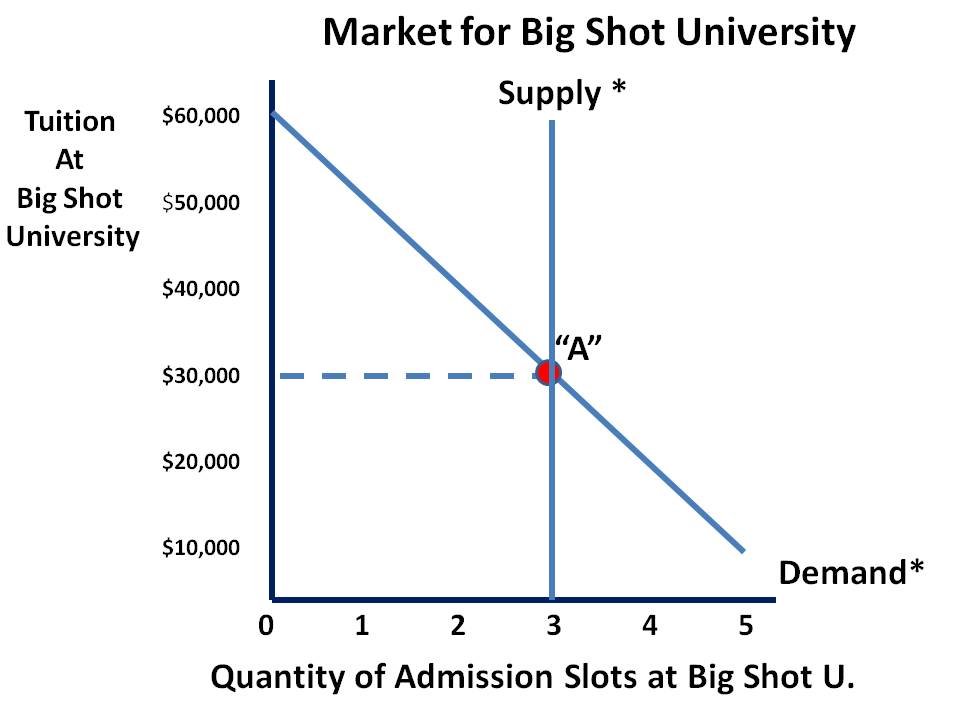
     Let's use the example of Big Shot U ("BSU"--get it,  B.S. You).  BSU knows that their profit maximizing tuition rate is $30,000 per year, Point "A",  on the graph below. Assume you and every other student knows this for sure. You have what is called "complete information" about the cost of attending BSU.
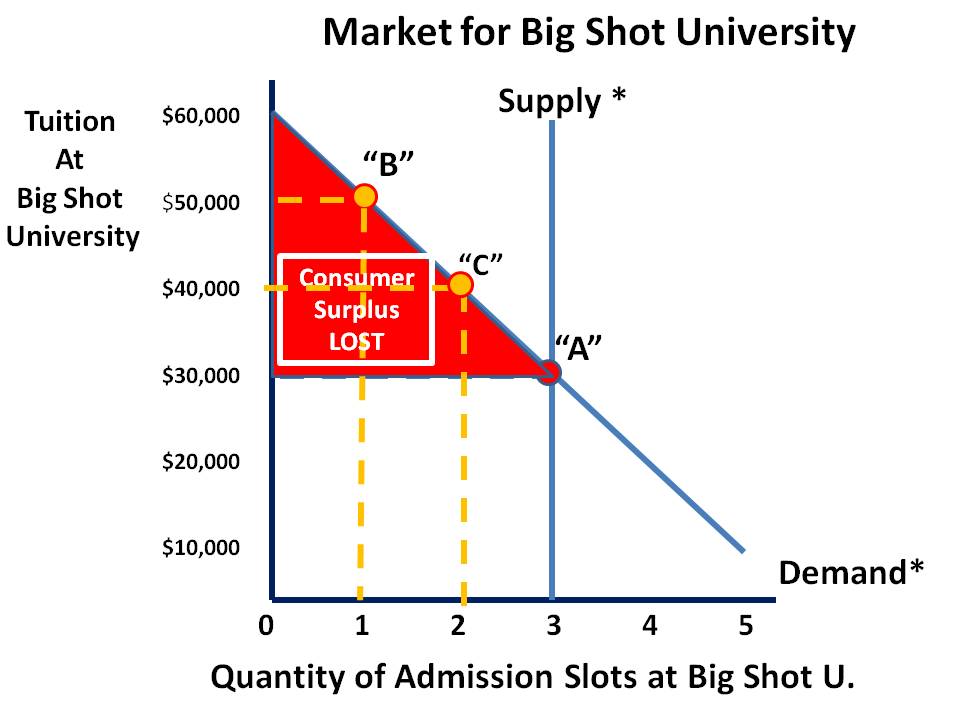
      However, the demand curve ("Demand*") for BSU shows that many students (2,999) would actually pay something more than $30,000 but less than $60,000 per year to attend BSU. But because of "complete information" about the price of BSU, they know that they don't have to pay more than $30,000.  Since they were willing and able to do so, then this group of 2,999 students reap what is called "Consumer Surplus". The area of Consumer Surplus is shown in blue in the graph below:


    If it were only this easy.  Because the actual tuition price is not widely known, the college can attempt to capture some of this Consumer Surplus by gathering information about you and your ability to pay. Then, they can offer you a "scholarship" package to see how much surplus, if any,  they can transfer from you to themselves.  They do this through a variety of means--information on your application, demographics, your zip code, and most importantly, your FAFSA. Colleges do their best to "segregate" as many of those 2,999 students based on ability to pay and extract as much from each of them as possible. 
  Assume BSU calculates the first 1,000 applicants (horizontal axis is in thousands) will pay less than $60,000 but as much as $50,000. Of the 3,000 students they need to fill seats, they got 1,000 of them to pay much more than $30,000.  BSU has captured some of that consumer surplus, illustrated below:
Now BSU goes to work on the next 1,000 (between 1,000 and 2,000) students and captures more surplus:


Now, to squeeze the Consumer Surplus out of the last 1,000 (between 2,000 and 3,000):
This sounds terrible, doesn't it? It is not uncommon. Businesses that are able to post vague prices can use information to segregate buyers and "price discriminate (car dealers, airlines, etc). Colleges would fall under the category of a First Degree Price Discriminator.
     Why is this a smart idea?  If everyone paid $30,000 in tuition then BSU's total revenues would be 3,000 X $30,000 = $90,000,000.  I will use imperfect calculations to show the change in revenues if they price discriminate---1,000 x $50,000 = $50,000,000, 1,000 x $40,000 = $40,000,000, and 1,000 x $3,000 = 30,000,000. Total revenues in this case would be at the minimun $120,000,000.  A $30 million difference!!
     Am I too cynical? I believe too much of the "scholarship" offers students recieve from colleges like BSU are a form of gamemanship to find out what your "reservation price" is.  I am not implying students don't deserve those scholarships but I believe the scholarships and their particular amounts serve a dual purpose.  I welcome respectful responses to back me up or tell me where I am going wrong... :)

Some jobs are saved, some may be created, and some are lost. So what is the net effect of protectionism? Yeah, I don't know either

If a country gets into a trade spat/war with another country, it is important to remember it is a two way street.  As with any fight, the other guy has weapons at his disposal too.  Frederic Bastiat reminds us from the grave, what is "seen" with protectionism are the jobs saved when the government intervenes (because the politicians make sure they tell us) to protect certain industries, but what is "unseen" (or at least murky) are the jobs that are lost or NEVER created by protectionist measures.  Some jobs are saved, some may be created, and some are lost.  So what is the net effect of protectionism? Yeah, I don't know either...Below is a list of states that will likely have causalities in the event of a tit-for-tat trade spat with China...

10 US States That Will Get Murdered If China Slows Its Imports(click on link to see the rest of the states)

#1 California

$9.7 billion of exports to China last year
175% growth over decade
--computers and electronics worth $2.9 billion

--waste and scrap worth $2.1 billion

--machinery (except electrical) worth $925 million

--transportation equipment worth $824 million

--chemicals worth $758 million


#2 Washington

$9.1 billion of exports to China last year

379% growth over decade

--transportation equipment worth $4.1 billion

--crop production worth $3.3 billion

--waste and scrap worth $423 million

--computers and electronics worth $265 million

--minerals and ores worth $134 million

#3 Texas

$8.9 billion of exports to China last year
513% growth over decade
--chemicals worth $3.6 billion

--computers and electronics worth $1.5 billion

--machinery (except electrical) worth $916 million

--crop production worth $703 million

--waste and scrap worth $565 million

Saturday, November 20, 2010

The Reserve Requirement is in the news! The Reserve Requirement is in the news!

     Ok, not in the US, but in China. However, it is an important concept that applies to the US banking system, so here we go with a basic primer on it...
     One of the monetary policy tools the U.S. Federal Reserve has at its disposal to control the amount of money commercial banks can loan out is called the "Reserve Requirement Ratio". The Reserve Requirement Ratio (aka "RRR") is set by the Federal Reserve. When a bank receives a deposit, it is required to with-hold a percentage of that deposit in its Required Reserves account with the Federal Reserve. The rest of the deposit not subjected to the reserve requirement is then put in the banks "excess reserves" account and may be lent out by the bank in the form of a loan to a customer.
     Here is a simple example:  I deposit $1,000 into my checking account (aka "Demand Deposit" in banking parlance). Assume the Federal Reserve sets the RRR at 10%. The bank is required to with-hold $100 of my deposit in its Required Reserves account with the Federal Reserve and can deposit up to $900 in its "excess reserves" account. MY bank can then loan out up to $900 to a customer, who in turn, it is assumed, will purchase some new (or perhaps used) good and/or service with that money, hence increasing GDP.
     If the Federal Reserve wanted to INCREASE the amount of excess reserves my bank could loan out, then it would DECREASE the RRR.  If the RRR was lowered to 5%, then my bank would have to with-hold only $50 from the $1000 deposit and loan out $950, a larger amount than before. The assumption is that a borrower could now purchase $50 MORE in "stuff" than before the change in the RRR, hence a larger increase in GDP.  The Federal Reserve might employ this monetary policy tool if the economy were at less than full-employment or recession.  More excess reserves =more loans =lower interest rate on those loans= more purchase of GDP = increase in Aggregate Demand = closer to full-employment. 
    What works forward, also works in reverse. If the Federal Reserve wanted to DECREASE the amount of excess reserve my bank could loan out, it would INCREASE the RRR. If the RRR is increased to 20%, then my bank is required to with-hold $200 of the $1,000 demand deposit and can loan out, in excess reserves, a maximum of $800, which is $100 less than if the RRR were 10%.  Now LESS money is available to be loaned out and presumably LESS "stuff" will be purchased, hence GDP would decrease.  The Federal Reserve might employ this monetary policy tool if the economy were experiencing inflation.  Less excess reserves = fewer loans = higher interest rates on those loans = less purchase of GDP = decrease in Aggregate Demand = closer to full-employment (reducing price level/inflation). 
   I used the example of only one bank when the Federal Reserve utilizes the monetary policy tool of changing the RRR,  but it applies to all banks.  In general, what happens at one bank will happen at all banks (in a follow-up blog entry I will change this assumption).  So, if the Federal Reserve decreases the RRR all banks will be able to loan out more in excess reserves, which will tend to decrease interest rates as more excess reserves become available to be loaned out, which tends increase the number of loans, which tends to increase the purchase of consumer goods ("C") or investment goods ("I") which tends to increase GDP. I will ignore the effect this has on Net Exports in this example, but suffice it to say, it will also serve to increase GDP.  This will help solve recession.  I believe you can now follow the logic of what an increase in the RRR will have on the banking system to solve the problem of inflation. 
     All countries have some semblance of a Central Bank (we call ours "The Federal Reserve Bank of the US").  The Chinese Central Bank just increased its RRR for banks in China, so they have some concerns about inflation and are trying to reign in excess reserves.  Click HERE to read all about it. 
     It is a great time to teach an introductory college level class---MOST of textbook stuff is coming alive in the "real-world"! It is sad to say, but the crappy economy makes it easier to teach economics! (Should I have said that out loud???)

Can you belong to a United Nations Committee representing women AND bar women in your country from partipating in athletics? Yes, you can, if the price is right...

Another story makes me wonder about how the world works---Recently Saudi Arabia was "elected", read that purchased, a seat on the Unitied Nations subcommitte called "UN Women",

(NYTIMES)
""Most of the 41 board seats were divided among geographic blocs: Asia, Africa, Latin America, Eastern Europe and Western Europe. Six were set aside for major donors, which is how Saudi Arabia gained a seat..."

Now, this story today in the NYTIMES:
""Physical activity of any kind is forbidden in Saudi Arabia’s state-run girls’ schools. Though gyms for women exist in major Saudi cities, they are usually unmarked, so that customers need not fear attracting attention....Saudi Arabia does not permit women to represent it in international athletic competitions, and it is one of only three countries in the world that has yet to send women to the Olympic Games (the others are Qatar and Brunei). Though Saudi Arabia sent an official delegation of male athletes to Singapore for the Youth Olympics, Malhas — the daughter of an accomplished female show jumper, Arwa Mutabagani — had to enter on her own, at her own expense..."
On the UN Women's Committee website, they have these as over-arching goals:
"elimination of discrimination against women and girls, empowerment of women, achievement of equality between women and men as partners and beneficiaries of development, human rights, humanitarian action and peace and security."
I guess when you purchase a seat on the committee, instead of earning one, it is not necessary to read the "fine print" of the committees mission. I will keep you posted on the major initiatives and reforms  the Saudi's put forth on this commitee.  You better sleep before you check back. It might be a while...

Friday, November 19, 2010

Today is World Toilet Day! There is still time to join this, umm, movement, so to speak...


Volunteers pose on toilets during a World Toilet Day event in central Sydney, on Nov. 19. The event, run by the Australian Red Cross, aims to raise awareness of people living in areas that do not have access to safe drinking water and sanitation. (Tim Wimborne/Reuters)

 World Toilet Day: Top 10 nations lacking toilets


Click HERE for list...
See a lot of people squatting in the open today? Don't be offended. The so-called "big squat" was held worldwide to coincide with the 10th annual World Toilet Day, an initiative to bring awareness to the need for adequate sanitary facilities.


Every day, some 1.1 billion people go to the bathroom without any type of toilet, according to the World Health Organization. And even with a toilet, facilities are not necessarily sanitary. WaterAid America estimates that roughly 2.5 billion people – nearly 40 percent of the global population – do their business unsafely, often in public spaces.


World Toilet Day is organized by the Singapore-based World Toilet Organization, which has 235 member organizations in 58 countries "working toward eliminating the toilet taboo and delivering sustainable sanitation." Here's a list of the world's worst nations in terms of people lacking access to sanitary facilities.

Homeless Man returns found laptop and $3,300 cash...Do we have it in us to do the same?


Read the rest of theStory HERE...
Dave Tally, homeless and living on the fringe in Tempe, Ariz., for 11 years, is suddenly the center of attention.

Tally, 49, found a backpack containing $3,300 cash and a laptop and returned it to the owner.

Wednesday, November 17, 2010

Did I scoop the vaunted Financial Times magazine on Big Mac Inflation in China? Yeah, I think I did...:)

Toot! Toot! (that is me tooting my own horn)....This short piece in the Financial Times, China inflation: The Big Mac indicator, uses the price of a Big Mac in China as a measure of inflationary pressures that may be underway in China.
""More inflation warnings on Wednesday in China, this time from a highly symbolic source. The price of a Big Mac has risen from Rmb14 to Rmb15 at the branch of McDonald’s around the corner from the FT’s Beijing bureau - part of an across-the-board price hike that the US fast food chain blamed on rising costs of ingredients - even if that is still less than two-thirds of the price of a Big Mac in the US...""
If they had read THIS blog entry (reproduced below) of mine they would have known this weeks ago...Hey, I am a lowly high school economics teacher...let me have my time in the sun! :)
""Here is the latest "Big Mac Index"(graphic below) produced by The Economist magazine AND one produced in January 2010 (click HERE and HERE for my explanations of how The Big Mac Index works). Look at the cost of a Big Mac in the Euro area and then in China. How has the dollar price of a Big Mac changed in 9 months in each place? In January it took $4.79 to buy one in the Euro area (they took a weighted average) and in October it took $4.84 to buy one. So in dollar terms it became MORE expensive to buy a Big Mac. This implies the dollar lost value, or depreciated, relative to the Euro. Indeed, depreciation relative to the Euro has taken place this year. In China, a Big Mac cost $1.83 in January and in October it cost $2.18 (this is the amount we would give up to buy enough Yuan to purchase a Big Mac in Beijing). This implies the dollar lost value, or depreciated, relative to the Yuan (Chinese currency). SAY WHAT? This is NOT what has been the political discussion as of late. China has been criticized for NOT letting its currency appreciate relative to the dollar (as it SHOULD if it was traded in a flexible FOREX market) which would make its goods and services more expensive for us to buy and our goods and services less expensive for the Chinese to buy US goods and services. This presumably would lead to more balanced trade.


According to the Big Mac Index, from the two different time periods, Yuan appreciation HAS occurred. The dollar price of a Big Mac in China has INCREASED 19.6% ($2.18 minus $1.83 = $.35 divided by $1.83 times 100)!! The following could be happening: the Yuan has significantly appreciated in value, which would be BIG news, or there is Big Mac Inflation in China, or a combination of the two. We certainly have not seen nearly 20% appreciation, so I have to suspect inflation. One product does not make a trend, but is inflation rearing its ugly head in China? I pulled the thread---extra credit for doing the legwork to find out if this is the case... Note: the price of a Big Mac increased in the US, from $3.58 to $3.71, which is an increase of 3.6%. Can we say we have had inflation in the US for the last 9 month? No...so what else might contribute to the price increases in the US AND China for the Great Sandwich??  Extra-Extra Credit!! ""

Tuesday, November 16, 2010

The best of Social Enterprise---Bringing clean water FREE to people who need it and making polluters continents away pay for it. Does it get any better?

      A genius idea to provide FREE, CLEAN water to people in poor/developing countries by getting polluters to pay for it, whether they want to or not.  It is a positive, if unintended, consequence of Cap and Trade, a policy to reduce carbon emissions world-wide.  I encourage you to read the whole article, Clean Water at No Cost? Just Add Carbon Credits, but in a nut shell, here is how it works.
      Boiling water in, say, rural Sudan is a very carbon intensive process. It uses firewood in places where trees are in short supply and getting shorter. A company provides simple to use, but not maintenance-free water filters, that help reduce the carbon footprint in Sudan. By reducing carbon emissions in the Sudan, the company earns carbon credits that they in turn sell to polluters in India, China, the US, etc, who are polluting in excess of their alloted emissions.  The carbon credits are renewable every year, so the company has an incentive to maintain the existing water filters for free AND expand the use of them. Again, at no cost to the end-user and paid for by polluters continents away. 
     Regardless of how you may feel about the policy of Cap and Trade, this appears to be a creative way to engage in "Social Enterprise"--- help solve a social problem with market-based principles.  We need more of this type of thinking. 
   
View My Stats