Saturday, October 8, 2016

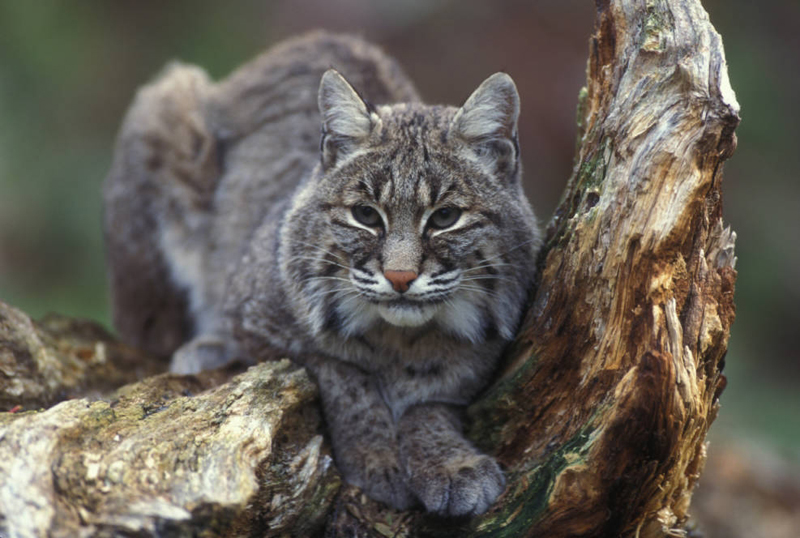
Bobcat hunting permits and Basic Economics. Not sure which gets killed more cruelly.


Here is an interesting article that shows conflict between basic economic principles and a social policy that makes for a terrific lesson.  The following is an excerpt from a media source in the State of Illinois (any highlights are mine):
6,000-plus apply for 500 bobcat permits; some aren’t hunters
"""More than 6,000 people applied for the 500 permits available to hunt for bobcats this fall in Illinois, which is having its first legal bobcat hunting season in more than 40 years. 
The Illinois Department of Natural Resources received 6,416 applications, which it accepted throughout the month of September, for 500 available permits, according to the Carbondale Southern Illinoisan. 
A lottery will be held to determine who gets the 500 available permits. 
Some of the applicants apparently are opposed to bobcat hunting, and would not be using any permits they receive. Rockford resident Jennifer Kuroda started a Facebook group called Illinois Bobcat Conservation, on which she encouraged opponents of bobcat hunting to apply for permits, according to Chicago radio station WBEZ. 
“I don’t feel that badly about doing it because I feel strongly that these animals need to be conserved at some level,” Kuroda told the radio station. 
Kuroda said 11 of her friends have applied for permits. 
The fee to apply for a bobcat permit is $5. Hunters who harvest one are required to purchase a possession permit for another $5. 
The bobcat was once listed as a threatened species in Illinois, but the designation was removed in 1999.""""
Read more here: http://www.bnd.com/news/local/article105844877.html#storylink=cpy

The number of permits issued is fixed at 500. No more will be issued. We can assume the Supply of Permits is Perfectly INELASTIC---regardless of the price, only 500 will be available.

The State has set a price of $5.00 for each permit. We can assume there will be a demand for these permits at that price. This is how the "equilibrium" sets up---but not for long:


We know from the response there are at least 6,000 people who would like a permit at $5.00. Quantity Demanded is greater than Quantity Supplied.

There is a shortage in this market of 5,500 permits at $5.00.

 Ceteris Paribus, what is true at $5.00 and Point "B" is going to be true at every other point on along "D*"---at some price the Quantity Demanded is going to be greater than it was before. The market Demand Curve shifts to the RIGHT.
In this case the "true" market price would rise to some price higher than "Pe = $5.00"  to "P 1= ???" at Point "C".

However, Illinois does not seem predisposed to do this. They also do not allow the permit to be transferred from one person to another.

This, in effect, puts a "Price Ceiling" on the permits---the price is not allowed to rise above $5.00.

What are the costs of this policy?
 1. Lot's of people can't get a permit. Consumer Surplus is diminished.
 2. Right now the State gets a total of $2,500 for issuing the permits ($5 each X 500).  That CAN'T possibly cover the costs of permit issuing and enforcement, can it?
 3.  LOTS of foregone fee  revenue! Would 500 of that vast surplus of consumers/hunters be willing and able to pay $1,000 for a permit? $2,000? More?

Why only $5.00?  The only reason I can think of is the issue of "equity"---a low permit price allows low income people the opportunity to participate in the hunt.  That seems like a weak argument to me given what is at stake.

What are the benefits of this policy?

Any ideas?

POSTSCRIPT: I did not include in the calculation (but should have) in the total revenue the fact that anyone just APPLYING had to pay $5.00.  So the actual total revenue generated is greater than I posited.  However, my question still stands---why is the permit so cheap?

Monday, October 3, 2016

Take me out to the ballpark...but at 1950 prices, please.


Found this on my Twitter feed (I lost the exact source. Apologies).

According to the Bureau of Labor Statistics (BLS) inflation calculator, $.25 (25 cents) in 1950 would be equivalent to $2.50 today.


Thursday, September 29, 2016


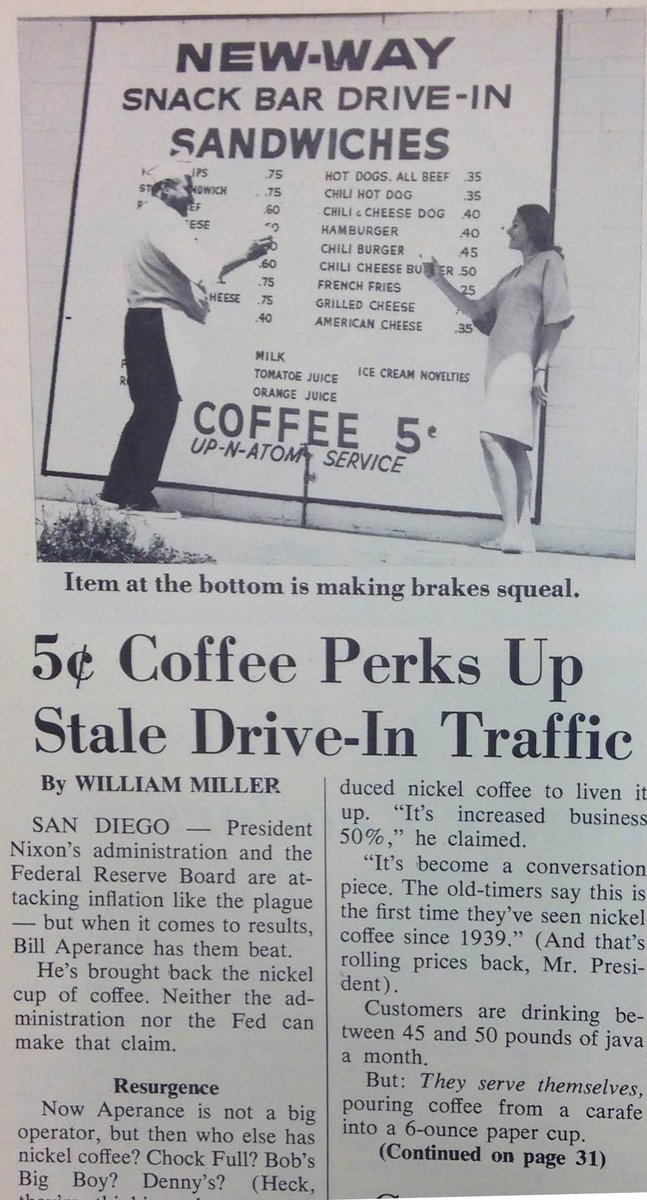
Found this on a Twitter account I follow---Restaurant News. (It has some great stuff for analyzing Microeconomic concepts from an industry students are very familiar with, one way or the other).

It is a menu board for a restaurant (as Restaurant News says) in 1969 and just the kind of thing that makes for a short economics lesson!

The price of a cup of coffee (does not say how many ounces it is) is 5 cents---a nickel.


Wednesday, September 28, 2016

Beef. It's what for dinner...before you run a half-marathon.

One of the Determinants of Demand is "a change in consumer tastes/preferences".  Advertisers and other advocacy groups try to promote their products in order to influence the buying decisions of consumers.

Here is an example from a Beef Industry lobbying group (from Morning Ag Clips):

The beef checkoff’s Northeast Beef Promotion Initiative in partnership with the South Dakota Beef Industry Council, the Pennsylvania Beef Council and the Kentucky Beef Council encouraged runners to “fuel up” with lean beef at the Rock ‘n’ Roll Philadelphia Half Marathon Health & Fitness Expo, Sept. 16-17.
Nearly 30,000 runners and their families toured the expo during the two-day event.  Visitors to the beef booth were challenged to test their beef knowledge through the ever-popular beef trivia spin wheel to win beef-related prizes. Attendees also learned the importance of fueling with high-quality protein through the checkoff’s Protein Challenge campaign. The checkoff’s Millennial-2-Millennial advocates and Team Beef members assisted checkoff by staffing the beef both.  After interacting with booth staff, an on-site event survey showed that 88 percent of attendees polled felt the positives of beef to outweigh the negatives.
- See more at: https://www.morningagclips.com/runners-fuel-up-with-beef/#sthash.Kb94esx8.dpuf

Below I created some slides to show students how this plays out on the Demand side of a Market.

Hope it helps!


Monday, September 5, 2016

Determining Comparative Advantage the "Easy Way'.

One of the hardest concepts for students (and teachers!) in the beginning of an economics course is Comparative Advantage. Specifically, determining the Opportunity Costs and then figuring out which country has the Comparative Advantage in the production of a good.

I think the confusion lies in the requirement that we look at the Opportunity Costs of producing one good in terms of the other, i.e. "the Opportunity Cost of producing 1 bushel of Corn is .5 bushels of Wheat".

I believe I have a "fail-proof" method that shows students who are having a hard time with the concept how to get the right answer EVERY TIME.

The slides below represent the second step in the process of determining Comparative Advantage.  If you are not sure how these were established go HERE for that explanation.

I will do a follow-up to this presentation, using this example, to show how acceptable "Terms of Trade" are determined in order for trade to be advantageous to both parties.


Friday, September 2, 2016

Comparative Advantage using "OOO"---Output Other Over". A concise explanation...

I put together the following slides to give you a step by step understanding of how this concept works. It can be confusing, as you have already found out.  "IOU"---Input Other Under" is in the works and I will post that as well.


Comparative Advantage using "OOO"---Output Other Over". A concise explanation...

I put together the following slides to give you a step by step understanding of how this concept works. It can be confusing, as you have already found out.  "IOU"---Input Other Under" is in the works and I will post that as well.


Wednesday, August 24, 2016

Surplus Cheese and US Agricultural policy. Let's go to the graphs.

I don't see this surplus as a problem but an opportunity for more Queso dip!

The US government is buying 11 million pounds of cheese because no one else will
""There is way too much cheese in America, so the US Department of Agriculture is buying a massive amount of it. 
According to a release from the USDA, it will buy 11 million pounds — worth roughly $20 million by its estimate — and distribute it to food banks around the country."""
The US cheese market has had a significant oversupply problem for most of the year because foreign buyers have looked elsewhere for their dairy products as a result of the strong dollar. Before this slowdown in exports, many farmers had ramped up their production because of record-high prices."""
This situation presents another opportunity to "go to the graphs" to explain what is going on in the Market for Cheese.


View My Stats