Showing posts with label Good ol' Days. Show all posts

Monday, August 15, 2011

More evidence that the good ol' days were not so great. The earninig power of the minimum wage in 1952 and Today...When would YOU have preferred to live?

With much hostility lately towards Capitalism and Free Markets in general (with justification) it is sometimes difficult to see the forest for the trees.  It has been the greatest force in history towards advancing the standards of living for a vast majority of the worlds people.  The good ol' days were not so great...I know this because I was there...

This is also a good lessson in purchasing power.  Money has value because of what it can purchase.  It is not how much you have, but what you can get in exchange for it. The choices today are amazing.
The following, in its entirety, is from Carpe Diem:
""To demonstrate how free market capitalism generates increased prosperity over time for average (or even low-income) Americans, economist W. Michael Cox of the Dallas Federal Reserve has compared the purchases at different points in time from the income earned by high school graduates or entering college freshmen working at a full-time, minimum-wage summer job (ignoring taxes). Here's a summary of his article "Capitalism's Many Benefits Create 'Luckiest Generation,'" which appeared in Investor's Business Daily in October 2000.  Several years ago, I presented an updated comparison of the purchases from summers jobs in 1949 and 2009 in this CD post. Here's another update:

In 1952, the minimum wage was $0.75 per hour (equivalent to $6.39 in today's dollars), and a full-time summer job at 40 hours per week for 12 weeks would have generated $360 in total summer earnings (ignoring taxes). Using retail prices from a 1952 Sears Christmas Catalog, I found that a teenager then would have only been able to purchase the following 3 items with his or her entire pre-tax summer earnings of $360 working at the minimum wage (with $15 borrowed from the parents to cover the full $375 cost):
Source: Carpe Diem

Now compare that that to the items in the table below that could be purchased by a teenager or college student this year with his or her summer earnings of $3,480 (ignoring taxes) at the current minimum wage of $7.25 per hour:

Source: Carpe Diem

According to Cox: "Add it all up. When it comes to their economic prospects, today’s young Americans are the Luckiest Generation in history—at least until their children grow up and forge an even luckier one. And even if real wages are flat, the explosion of new products over time at lower and lower prices translates into a rising standard of living for all income groups, even minimum wage workers." 

MP: Teenagers today can afford products today like laptop or notebook computers, Kindles, digital cameras, GPS systems, iPads, iPhones, and iPods that even a billionaire couldn't have purchased 20 years ago.  The comparison above illustrates that we've made a lot economic progress over the last 60 years since 1952 that has increased our national prosperity - and that's happened in spite of ten recessions, the stagflation of the 1970s with 18.5% mortgage rates and a 20% prime rate, the S&L crisis with almost 3,000 bank failures, several major stock market corrections, the Great Recession, etc. 

Even though the economy is still struggling to recover from the 2008-2009 recession, and we've had sub-par economic growth and sluggish job creation this year, economic progress and a rising standard of living will continue to move forward.  The economic challenges of the past haven't stopped innovation and prosperity in the long run, and the current challenges might slow progress in the short run, but won't in the long run.  Just like today's teenagers are infinitely more abundant than their counterparts in 1952 and can afford items not available to billionaires of past eras, the teenagers in 2070 will be infinitely more abundant than today's teens and will be able to afford products that today's billionaires can't even imagine, much less afford.  ""

Wednesday, January 12, 2011

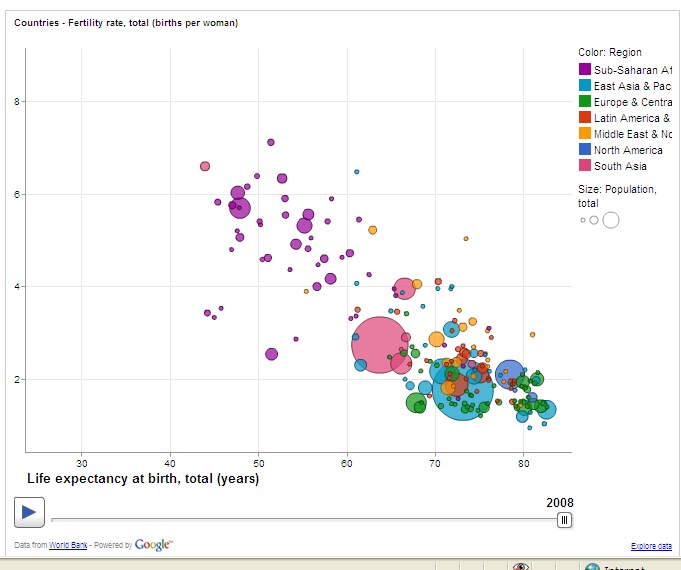
More evidence that THESE are the good ol' days for most of the world?

Click on the link below to see this graphic in video. I clipped two screen shots for illustration.  One shows the fertility rate and life expectancy in 1960 for different parts of the world and the second shows the same variables in 2008.  Notice how dispersed they groupings are in 1960 and how tight (relatively speaking) they are in 2008.  Fertility rates and life expectancy have changed dramatically in 50 years (my life-time) for most of the world.  Seems like evidence that life is better today for most people in the world than ever before, or does it...What do you think???

WATCH: Amazing Video Chart Showing China's Fertility Rate Dropping Off A Cliff


These are a complement to this excellent Has Rosling video supporting the same conclusion...

Tuesday, December 28, 2010

Good ol' Days--Part 3---Shipping costs in 1960 relative to today...I was born too early!! The good ol' days are today...

Professor Mark Perry at Carpe Diem has done a series of "then and now" price comparisons using a terrific online resource from Radio Shack. They have put the ENTIRE contents of decades worth of their catalogs online. It is really fun to look at the catalog from my (or your) birth year. The pictures are fun to look at and for those of you who are really into the technical aspects of consumer electronics will be AMAZED at the detail they go into with each good. Don't see that anymore....

Dr Perry has focused on final goods, but I was curious about the transportation costs of getting a good delivered to you.  Below you will find the table from the 1960 catalog (my birth year).  If I wanted to buy something that weighed 11 pounds (easy to do the math) and have it shipped to me it would have cost $6.30 in 1960 (1st pound $.70 and each additional pound $.56).  I also used "Zone 5" estimating that the package would travel 1000 miles to get to me.  Using an inflation calculator, that would be $46.57 in TODAY's dollars! WOW!
Radio Shack Catalog--1960
From the US Postal Service website, I found the following:
Just guessing, but an 11 pound item would probably fit in either of the boxes on the right.  These are retail prices, so a large company like radio shack probably gets a significant price break on it shipping costs from the USPS.  Shipping costs are 3 to 4 (maybe 5) times cheaper today than in 1960.

Not only have the goods we buy today gone down in price but the transportation costs to get them to us have decreased significantly as well.  In the age of a global supply chain, it seems you could not have one without the other...

Sunday, December 26, 2010

""The Good ol' Days""-- Part 2...

(See Part 1 HERE)...Mark Perry at Carpe Diem gives further evidence that the "good ol' days" are TODAY, and as someone born in 1960 I tend to agree.  What gives money its value to the great un-washed is what we can exchange it for in the quantity and quality of goods/services.  You can extend this analysis to consumer goods across the board IF those goods are (1) bought in competitive markets domestically that are subjected to limited government interference through significant market distorting subsidies (private and public goods, i.e. education, medical care) and (2) subjected to international trade and competition.  Please visit this ENTRY many active links in this blog entry I did not include...

""Here's another comparison of consumer purchasing power in the 1960s versus today, based on the time cost of common household appliances like a kitchen oven. The Sears Kenmore oven pictured below retailed for $330 in 1966, which would represent 121.3 hours of work (about three weeks) at the average hourly wage in that year (ignoring taxes).


At the current average hourly wage of $19.10, today's average consumer would earn a little more than $2,300 working 121.3 hours, and would be able to furnish their entire kitchen with the new appliances pictured below (click to enlarge) from Best Buy including a high-efficiency front-loading washing machine, super capacity gas dryer, 30-inch gas stove, 8.8 cubic feet chest freezer, 16.5 cubic foot refrigerator, dishwasher, mid-size microwave and blender:


Measured by what is ultimately most important, the value of our time, household appliances keep getting cheaper and cheaper, thanks to innovation, technology improvements, supply chain efficiencies, increases in productivity and other market-driven efficiencies that drive prices lower and lower year by year. As much as we hear about declines in median income, economic stagnation, the disappearance of the middle class, falling real wages, increasing income inequality, the data tell a much different story: The rich are getting richer and the poor are getting richer.''

Friday, December 24, 2010

Which Christmas would you prefer? The one from the good ol' days of 1964 or the Malthusian days of 2010?..The choice is easy for me.

Ahhh...the good ol' days of the 1960's!! Ummm, not so much.  I think we suffer from a collective case of "good old day" syndrome.  You tell me, would you rather have the Christmas of 1964 or 2010? (HT: Carpe Diem)


Carpe Diem
 I remember my "rich" friends getting a T.V. like either one of these! The small white boxes on the picture show the equivalent of $749 and $799 in 1964 to today's dollars--$$5,300 and $5,650, respectively.  In other words, factoring in inflation, the purchasing power of $749 in 1964 is equivalent to the purchasing power of $5,300 today. Another way of looking at it, is that 1964 TV would cost you $5,300! Yikes! The true test of the value of money is what it can buy. Below are some examples of bundles of goods you could buy today with the equivalent of 1964 dollars.  I can buy ALL these today AND a better TV to boot,  than I could in 1964!:

Carpe Diem
AND

Carpe Diem


The ONLY reason I would choose 1964 is because I would only be 4 years old...Other than that, well...Perhaps THESE are the good ol' days!

Source CARPE DIEM:

""Bottom Line: For a consumer or household spending $750 in 1964, all they would have been able to afford was a console color TV from the Sears Christmas catalog. A consumer or household spending that same amount of inflation-adjusted dollars today ($5,300) would be able buy able to furnish their entire kitchen with 8 brand-new appliances (refrigerator, freezer, dishwasher, range, washer, dryer, microwave and blender) and buy 9 state-of-the-art electronic items (laptop, GPS, camera, home theater, plasma HDTV, iPod Touch, Blu-ray player, 300-CD changer and a Tivo recorder). And of course, even a billionaire in 1964 wouldn't have been able to purchase many of the items that even a teenager can afford today, e.g. laptop, GPS, digital camera.
As much as we might complain about high unemployment, high taxes, a huge deficit, we have a lot to be thankful for, and we've made a lot of economic progress since the 1960s as the example above illustrates, thanks to the "magic of the marketplace."""

Wednesday, December 15, 2010

Nice graphic on how some things have changed since the year 2000...

Technology use by the masses has really taken off in 10 years...Quite incredible if you stop to think about it...The price of gas intrigued me.  From 2000 until today (roughly $2.89) the price has increased 95%. Taking into account inflation, $1.48 in 2000 is the equivalent to $1.88 today (inflation calculator HERE).  In other words, if gas prices had simply increased in price along with the prices of everything else, as measured by the Consumer Price Index (CPI), we should be able to buy gas for $1.88 a gallon (a 27% increase).
Source HERE
View My Stats