Showing posts with label Poverty. Show all posts

Friday, May 31, 2013

1 Billion fewer people living in Extreme Poverty in the world just since 2000. Who (or what) is responsible for this miracle? Nice graphic here.

Here is a graph from The Economist showing the dramatic decline in the number of people in the world living on $1.25 per day (or less).  This is the formal UN definition of "Extreme Poverty". 

Focus on the span between 2000 and 2013 (guesstimate). The slope gets steep--approx 1 Billion people have climb above the $1.25 mark in 13 years.  Keep in mind, since 2000 the world population has GROWN by about 800 million as well

While this is good news, the drop was not evenly distributed.  China alone is responsible for about 75% of the decrease.  Of course, this is mostly due to the rapid industrialization and globalization China set in motion with more market orientated (very loose and generous definition) policies in the 80's and 90's.


Source: The Economist

Wednesday, August 10, 2011

A simple, inexpensive product is saving lives in Somalia...Why do the inventors of this product NOT have a Nobel Prize?

I learned something new today. It is one of those things that makes me wonder why the inventors of this product have not won an Nobel Prize.  At the minimum, they should be featured on "Oprah"!!!

The product is called "Plumpy'Nut" and it is an easy to administer, peanut base food, that is fed to extremely malnourished people.  It is playing a major role in the current human tragedy in Somalia. It is very inexpensive and easy to prepare and feed to children.  Apparently it actually tastes good too.

 Anderson Cooper interviewed someone about this product (he may have been a rep for the company, but I don't remember). Anderson asked him about the dangers for a child that might have a peanut allergy.  The person said something that really surprised me AND Anderson too: Peanut allergies are an issue in developed countries and not in under-developed, especially very poor ones.  I had never heard this before.  I could not find a definitive reason for this, but the "Hygiene Hypothesis" seemed to make sense to me, but I cannot vouch for its veracity:

""In medicine, the Hygiene Hypothesis states that a lack of early childhood exposure to infectious agents, symbiotic microorganisms (e.g., gut flora or probiotics), and parasites increases susceptibility to allergic diseases by suppressing natural development of the immune system.[1] The rise of autoimmune diseases and acute lymphoblastic leukemia in young people in the developed world has also been linked to the hygiene hypothesis...""


In other words, a high(er) level of hygiene makes us less immune to potential allergies of all types.

Whatever...This is a good lesson for students and how they can impact people with science and technology.  You may not be a "Do-Gooder" in the classic sense of helping people directly, but your research and development skills/knowledge may do more good than anything else.

Saturday, June 25, 2011

This "Summer" we need to "Fall" for the Arab "Spring" or it will be a dark "Winter" for seasons to come for us. The issue in one chart here...

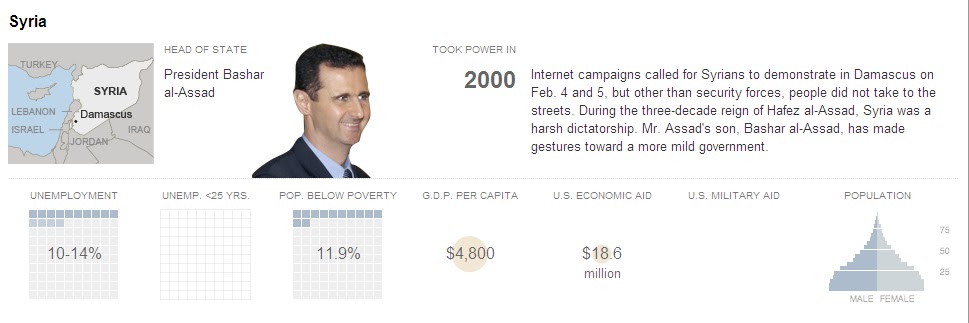
Further evidence (for me) that the underlying reason for the "Arab Spring" movement in the Middle East can be explained in economic terms.  The chart below shows the rate of unemployment for young(er) people in select Middle Eastern countries relative to other parts of the world.  Below that are snapshots of most of the countries represented in the chart.  Focus just on the population pyramids in each one.

There is a toxic mix of a lack of economic opportunity AND a demographic balance tilted toward the very young.  Also, as noted here, "In contrast to most of the world, joblessness in many Middle Eastern countries tends to increase with schooling: the unemployment rate among those with college degrees exceeds 15 percent in Egypt, Jordan, and Tunisia."

Hmmm...lots of young, educated people with access to technology, diffuse knowledge of the "outside" world and a lack of opportunity domestically---Change in the region is inevitable--regardless of the despots actions today...   

Source: The Conversable Economist


Saturday, May 21, 2011

While the giant slept the world moved on to eradicate poverty...We just don't get what is happening in the rest of the world.


Source: CSM
  The world is changing rapidly and is becoming less dependent on the success of the US.  We are still very relevant but, in my opinion, the economic success of the rest/most of the world is eroding our status .  And, I fear, we are letting them.  1.4 Billion  Chinese, 1.3 Billion Indians, 190 million  Brazilians, AND the continent of Africa are rapidly developing middle-classes. These middle-classes are not to be confused with the US middle-class, which in dollar terms is way ahead of the aforementioned countries.  BUT the purchasing power of 100's of millions of people is increasing at an increasing rate.  Rising incomes around the world should not be seen as a problem for us, but an opportunity.  Instead of complaining about the "fairness" of trade with the rest of the world, I would prefer we as a nation welcome them out of poverty and ask if there is anything we can sell them (YES! We do make stuff!) that they would FREELY like to buy from us...THAT is what a competitive country does. 

Surging BRIC middle classes are eclipsing global poverty

The world will, for the first time in history, move from being mostly poor to mostly middle-class by 2022, the Organization for Economic Cooperation and Development projects. Asians, by some predictions, could constitute as much as two-thirds of the global middle class, shifting the balance of economic power from West to East. Already, some analyses of International Monetary Fund data suggest that the size of the Chinese economy could eclipse that of the United States in just five years.


By 2030, the global middle class is widely projected to at least double in size to as many as 5 billion – a surge unseen since the Industrial Revolution. This boom, however, is more global, more rapid, and is likely to have a far different – and perhaps far greater – impact in terms of global power, economics, and environment, say economists and sociologists.

But today's middle-class boom is unlike the Industrial Revolution, in which rising prosperity became a catalyst for increased individual and political freedom. Those in the emerging global middle classes – from an Indian acquiring a flush toilet at home to a Brazilian who can now afford private school to a Chinese lawyer with a new car in the driveway – are likely to redefine their traditional roles, and in doing so, redefine the world itself. 
 "I would expect that as the global middle class gets transformed by the entrance of hundreds of millions of Indian, Brazilian, and Chinese families, the concept of what we see as the middle-class values may change," says Sonalde Desai, a sociologist with the National Council of Applied Economic Research in Delhi (NCAER). "Historically, sociologists have defined 'middle class' as those with salaries…. I think 'middle class' is very much a state of mind."
View My Stats