Showing posts with label Commons. Show all posts

Friday, May 30, 2014

Why we can't have nice things---"Disaster Assistance to New England fisherman edition"

Why we can't have nice things---"Disaster Assistance Edition".

Below are two articles on the same topic---Federal disaster assistance for fisherman in New England.  

What is/was the "disaster"?   Federal regulations restricting the catch of certain types of fish due to, well, over fishing.  Yup, that's it. 

What gets me is the disaster aid morphs into something more, or maybe the right word is less---notice in SOME of the compensation goes to the fisherman, but most (a majority) goes to other entities for other things that don't directly aid the fisherman in need.

Cash starts to drift into less disaster affected related areas. 

NH fishing industry receives $2M in federal fundsHalf of the aid will go to groundfishermen

Kendall said according to the formula, those who qualify may receive about $32,800 each from the disaster relief fund. At this point, it’s still unclear how many will qualify, although Kendall expects everyone may. 
At the meeting on Tuesday, the industry will learn how the remainder of the money will be spent. The agreement outlines how the disaster relief funds will be distributed to support New Hampshire’s fishing industry. The money will come down from the federal agency and go to New Hampshire Fish and Game for distribution, Kendall said. 
Some of the remaining million dollars could go to help with (commercial fishing) infrastructure, like the Cooperative,” Kendall said. “And some may go to recreational charter fishing boat captains, who are also affected. We should find that out on Tuesday.

RI fishermen to receive nearly $2 million in disaster aid

Under the plan, one-third will provide direct assistance to fishermen, one-third will go toward states to support their commercial fishing industry and the final third will be held by the National Marine Fisheries Service for a possible program to pay fishermen to leave the industry.
“This is an important step to get money directly to fishermen and provide Rhode Island and other states with additional resources to respond to the unique needs of their fishing communities,” U.S. Sen. Jack Reed, D-RI, said in a statement.
This last paragraph REALLY bugs me.  Everything after "This is an important step to get money directly to the fisherman..." needs to go away.  This is Cronyism , pork, whatever you want to call it.

Federal Disaster Aid to fix the broken window is fine with me.  But not if all the window needs is a cleaning.


Wednesday, June 8, 2011

How do we keep the elephant from becoming extinct? Easy! Let people shoot them, eat them and sell the ivory. Get over your squimishness. The elephants NEED you to support this!!

Below is a graphic (HT: Carpe Diem) comparing the elephant population of Kenya and Zimbabwe from 1970 to 2011.  You can see they run counter to each other. Why? It is the result of how each country dealt with the problem of "The Tragedy of the Commons"...Kenya banned hunting of elephants and Zimbabwe gave ownership rights to the elephants to local communities. It may be distasteful to many the way they went about saving the elephant from extinction but they, well, saved the elephant from extinction.  Please read the excerpt below and at least consider the effectiveness of this approach. The elephant population needs you to help them survive!   
Source: Carpe Diem
 The following is from Defining Ideas (HT: Carpe Diem)

In the 1970s, Kenya had about six times as many elephants as Zimbabwe, and today Zimbabwe has three times more elephants than Kenya (see chart). What happened that caused the dramatic reversal in elephant populations in the two African countries?


Terry Anderson and Shawn Regan of the Property and Environment Research Center (PERC) explain in their excellent article "Shoot an Elephant, Save a Community":

"Anti-hunting groups succeeded in getting Kenya to ban all hunting in 1977. Since then, its population of large wild animals has declined between 60 and 70 percent. The country’s elephant population declined from 167,000 in 1973 to just 16,000 in 1989. Poaching took its toll on elephants because of their damage to both cropland and people. Today Kenya wildlife officials boast a doubling of the country’s elephant population to 32,000, but nearly all are in protected national parks where poaching can be controlled.

In sharp contrast to Kenya, consider what has happened in Zimbabwe. In 1989, results-oriented groups such as the World Wildlife Fund helped implement a program known as the Communal Areas Management Program for Indigenous Resources or CAMPFIRE. This approach devolves the rights to benefit from, dispose of, and manage natural resources to the local level, including the right to allow safari hunting. Community leaders with local knowledge about wildlife and its interface with humans help establish sustainable hunting quotas. Hunting then provides jobs for community members, compensation for crop and property damage, revenue to build schools, clinics, and water wells, and meat for villagers.

By granting local people control over wildlife resources, their incentive to protect it has strengthened. As a result, poaching has been contained and human-wildlife conflicts have been reduced. While challenges remain, especially from the current political climate in Zimbabwe, CAMPFIRE has quietly produced results with strikingly little activist rhetoric.

Between 1989 and 2005, Zimbabwe’s total elephant population more than doubled from 37,000 to 85,000, with half living outside of national parks. Today, some put the number as high as 100,000, even after decades of legal, trophy hunting. All of this has occurred with an economy in shambles, regime uncertainty, and mounting socio-political challenges."

Saturday, June 4, 2011

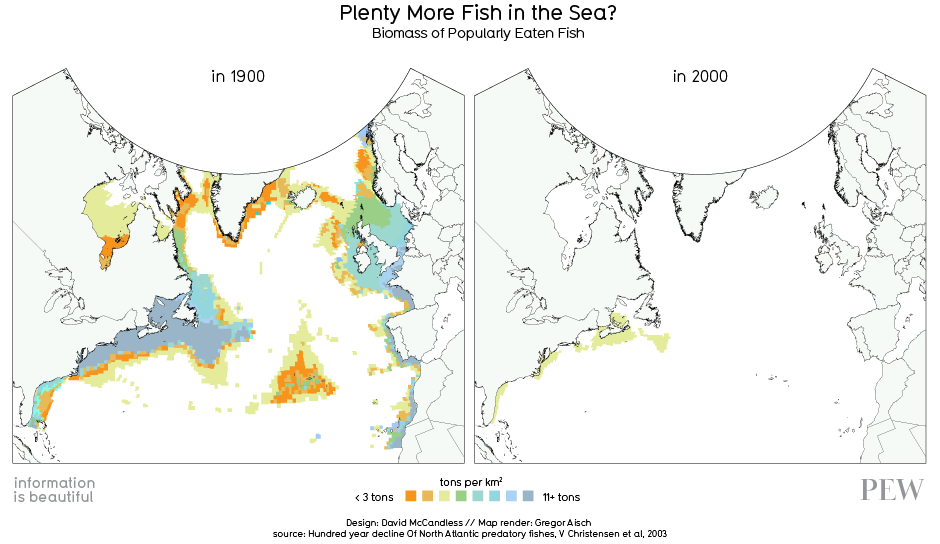
Tragedy of the Fishy's Part 2---Nice map showing the depletion of major North Atlantic fishing grounds...We can stop trying to Find Nemo now. He is gone...

Not exactly sure how they got the data from 1900 to make this map....but there is no question that the major fishing areas of the North Atlantic are getting  fished-out.  While many efforts have been tried to reign in commercial fishing, the "Tragedy of the Commons" is playing out in this situation. 


Source: HERE HT: Paul Kedrosky
 

Saturday, January 22, 2011

The US loses more ground in a measure of Economic Freedom--From Free to Mostly Free...I don't like the sound of that..


The Heritage Foundation
 A highly regarded survey of economic freedom shows the US losing ground in economic freedom, by their metrics.  We have moved from "Free" to "Mostly Free". Not a good turn of events...Look at the whole survey to get a better perspective.

The 2011 Index of Economic Freedom

"The U.S., which fell from the ranks of “free” economies to the “mostly free” category in 2010, continued to lose ground. Its score slipped by 0.2 points to 77.8, dropping its world ranking to 9th place, one slot behind an improving Denmark.

The U.S. lost ground in four of the 10 economic freedoms measured by the Index, with the greatest decline resulting from the explosive growth of government spending. Monetary freedom also declined. “Government interventions in housing, automotive, health and financial markets have substantially increased price distortions,” the authors note. “Drastic legislative changes in health care and financial regulations have retarded job creation and injected substantial uncertainty into business investment planning.”""

Thursday, January 20, 2011

Step right up and get your Lion tacos! What? Hmm...Maybe this is the BEST thing that has happened to them as a species.

Is this the BEST thing that could happen to Lions as a species?  Apply what you know about "The Tragedy of the Commons" and private property rights to analyze this issue.  An uncomfortable topic, but is it a solution to preserving not only lions but elephants, gorillas, tigers, whales, and many other endangered species?
.
Boca, gaining a rep for exotic tacos, plans lion-meat offering


""In the six months since it launched Exotic Taco Wednesdays, Boca Tacos y Tequila has served up python, alligator, elk, kangaroo and rattlesnake.
Frog legs, turtle, duck and Rocky Mountain oysters have also made appearances.
"We've done just about anything we can get our hands on," said owner Bryan Mazon. "Every Wednesday we do something a little bit different."


Last week he announced on Boca's Facebook page that the UA-area taco shop was accepting prepaid orders for African lion, to be served on Feb. 16. Orders must be placed by 3 p.m. Feb. 7.


"I've gotten a lot of questions, like if it's legal," said Mazon, adding that a few lion tacos have been reserved so far. "We're still a month out, too."


According to the Food and Drug Administration, lion and other game meat can be sold as long as the species isn't endangered.""

Thursday, December 30, 2010

If you shovel snow from a public parking space, can you "save" that space for yourself? Show your work for full credit...


Interesting how circumstances can change the way people think about public property.  Just because someone shoveled a space they feel entitled to it.  Perhaps these residents are using this passage from John Locke "Two Treatises on Government" to justify their attempt at co-opting of public property:

""The labour of his body, and the work of his hands, we may say, are properly his. Whatsoever then he removes out of the state that nature hath provided, and left it in, he hath mixed his labour with, and joined to it something that is his own, and thereby makes it his property. It being by him removed from the common state nature hath placed it in, it hath by this labour something annexed to it, that excludes the common right of other men: for this labour being the unquestionable property of the labourer, no man but he can have a right to what that is once joined to, at least where there is enough, and as good, left in common for others.""
However, I don't believe Locke would not approve of using his words in this case with land legally appropriated for use "in the common"--it is no longer "in the state of nature"--or is it? If government fails in its duty to preserve the property in common (not plowing the road for the safety/convenience of its citizens),should/could it not be considered plunged back into the state of nature?  It would be an interesting episode of COPS to see a resident use Locke to justify  his place-holding of a public parking spot...I am guessing that would end with a tasing.

Monday, November 22, 2010

A common tragedy has been avoided in Mexico---they CAN see the forest for the trees!! And that is a good thing...

Granting ownership of a resource to the people most vested in seeing it used efficiently will enhance the sustainability of that resource for years/generations to come. When a community sees the government does not care about the sustainability of a resource, then they tend to join in the pillaging of that resource to get what they can out of it as well.  There is no incentive to preserve and conserve. Secure individual or local community rights changes that dynamic.  While this may not work in all circumstances, the world could use a little more of it to avoid the tragedy created by The Tragedy of the Commons.  This is a nice article about the success of transferring private property rights from "the people" to actual people...

NYTIMES: Growing a Forest, and Harvesting Jobs, in Mexico

“We’re the owners of this land and we have tried to conserve this forest for our children, for our descendants,” Alejandro Vargas said, leaning on his machete as he took a break. “Because we have lived from this for many years.”


Three decades ago the Zapotec Indians here in the state of Oaxaca in southern Mexico fought for and won the right to communally manage the forest. Before that, state-owned companies had exploited it as they pleased under federal government concessions.


They slowly built their own lumber business and, at the same time, began studying how to protect the forest. Now, the town’s enterprises employ 300 people who harvest timber, produce wooden furniture and care for the woodlands, and Ixtlán has grown to become the gold standard of community forest ownership and management, international forestry experts say....
View My Stats