Showing posts with label College Advice. Show all posts

Thursday, May 29, 2014

Chart showing why AT THE MINIMUM you should go to (and finish) a Community College.

The Upshot at the NY Times has a terrific analysis (and the bar chart below) of how important the Community College systems is in the US.  Personally, I don't think it gets enough attention and should be much more high profile.  It needs to be a integral part of preparing the workforce for the present and future.

Note how close the unemployment rate is to those with a bachelors degree.  A "2-year degree, occupational" trains you to do a specific job.  This statistic should be one that schools, teachers and counselors shout from the rooftops!!

I went to a C.C. to get, quite frankly, some confidence that I could do college.  I was not a good student in high school.  I went into the Marine Corps for 4 years.  After I got out I knew I wanted to go to college but thought for a variety of reasons I could not cut it.  We can get caught up in our insecurities to our detriment.

Turns out to succeed in college all you need is some self-discipline, perseverance, a willingness to ask questions and a desire to find the answers.  Who would have thunk'?

Anyway, props to the C.C. system and I hope you get the attention you deserve.

Source: The Upshot at NYTIMES

Tuesday, May 27, 2014

Nice graph(s) putting Student Debt levels since 2005 in perspective

From the St Louis Federal Reserve ("The Share of Borrowers with High Student Loan Balances is Rising")

The top graph shows the ratio of outstanding student debt in a particular year to the debt level in 2005. For example, take the time period of between 2011 and 2012 (I inserted an RED vertical line).

Total Student Debt (top green line) was 2 times what it was in 2005.

The number of debtors is about 1.58 times more than in 2005.

The average balances held by debtors was about 1.3 times as much as those in 2005.


The bottom bar chart shows, in percent form, the change in debt levels from students in 2005 and 2012.

In 2005 about 56% of student loan balances were $10,000 or less (darker bar). In 2012--40% (lighter bar)---PROGRESS, right!! Not so fast.

The difference essentially moved to the higher average debt levels.  Notice the light bars get significantly higher than the dark bars as average debt levels increase, showing a larger (1) nominal change and more importantly (2) a significant percentage change from one time period to another.

For instance, the change in average balances in the $25K-$50K went from 11% to 18% (eye-balling).  That is a 7% percentage point increase, but NOT a 7% increase in average loan balance. The percentage increase would be (18% - 11% = 7% and 7%/11% X 100) +64%.

If you are already in college you are well aware of this.

If you are thinking of going to college you should be aware of this.

If you are a teacher of High School students you should be aware of this AND make your students aware of it also.

Hope this helps.

Wednesday, March 20, 2013

Why are women obtaining college degrees at a much higher rate than men? Do the guys need a little extra help??

I saw this graphic in an article at The Atlantic illustrating the "colleg degree gap" between men and women in cities/metropolitan areas around the US.  The article is very interesting. Worth a read.

I have to admit, the disparity took me a bit by surprise.  As of 2011, as a percentage, women earned 27% more college degrees than men earned (36.1% - 28.4%/28.4% X 100). That seems statistically significant, even to a high school economics teacher.

What are the social implications, if any, of this trend? Do we need more Affirmative Action policies for men from all the groups listed below? 
Source: The Atlantic

Sunday, August 19, 2012

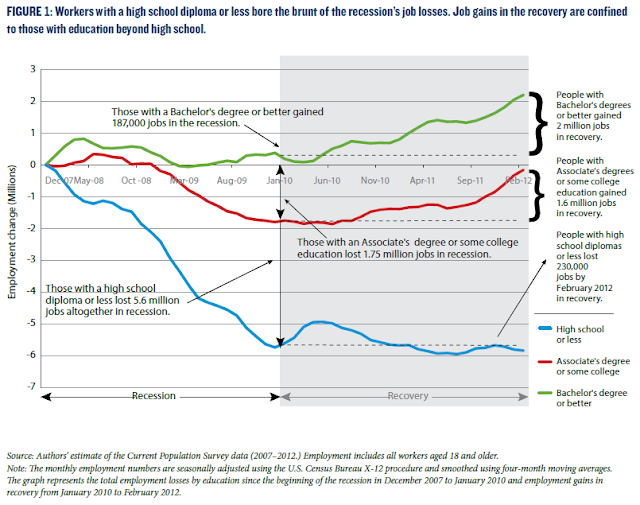
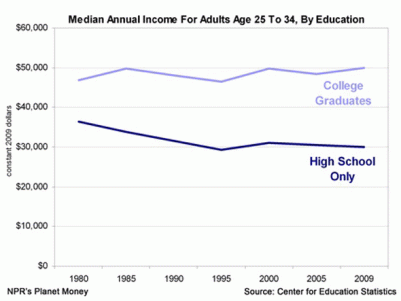
Teachers: If you need a quick visual to emphasize to students the link between education and employment show them these graphs. Students: If you need a reminder as to the importance of education and future employment, PLEASE look at these too.

There is a lot going on in this first graph, but it is important to know what is happening.

The vertical axis shows the percentage change in employment (jobs gained) since the official start of the Great Recession, through the official end of the recession (everything to the left of Jan 2010) and finally through the "recovery" to the present (everything in blue).

Note the bold brackets to the right showing the numerical change in jobs based on the level of education a worker has. 

More education does not guarantee you anything but statistically you are more likely to (1) find a job, (2) not lose your job, (3) if you do lose your job you are more likely to find another one in a shorter period of time.

Source: KPC


 This second graph shows the value of education over an extended period of time--since 1989.

Dropping out or even finishing high school is not enough. ANY type of additional education will help you gain skills that make you more valuable to employers. 

Source: KPC

Monday, November 7, 2011

My short commentary on a graph that all students in college (or going to go) should see and think about...

Below is a selective grouping of college majors to illustrate the point that since 1985 there has been a rapid increase in the number of students getting degrees in majors, that, well, for the lack of a better term---don't have much earning power in the marketplace.  (Go HERE for the original source for this and a more extensive discussion)

The number of students that get degrees in majors that DO have earning power in todays marketplace has not changed much at all (Note that this number does NOT included foreign students receiving a degree from a US college--that number is relatively large!).

Students that spend/borrow LOTS of money to get a degree with limited earning power  need to understand this from the get go.  I am not saying this because I dont think these majors are important. That would not be true.  You need to do what is best for you. However, to not consider your earning potential, especially when you have to pay for it yourself, is not being responsible to your "future self" that has to live with a loan debt to pay back..
Source: Marginal Revolution

Sunday, August 21, 2011

Here are 5 Money Tips for College Freshman---so simple, yet so difficult to achieve--BUT TRY!!

Five Money Tips for Every College Freshman (Wall Street Journal)

Freshman year of college can mean countless adjustments -- from sharing a room to hours of free time between classes. It's also some young adults' first taste of relative financial independence.

With that in mind, we've asked financial advisers to give freshmen five money rules to remember:

1. Live like a student.

Not like a rock star. Before heading off to school, create a budget for the semester using a free online personal-finance site such as Mint.com or start tracking your cash flow using software such as Quicken, says Jeremy Portnoff, a certified financial planner at Portnoff Financial in Westfield, N.J.

 Mr. Portnoff says setting a budget for both big-ticket items such as books and incidentals such as Friday night pizza will help ensure that you don't run out of money by Thanksgiving. Also, consider switching to a bank with an ATM on or near campus to avoid unnecessary fees, he says.

Mark Kantrowitz, publisher of financial-aid site FinAid.org, says your total debt at graduation should be less than your expected starting salary. "If you borrow more, you may still be repaying student loans when your children enroll in college," he says.

2. Show your ID.

You can get discounts with your school ID on everything from Broadway tickets to off-campus restaurants. If you don't already own a computer, you might find a cheaper deal by checking the discounts your school offers, says Matt Dobbie, a MassMutual financial adviser in Camp Hill, Pa.

You also can save with the $20 Student Advantage card, which provides 20% off standard Greyhound fares, 15% off Amtrak and discounts at online retailers such as BarnesandNoble.com and Target.com. Taking advantage of student discounts with friends can help avoid some of the peer pressure to spend above your means, says Mr. Dobbie.

3. Get a job.

The tab for spring break and dinners out with friends can add up quickly. Getting a job can help fill in a budgeting shortfall or, ideally, reduce how much you need to borrow, says June Walbert, a San Antonio-based certified financial planner at USAA, a financial-services company for people with military ties.

Look for work on-campus or at local restaurants or clothing stores. Even baby-sitting, house sitting or starting up a business -- provided it doesn't become all consuming -- shouldn't be ruled out.

4. Protect yourself.

Even with no or little assets, identity theft can be an expensive and nasty headache. "Guard your Social Security number with your life," says Steve Curley, an Orlando-based certified financial planner at Water Oak Advisors. Be especially wary of signing up for multiple "free" credit cards since infrequent use can increase the likelihood of identity theft going undetected. Shred old credit-card statements and bills, avoid using shared campus computers to conduct online banking, and take caution when using mobile devices to access bank records, Mr. Curley says. Also, get in the habit of checking your monthly bank and credit card statements for suspicious activity and reviewing your credit report annually. You can get a free report each year at AnnualCreditReport.com.

5. Start saving.

It's never too soon to start saving, says Bruce Barton, a San Jose, Calif.-based certified financial planner at Parkworth Wealth Management. "Even saving a modest amount like $25 a month helps you learn good saving and investing habits," he says. Mr. Barton recommends students open a Roth individual retirement account with extra cash from their summer job, tax refund or birthday money they may receive from family.

And when he gives financial-literacy workshops to clients' college-bound children, Mr. Barton is sure to point out the "magic of compounding," which shows students how saving a seemingly small amount today can add up years down the road.

Tuesday, August 2, 2011

Nice graph contrasting educational attainment and employment levels. I also see income inequality, don't you?

It is generally accepted that the mantra "the more you learn, the more you earn" is still valid even in our changing economy. Perhaps more so now.  How much of the increasing income gap in the US can be attributed to the "knowledge gap". The graph below contrasts college graduates (use scale numbers of the left) with high school dropouts(use number scale on the right) and their respective employment levels. These represent the extreme ends of educational attainment, so you have to assume the other levels (HS grad, some college, Associates Degree, Trade School, etc) are somewhere in between.  Notice the relatively constant upward trajectory for college graduates--I see an explicit knowledge gap and an implicit income gap. 
Source: Carpe Diem
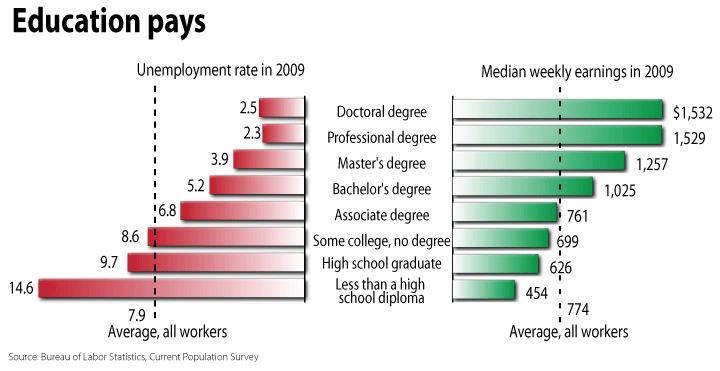
In the chart below, look at the income data on the right. While this is just a snapshot of income comparison in one year, I am going to go out on a limb and guess if you take data 15 years before and 3 years after 2009 you will find the same trend---increasing income inequality based on level of education. 
Source: Wikipedia

Tuesday, July 26, 2011

College and Cigarettes---What do they have in common? You smoke one (but DON'T!) and the other smokes you (well, at least your wallet)...

Well, they both burn though your money--one figuratively and one literally.  Since 1970 the cost of attending higher education has increased 1,000%, medical care approx 550%, housing approx 420% and the price level of ALL things measured in the Consumer Price Index (including the items already mentioned) approx 375%. Do you ever ask yourself WHY college, overtime, has increased in price much more relative to ANYTHING else in the economy? Opps, an exception below...
Source: Carpe Diem

Cigarettes and tobacco products have increased more. We know that is because taxes have increased on those products significantly. Higher education is not heavily tax, BUT it is heavily subsidized. It that the root of the problem? We all know how much we PAY for college, but I believe no one knows how much it actually COSTS. Those are two different concepts.

Tuesday, July 5, 2011

Where's Waldo? Likely calling a moving company to book a move to China...Need more evidence that it is in your interest to know more about China? See this graphic, graphic...

We can choose to view China as a problem or as an opportunity. The Genie IS out of the bottle and my advice for young people is to seriously look at what you can to do to prepare yourself for a future with a more prosperous China. Can't ignore hundreds of millions of potential new customers for US goods and/or services.

Below is a graphic from moving company data on international corporate moves. If you are in college, or are about to be, then consider mixing in a little instruction in Mandarin.  Spend a semester there.  Regardless of your major, whether it is medical, technical, business, marketing, etc, it will only enhance your marketability.   


Source: WSJ

Movers Pick Up China Business

""The rising numbers of U.S. workers and students moving to China are a bright spot for moving companies like St. Louis-based UniGroup Worldwide, which has seen domestic business decline.

The closely held company, an affiliate of Mayflower Transit and United Van Lines, handles moves for corporate clients that pay to relocate employees. Between 2008 and 2010, the number of moves from the U.S. to China it handled grew nearly 47% to 396. Meanwhile, United Van Lines saw interstate moves in the continental U.S. decline 26% to 146,837 in the same time period.


China was the third-most common international destination for UniGroup, behind the United Kingdom and Germany, according to the company, which handled more than 15,000 moves last year.

In part to handle the growth in Asia, since 2007, UniGroup has purchased offices in China, Hong Kong and Singapore, among other locations, said president Brian Iles.

Ernst & Young, which has about 9,000 employees in China, has hired more than 1,500 in the last year and plans to hire another 2,000 by next July, said Bin Wolfe, people leader for the company's Asia-Pacific region. Although most of those employees will be native Chinese, Ms. Wolfe said in the last couple years, more employees from the U.S. have sought to get experience in emerging markets such as China.

Chinese students studying in the U.S. are also increasingly moving back to their native country upon graduation, she said.

"There is a lot of competition out there. People with strong experiences and bilingual skills are in high demand," she said.""

Sunday, July 3, 2011

Colleges are accepting more out-of-state students for admissions for the extra money. Does this mean the admittance of FEWER in-state students? There HAS to be some impact "at the margin", right? See interesting statistics here...

Interesting college admissions numbers from California. The acceptance of out-of-state (Foreign students included in this statistic too) has increased dramatically just in one year. As high as a 100% increase and some schools. With budget cuts, they are aggressively accepting more out of states students than they may have otherwise.  The obvious reason is out of state students pay a much higher tuition rate BUT do not cost anymore than an in-state student.  A negative---Does this potentially "crowed out" the admissions of in-state students seeking admittance to a California college/university?  A positive---does this allow the university system to keep tuition rates lower for California residents than they otherwise would be, even at the expense of admitting fewer in-state students?

Source: Matthew Yglesias
HT: Mattew Yglesias

Saturday, June 25, 2011

More evidence that you need to obtain Higher Education---see graph and explanation here

This graph shows the change in income over time between someone with a college degree vs a high school diploma. Notice on the tail end to the right that the lines start to move in opposite directions.  Before this time period they pretty much moved together (exception is between 1980 and 1985).  I want to emphasize that this does NOT mean that someone with solely a HS diploma will not succeed financially. These are moving averages. However, you will notice the decline in income for those with HS degree only. Also, This graph is not counting people with associate degrees or some other type of technical skills based education/training.  I would assume if you graphed the incomes of this class of people, the line would fall somewhere in between these two. 

Source: Business Insider
From all that I read in the business/economic literature, I believe this trend will continue. We are in the midst of a higher skills based economy, not only domestically but globally.  Like it or not, for most of us, it is a necessity to obtain, whether through college or other advanced educational institutions, and maintain the highest skill set we possibly can.  We may not like it, but that is simply the way it is.  We (maining you) gotta get on board with it...

Saturday, May 28, 2011

My back of the envelope analysis of why it makes Sense AND Cents to take AP classes and the AP tests seriously. By my count it is costing you AT THE MINIMUM $25,000 by not doing so! YES, that number is right...See my calculations...

How much is NOT taking AP classes and AP Tests costing you in REAL dollars? The calculation below will give you an idea of how much it costs you to forgo the rigor of Advanced Placement classes.  It is difficult to account for all costs, explicit or implicit.  I believe the bottom line number I arrive at is a LOW figure because of the particular number I use for tuition, room and board.  Read it and let me know of any other "opportunity costs" I have left out that will either INCREASE the difference or DECREASE it.  I am open to revision of these numbers...

Here is my step by step analysis of why you SHOULD take AP classes and the AP test in those subjects:

Skip AP classes in High School---Go directly to college

1. Go to college and take 5 classes, which equals 15 credit hours towards a degree.

2. Estimated  cost of attending a Public University in Texas  $8,000 (room, board, tuition, books,etc) to take 15 credit hours. This is an UNDER ESTIMATION!

3. To put this in perspective, if you had a job earning $8.00 per hour (net after taxes) you would have to work 1,000 hours to earn the money to pay a semesters tuition.  This is probably an OVER ESTIMATION or your net hourly wage.

4. 1000 hours/40 per week = 25 weeks of work (almost 6 months) to earn the money to attend college for 1 semester!!

5.  This assumes ALL your earnings went to pay for college and nothing else.

6. If you have to pay living expenses out of your paycheck, you may have to take out a loan, so add that to the cost of a semester. For simplicity, we will leave that out of the equation.

7. Your total cost for a semester of college for our purposes is $8,000,  and most likely more.

Now assume you took AP classes in High School.

1. Take 5 AP classes in High School. Take 5 AP tests and get a score that your college will take for credit

2. Each AP test costs $56

3. Total cost for AP tests $280.00

4. Assume you study an extra 10 hours a week for AP classes relative to non-AP classes.  We have 36 weeks of school  X  10  hours per week = 360 hours of extra study time

5. Assume we account for the money you “lost” by not working and studying instead---$8.00/hr X 360 = $2,800 (your opportunity cost of not working)

Lets total up what we have so far.

Your total cost of a semester of college WITHOUT AP tests= $8,000

WITH AP tests =$3,080 ($280 AP tests + $2,800 forgone wages)

The difference/savings =$4,920 WITH AP CREDIT

ALSO—you took care of a semester of college while still in high school (where you have to be ANYWAY). You can finish college a semester earlier than normal. You can get a full time job after getting your degree. Assume you get a job paying $40,000 per year (depending on your degree, add some (or a lot) or subtract some. That extra semester in college is costing you about $20,000 in income!! You have to add that into the above calculations.

Lost income by attending an extra semester of college = $20,000

The Total Cost of NOT getting 15 hours (1 Semester) of AP credit = $24,920

ANY QUESTIONS???

Friday, May 20, 2011

What are the regrets that the latest college graduates have about their education? This may be of interest to those of you in college or about to start...

This is from a recent survey of college graduates. All of these graduates would have started college before the latest recession.  Interesting how the largest portion would have chosen different majors.  I am assuming this is mainly because of the difficulty in finding employment in the current economic climate.  Perhaps those of you on the journey now can take heed in this surveys findings....

Source: Economix


Monday, May 9, 2011

A typical college student graduates with $22,900 in loans...I say this is AWESOME!! Read why here...

The graph below shows the average student debt load over time a student accumulates when they graduate from college---$22,900.  Yes, this is quite a bit of money, but NOT alot.  The income the average college graduate earns over the course of their working life will pay this back and MUCH MORE.  You are more likely to stay employed over time and if not, then more likely to find work sooner.  You are more likely to work in a job you actually like and have a passion for.  This is not to say people without degrees don't experience these things too, but the ODDS are much less then with a degree.  Is this piece of mind worth alittle (alot)?  What else could you spend/invest $22,900 on that will earn you a rate of return that amounts to several multiples of that $22,900.  It is the price of a moderately price car that will last you less than 10 years.   

While I agree that the price of college tuition is too high (whole other discussion), I am not sure so much hand-wringing should surround the level of debt. You get what you pay for, so don't go to school just to get a degree. Go to school to get an education (yes, there IS a difference) that will repay you not only in dollars, but in quality of life and piece of mind.  Where am I going wrong???? Take your shots.
Source: Real Time Economics

""In the long run, the investment is probably worth it. Education is a much better reason to borrow money than buying cars or McMansions, and it endows people with economic advantages that the recession and slow recovery have only accentuated. As of 2009, the annual pre-tax income of households headed by people with at least a college degree exceeded that of less-educated households by 101%, up from 91% in 2006. As of April, the unemployment rate among college graduates stood at 4.5%, compared to 9.7% for those with only a high-school diploma and 14.6% for those who never finished high school.""

Sunday, May 8, 2011

Should Engineering majors pay more in tuition than English majors? Is this an idea whose time has come??

Below is an article on charging students in certain majors more in tuition based on the earning potential of that major. This is a way of capturing, in the present, some of future value of your degree.  It SEEMS like a good idea.  Engineering, Science and Medical degrees are more "capital intensive", meaning they require more physical facilities than most other degrees.  These are expensive to provide and benefit a smaller part of the student body.  It is fair for latter group to subsidize the former?  I am not sure about this development. I welcome your arguments either way.

UNL tuition may vary by majors

An engineering student likely will make significantly more money after college than an English major.


So the University of Nebraska-Lincoln is proposing a new tuition structure to allow it to charge engineering students significantly more for a bachelor's degree than it charges English majors.

UNL Chancellor Harvey Perlman is scheduled to present a “differential tuition” proposal to the NU Board of Regents Friday.

Specific details are being kept under wraps until Friday's meeting. But the proposal is expected to allow UNL, for the first time, to charge more tuition for some undergraduate programs than for others.

It would be a watershed departure from the concept that all Nebraska resident undergraduates should pay the same tuition for their degrees — currently $198.25 per credit hour — no matter what they study.


Wednesday, January 19, 2011

Salaries of Top College Majors by starting and career mid-point pay...Economics is near the top...just sayin'...

DegreesDegrees
Methodology
Annual pay for Bachelors graduates without higher degrees. Typical starting graduates have 2 years of experience; mid-career have 15 years. See full methodology for more.
HERE is the source and a more comprehensive list...

Sunday, January 2, 2011

Tips for communicating with your collge professors by e-mail...Only one chance to make a first impression...

Here are some tips for e-mailing your Professors in college.  Most center around "growing up". Numbers 1, 8 and 9 would be my personal pet peeves ..(Source: Chris Blattman)


1. Kick the email address from high school. It’s time for “hot_muffin92@hotmail.com” and “mikey_g@gmail.com” to rest in peace.

2. Greet. Politely. Launching straight into the message is bad, but “Hi!” is poor form and “Hey Prof!” is an unmitigated disaster. “Dear” and “Hi” are fine, so long as you follow both by a name or title: “Hi Professor” or “Hi Mr. ____”.

3. On second thought, be careful with the Mr. and Ms. I could care less if strangers address me as Mr., Dr. or Prof. Blattman. Few of my colleagues seem to feel the same way. Sadly your approach must conform to the average (or even lowest common) ego. If you’re not sure if the person is a Dr. or not, three seconds on Google should tell you.

4. Capitalize and punctuate. otherwise we will lol at yr sad attempts

5. But not all punctuation. Of the exclamation point, Elmore Leonard said “You are allowed no more than two or three per 100,000 words of prose.” That’s roughly one exclamation point for every 500 messages you send. Use them wisely, for their overuse is the first sign of an immature mind. (Related, from Terry Pratchett: “Five exclamation marks, the sure sign of an insane mind.”)

6. Death to the emoticon. Keep them for your friends. And recall that, for centuries of the printed word, writers managed to convey sarcastic and funny without the semicolon and parenthesis. If you think your comment needs an emoticon, this is a sign you need to rewrite (or delete) the remark.

7. Avoid fancy typefaces or “stationery”. One word: cheeseball.

8. Be clear and concise. Write short messages, make clear requests, get to your point rapidly, and offer to provide more information rather than launch into your life story.

9. Don’t ask for information before you’ve looked on Google. “Can you send me paper X?” is annoying. But the best I’ve received: a request to explain the Cold War.

10. Don’t sound presumptuous. Many people are busy and important (and everybody thinks they are). If you are asking for anything requiring time or energy, it is courteous to be demure.

11. No quotes from famous people in your signature. See “cheeseball” above.
12. With your juniors, do the above as fastidiously as with your seniors. Allow me, momentarily, to break rule #11: ”Modesty is not only an ornament, but also a guard to virtue” – Joseph Addison

Saturday, December 11, 2010

If you are a Senior and applying for College NOW, PLEASE, PLEASE, PLEASE read these mistakes to avoid! The MOST important one is #2, followed by #1...

Number 2 is near and dear to my heart as an AP teacher and requires no explanation. It is self-evident, in my opinion.  Number 1 is the one we need to work on at our school.  I think too many students get this one wrong. Many are "accumulators" when it comes to extra-cirriculars.  "Quality is always better than quantity" when it comes to deciding which activities to engage in. If I was an admissions officer, I am sure I could see right through the application where the student is an officer is a gazillion clubs and volunteers more time than Mother Teresa could have in her lifetime. Pick one or two activities and GO DEEP with them! Get something substantial accomplished and that will show through...

Five mistakes to avoid on your college application

1. Being too 'well rounded'

For many parents this may come as a shock, but colleges don’t necessarily favor the students with the longest list of extracurricular activities.
“Right now, the buzz word is really being ‘angular,’ ” says Lee Bierer, an independent college adviser who runs College Admissions Strategies in Charlotte, N.C. “Colleges aren’t looking for what I call ‘serial joiners’ ” who simply show up at various club meetings, she says. “What they’re looking for is a sustained interest, a commitment, responsibility, taking on a leadership role, showing commitment.”


2. Taking the easy path

Some students worry so much about getting high grades that they don’t take courses that really challenge them.


“Colleges would rather see students earn a C in an AP course or a B in an honors course than all As in standard academic-level classes,” says Michael Curtis, a high school counselor in Bucks County, Pa., who created the MyHSCounselor.com college-planning portal.


Don’t just take his word for it. Seven out of 10 college and university admissions officials rated “strength of curriculum” as a top factor in applications, according to the 2010 College Admissions Report by the National Association of College Admission Counseling.

3. Lapses on the online apps

About 80 percent of college applications are done online now. The Common Application, accepted by about 400 colleges, also makes it easy to streamline the process.


But it’s a digital danger zone, too. Imagine being an admissions officer at Princeton and reading a passionate essay about how a student would be a perfect fit for ... Yale. Yes, in addition to spell-check horror stories, students still manage to send off applications with the wrong school’s name embedded in the text. Be sure to proofread. And proofread again.


Another common mistake with the Common Application: forgetting that some schools require supplemental essays. If you don’t submit a complete application, it won’t even get a reading.


4. Dime-a-dozen essays

Now that students are applying to more and more colleges, they run the risk of making their applications more generic,” says Michael Pelly, who oversees admissions and financial aid as a vice chancellor at Chapman University in California.


Answers to application questions should be specific and should reflect an understanding of why you would be a good fit at that particular college, he says, just as résumés are tailored when applying for jobs. It’s easy to spot cut-and-paste answers, he warns.

When writing a personal essay, pick a topic that shows how you tick or what you care deeply about, says college adviser Lee Bierer. So many students now take service-oriented trips, for instance, that it comes across as clichéd to write about how much more fortunate you are than you ever realized.


Her ears perked up recently when one advisee mentioned that he has spent half an hour a day for the past three years practicing to be ambidextrous, because he read somewhere that ambidextrous people are more successful. “That’s an essay topic, “ she says, “something not every other kid has done.”

5. Procrastinating

Do your homework early. Research career ideas and colleges with majors that could lead to careers that interest you.


Don’t wait until the week before a deadline to ask a teacher or a coach to give you a letter of recommendation.

Don’t show up at an interview without knowing enough about a school to explain why you’d make a great contribution there. A surprising number of students start chatting about their intended major only to find, in embarrassment, that the college they are interviewing for doesn’t even offer it.


Research costs and financial aid thoroughly, and as early as possible. “Never overlook a college simply because of the published cost,” says Kris Roach, director of admissions and financial aid at the University of St. Thomas in St. Paul, Minn. “For many students, what they pay out of pocket for a college education is very different than the published price because of merit-based scholarships and need-based financial aid.”


And don’t delay filing financial-aid paperwork. Some stend to be doled out on a first-come, first-served basis.chools may have rolling admissions, but their grants tend to be doled out on a first-come, first-served basis.

Sunday, December 5, 2010

A bit of advice for college bound students---it is free and worth what you pay for it...maybe even a little more!!

PLEASE, PLEASE, PLEASE consider spending a semester (or two) in a foreign country when you are in college.  The experience will stay with you forever on a  personal level, but it WILL help you in your career/profession.  In today's marketplace you never know where opportunities may lead you.  Having this kind of exposure increases your value to an employer, EVEN if they don't send you overseas.

NYTIMES: When a Career Path Leads Abroad

Choosing the wrong person for an overseas job is costly, for both companies and workers. “The failure rate with international assignments is quite high,” Professor Teagarden said — people come home before their contracted time or they don’t achieve their goals. Business is lost, and professional and personal relationships can be damaged, she said.

That is why she and her colleagues at Thunderbird have identified a “global mind-set” — attributes of a successful overseas employee. For one thing, people who thrive overseas are drawn to variety and novelty, she said. For example, ask someone what types of food or television programs they like, she said. If their answers cover a wide range, she said, these are likely to be better candidates for an international assignment.

They also show resiliency and are willing to take risks, she said. “They may be a black sheep or the outlier at home,” she said, and the international assignment fills a professional void in their lives.
Her book focuses on women; she and Ms. Yeatman found that the women they surveyed who worked abroad (the typical assignment was three to five years) advanced professionally at a much faster pace than women who stayed in their home countries.
Like Ms. Berdan, Mr. Wall says overseas experience tends to help people’s careers — especially in the new, more global economy. “We really encourage international exposure and experience,” Mr. Wall said. “It creates a more well-rounded professional.”

Thursday, November 25, 2010

Need money for College? The Dallas Federal Reserve Bank Essay contest may be for you!

This is a great opportunity for you if you like to write and are at least a little bit interested in economics. You don't need alot of economic knowledge for this contest, but it helps! Check out the topic.  It is an easy one this year...From what I gather, they don't get alot of entries so you have a better than average chance of winning...Go to the essay contest webpage HERE for more details...I will be happy to assist you in getting started with your essay...

21st Annual Essay Contest 2011

Topic: Consume or Conserve?

Essay contest deadline: March 11, 2011

One of the basic questions of economics is the choice between consumption and saving. When scarce resources are used today, what is the impact? Will future generations lack important resources because they have been depleted? Can the use of some types of resources cause irreparable harm to the environment?

A variety of public and private initiatives seek to encourage consumers to conserve natural resources in order to slow resource depletion or minimize environmental impact.

Curbside recycling in a city

Land that is set aside through private or public initiatives

Mandatory fuel standards or tax credits for hybrid vehicles

Carbon taxes or cap and trade systems

Green building codes

The 2011 Economic Essay Contest, Consume or Conserve?, asks you to judge one of these conservation initiatives or one of your own choosing. Use basic economic concepts, such as scarcity and opportunity costs, and fundamental economic models, like supply and demand, to analyze the merits and effectiveness of a specific conservation plan or environmental regulation. The initiative that you analyze might be local, national or global in scope. In your essay, describe the plan and its benefits, evaluate the costs of the plan and draw a conclusion about the effort.

Contest Details

The contest is open to 11th and 12th grade students attending schools in the Eleventh Federal Reserve District, which covers Texas, northern Louisiana and southern New Mexico. Participants submit essays to the appropriate office of the Dallas Fed, as determined by the location of their school. See the list of Eleventh District counties to determine the appropriate office.
View My Stats