Showing posts with label Creative Destruction. Show all posts

Tuesday, August 15, 2017

Smartphone/Creative Destruction Cartoon. I see lots of consumer and producer surplus value. How about you?

Stop and think about ALL the separate and distinct products we used to have to purchase individually to do all the things a Smartphone can do today.

One way to think of Smartphones is it is a plus for the environment.  Think about all the resources, most non-renewable, that are not employed because they are contained in one small rectangular case.

I am not sure the real value of these devices is captured in the price we pay.  I have to think the surplus value far (?) exceeds the price.

What do you think?

Found on Twitter. No real source to cite.

Friday, May 16, 2014

Since 1994 we receive 150 more TV channels and but only watch an additional 7. Progress?

The number of TV channels the average person can receive in their homes has increased 375% (189.1-40.4= 148.7/40.4 X 100)

The number the average person actually watches has increased by 72% (17.5-10.2 = 7.3/10.2 X 100).

To put in in simpler terms, we get about 150 more channels but only watch an additional 7, since 1994.

Infographic: Many Channels, Few Watched | Statista

Friday, May 31, 2013

The High School Yearbook industry is being challenged. I say "AMEN TO THAT". Bet you do too. See here why...

 Creative Destruction is a term credited to economist Joseph Schumpter that describes the process by which market activity evolves to change or challenge existing market structures. In other words, new ideas, technology, innovation or processes emerge to replace current ways of providing goods and/or services (that is my simplistic explanation---go to the link above for much more detail).

One area ripe for this to take place is the stodgy business of High School Yearbooks.  For A LONG TIME the business has run on the same inefficient model.  Here is an article highlighting a young entrepreneur who saw an opportunity to challenge this traditional model:

Most Likely to Succeed  The school yearbook business is a scandal. Here’s how to fix it 

When Aaron Greco, a young tech entrepreneur, started sniffing around the yearbook business a few years ago, he was surprised by these shenanigans. The fundamental problem with the yearbook business, he realized, was that big yearbook providers were producing their books using offset printing—an expensive printing system that’s great for books with large print runs but that leads to high costs and little flexibility for yearbooks, whose print runs number in the hundreds or low thousands. Over the past decade, we’ve seen the rise of digital on-demand printing, which is now commonly used for photo books (the sort you order from Shutterfly or Blurb) and self-publishing. Greco had a brilliant idea: Why not use the same printing process for yearbooks?
This is a good example of the power of a free people operating in an open marketplace coming up with a better way of doing something and with hard work and perseverance challenge an existing market structure.

I highlighted "open" because if existing yearbook providers don't want to (or can't) compete then they may try to limit challengers by using the political process to put up barriers. That is called Crony-Capitalism. 

I hope this does not happen in this case, but it would not surprise me. 

We need more Creative Destruction, not less.  It makes the world a better place.

Sunday, December 9, 2012

Why has the price of computers decreased but the price of broadband internet connection increased (or HAS it?). If you need an analysis for a Microeconomics class this will be helpful.

...or a Macroeconomics class as well...

The author of this blog entry (found HERE and also pasted in full below the fold at the bottom of this entry) uses a graph to show how, in the last 5 years, the price of computers (BLACK arrow) has decreased over 40%  but the price of Broadband (RED arrow) has increased (slight, but an increase).

While the blog entry is very short it suggests (explicitly and implicitly) 2 Microeconomic and 1 Macroeconomic concept that are important for students to know.


(1) In Microeconomics, two goods are considered Complements if they are used together. They are separate and distinct goods, each with their own market price and cost of producing. They are largely dependent on each other to function profitably in the market place. 

When the PRICE of one of the complementary goods DECREASES (in this case computers), the DEMAND for the other good used with it INCREASES (Broadband Internet connection).  This makes sense.  People buy more computers so they need more internet access. This could be the reason, but...

(2) The computer market is vast and their are lots of competitors.  With more competition, prices tend to gravitate closer to the actual cost of production (this is a characteristic of a "perfectly competitive firm").  In broadband "production" this is less so:

"The high, fixed costs of broadband means that there hasn’t been a big rise in competition among providers, according to Scott Wallsten, Vice President for Research and Senior Fellow at Technology Policy Institute. Indeed, most Americans don’t have more than two options when it comes to wireline broadband providers...."


High fixed costs serve as a barrier to entry in markets. It takes very large upfront investments that may take years to re-cover.  Hence competition is more limited AND the producer is able to charge a price, dictated by the market demand for the good/service, that is something greater than the cost of producing.  In other words, the producer has pricing power ABOVE the Marginal Cost of producing extra units of the good/service.  This could be the answer, but...

The Macroeconomic concept comes from one the commenter's on the blog entry in regards as to how the Consumer Price Index is calculated and its accommodation for changes in the quality of a good or service over time. 

Is the price consumers paid for broadband in 2007 the SAME broadband they pay for in 2012?

If the price of broadband (consider it just a single good/service) has increased 10% since 2007  BUT the amount of speed, quality of the connection, and places I can access it has increased, say 50% or more, am I not better off per dollar spent?

Has the BLS fully accounted for this quality change and it is built into the price change noted in the chart, so in real terms broadband has increased 10%?  This could be the reason, but...

This is why I love Economics! All three answers COULD be correct!

What do you think?  Which one seems the likely culprit or am I missing a piece of the puzzle? 


Saturday, December 1, 2012

See the pictures here of how Amazon.com is going to cause a long and painful death for Walmart and other Brick and Mortar businesses.

I have not seen these pictures before of an Amazons.com's "Product Fulfillment Center".  Fancy name for gigantic warehouses around the country that serve a particular geographic area. 

It seems this should be something Wal-Mart fears long-term. 

Technological change advancement, peoples willingness to use that technology, and new patterns of buying behavior will serve to accelerate "creative destruction" in the retail sector. 

Saturday, September 24, 2011

Rising out of the dust of Creative Destruction: The resurgence of Vinyl Records. See the numbers...

Back to black:  Oddly, the hunger for records is widespread
ONE common trend in many Western countries, regardless of the health of their recorded-music markets, is clear: vinyl is back. Sales of LPs were up in both Britain and Germany last year. In America vinyl sales are running 39% above last year’s level (see chart). In Spain sales have risen from 16,000 in 2005 to 104,000 in 2010. That is an increase from a tiny base, but any rise in media sales in Spain’s ravaged market is noteworthy.
This is a second revival for vinyl. The first, in the late 1990s, was driven largely by dance music. Teenagers bought Technics turntables and dreamed of becoming disc jockeys in Ibiza. But being a DJ is difficult and involves lugging heavy crates. Many have now gone over to laptops and memory
These days the most fervent vinyl enthusiasts are mostly after rock music. Chris Muratore of Nielsen, a research firm, says a little over half the top-selling vinyl albums in America this year have been releases by indie bands such as Bon Iver and Fleet Foxes. Last year’s bestselling new vinyl album was “The Suburbs” by Arcade Fire. Most of the other records sold are reissues of classic albums. Those idiosyncratic baby-boomers who were persuaded to trade in their LPs for CDs 20 years ago are now being told to buy records once again.


What is going on? Oliver Goss of Record Pressing, a San Francisco vinyl factory, says it is a mixture of convenience and beauty. Many vinyl records come with codes for downloading the album from the internet, making them more convenient than CDs. And fans like having something large and heavy to hold in their hands. Some think that half the records sold are not actually played.
Vinyl has a distinction factor, too. “It is just cooler than a download,” explains Steve Redmond, a spokesman for Britain’s annual Record Store Day. People used to buy bootleg CDs and Japanese imports containing music that none of their friends could get hold of. Now that almost every track is available free on music-streaming services like Spotify or on a pirate website, music fans need something else to boast about. That limited-edition 12-inch in translucent blue vinyl will do nicely.

Monday, July 25, 2011

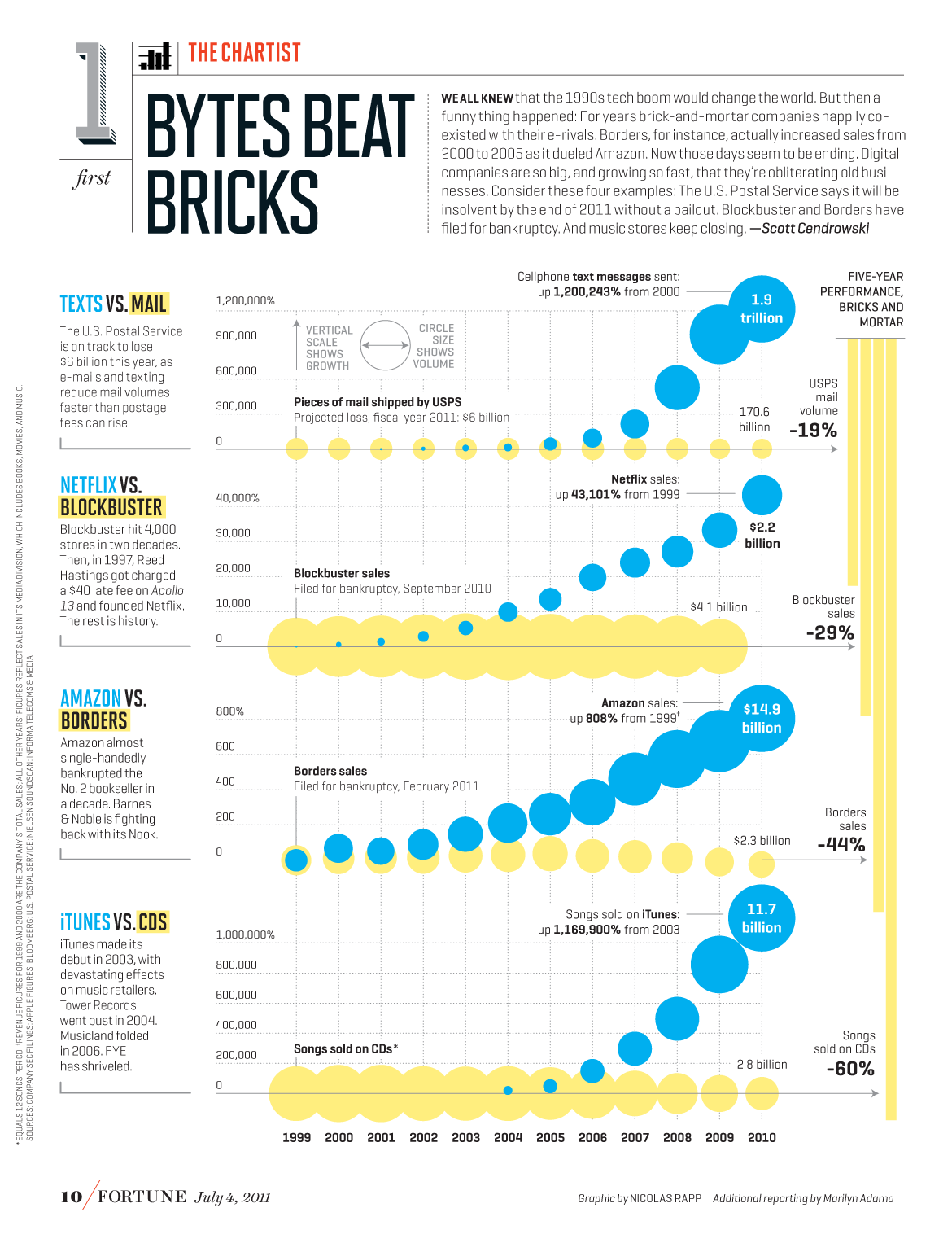
Texts Messages, Amazon, Netflix, and I-Tunes are responsible for Income Inequality in the US. This is what I see in this Infrographic...Can you see it too?

How the "creative" advancement and market implementation of technology has "destroyed" industries over time.  Old jobs destroyed (that's gotta hurt some people) and new jobs emerge (probably not jobs that the first group can perform)---this in a nutshell gives insight into the problem of rising income inequality in the US. Think about the skills required to perform the jobs in each of the compared industries below... It is not the whole story, but there is a link...  
Source: Chartporn

""We all knew that the 1990s tech boom would change the world. But then a funny thing happened: For years brick-and-mortar companies happily coexisted with their e-rivals. Borders, for instance, actually increased sales from 2000 to 2005 as it dueled Amazon. Now those days seem to be ending. Digital companies are so big, and growing so fast, that they’re obliterating old businesses. Consider these four examples: The U.S. Postal Service says it will be insolvent by the end of 2011 without a bailout. Blockbuster and Borders have filed for bankruptcy. And music stores keep closing.""
 

Sunday, July 17, 2011

It does not matter what the price of rice is in China. You still need chopsticks to eat it...Guess which country is a growing supplier of them?

Comparative advantage is a strange thing... A Georgia company is a leading exporter of chopsticks, of all things, to China...Nice example of a small business with an unromantic product filling a niche.  Read story HERE and/or watch video below...HT: Carpe Diem

Tuesday, June 28, 2011

That did not take long...The Tom Tom navigator has been effectively "Creatively Destroyed"..

The Tom Tom came to market in 2002 and the writing is on the wall (or LCD/LED screen) for its demise.  The "Smart Phone" is rapidly consolidating the sheer number of separate devices we currently use into one hand-held device.  I marvel at the changes I have seen in my lifetime (51 years), more specifically in the last 20 years. 

Smart Phones Sting Tom Tom
""Dutch navigation-system maker TomTom NV cut its sales forecast for the second time in two months, an indication that smartphones are eating into the market for standalone navigation devices more quickly than expected.

TomTom pointed to the crumbling North American market for personal-navigation devices, which it now expects will shrink by 30% this year.

Smartphone use, meanwhile, keeps growing. Some 72.5 million people in the U.S. owned smartphones as of the first three months of 2011, up 15% from the fourth quarter, according to market tracker comScore.

Increasingly powerful phones are disrupting the markets for a number of portable devices. Makers of videogame players, digital cameras and hand-held video recorders all are feeling some pressure. Hand-held GPS devices have become a particularly hard sell.""

Sunday, May 15, 2011

Manufacturing jobs DOWN, Manufacturing Output UP! How can THAT happen?


Source: LA TIMES
 The above graphic shows the decline in manufacturing jobs in the US. This is only half the story.  True,  employment in this sector is decreasing, but our actual manufacturing output per person is INCREASING:

Souce: Carpe Diem

This is production domestically in the US, not including "off-shored" production.  How can we have more output with fewer workers?  The use of technology in just about all phases of production is the primary culprit. Have you ever watched an episode of "How It Is Made" on The Science Channel? View some of the clips at the site and look to see how many workers there are (relatively few) and at the technology/processes that are used to perform tasks that only a few years ago required many workers to do.  The jobs lost in American manufacturing in many cases were good paying jobs that allowed for a middle-class level standard of living for millions of Americans.   

Watch these two short videos and count the number of production workers...It won't take long.


Friday, May 13, 2011

Why have LCD TV's come down in price so much and so fast? Nice Graphics here showing why...

This graphic shows the change in price of various widths of LCD TV screens since their introduction into the marketplace.  It is quite remarkable how the price of the larger screens have decreased the point where price is somewhat irrelevant. The only decision you face is how big you want your TV to be. 

Source: Wired
The primary reason is illustrated in this next graphic.  Since 2007 the widths of screens, the most expensive component, have increased significantly because of a technological break-through in the production of the LCD screens themselves. Note the dramatic increase in widths during the 2007-09 period:
Source: Wired


""Like multicore computer chips, Android smartphones, and Starbucks coffee, LCD TVs are getting cheaper—and bigger—all the time. Inevitably, your brother-in-law’s new 55-inch TV cost less than the 48-inch model you bought two years ago. Why? Science! See, flat-panel displays are made by machines that print arrays of circuits on sheets of glass and then slice those sheets into screens like high tech brownies. And since 1999, those machines have increased in size by 800 percent. Thus, the Law of Big Glass: The larger the glass printer, the cheaper—or bigger—the TV.


In 1993, the industry-standard tool for “printing” display circuitry, a TFT-LCD deposition machine, could work with glass no bigger than about 18 inches square. Today, they can handle sheets that are 11 feet on a side—the size of a garage door—and just a millimeter thick. A 20-inch flatscreen TV cost $1,200 in 1999; it costs just $84 today.

The law applies to organic LED displays, too—which is great, since they’re brighter and more energy-efficient than LCDs. OLED screens use a related manufacturing process, and right now they’re printed on 4 x 5-foot sheets. But the Law of Big Glass says 55-inch OLEDs will someday go for less than $1,000 at Costco. By then you’ll probably want a tiny, ridiculously expensive holodeck""

Saturday, January 29, 2011

Creative Destruction by way of the Smartphone---I am in awe of technology and its potential

Being of "a certain age", I pause everytime I see something like this and think about how technology has changed in a relatively short period of time.  Look at your phone for second and be reminded of the "back story" reason for its existence. It is a simple device---now. But the road to its simplicity is paved with lots of reseach and development, trial and error, labor and other resources.  What used to take many separate devices (TV, radio, computer, telephone, etc) has been condensed down to something you can hold in your hand and store in your pocket. I am not sure if this has conserved resources or not in its totality, but it certainly seems to have been an efficient and desirable re-allocation of societal resources.  What do you think?  If you disagree, then you have to respond to me with a technology that is at least 40 years old.  Don't call me on my home phone--I don't have one!

HT: Carpe Diem

Saturday, January 8, 2011

VERY cool graphic on the life-cycle of various technologies---one innovation replaces another AND becomes less expensive!!

Observe Creative Destruction as it happens.  Innovation either improves or destroys existing technology  allowing a new and improved version to come to the market-place.  Graphic is measured since 1980 and it shows by the size of the bubble the relative change in the cost of the good over time. The axis on the right shows the number of units of the good sold...I am always amazed by the changes that have taken place in my lifetime AND yours, all you young people! (click on image to make bigger OR go to the source HERE for full screen view)

Source Washington Post


Tuesday, November 30, 2010

Is Cyber-Monday "Creatively Destroying" Black-Friday? I sure hope so...

Although it will make the news a bit more boring if it does. No more video of people shoving each other through doors to get to the "Deals". That always puts me in the Christmas spirit...

'Cyber Monday' Sales Show Strength


Online retailers experienced a sales surge Monday, capping off a holiday shopping week in which more Americans than ever decided to skip the mall and buy on the Web.


Early estimates indicated overall sales gains of about 20% from a year earlier for "Cyber Monday," the nickname for the Monday after Thanksgiving.


..That comes on top of strong online sales growth on Thanksgiving Day and Black Friday. For those two days combined, comScore Inc. reported that online shoppers spent about $1.1 billion, up more than 15% from $913 million a year earlier.


Online shopping is on pace to take even more share away from the rest of American retail. Through the four-day Thanksgiving weekend, a survey by the National Retail Federation reported that traffic to stores and websites was up 8.7%, with the average shopper spending 6.4% more than a year ago.


Driving activity were Cyber Monday discounts of as much as 60% on sites such as Toysrus.com, as well as extensive free shipping offers.

Sunday, November 28, 2010

"Wait a minute Mr. Postman"...Actually, dont wait...you are being "creatively destroyed" by the marketplace...You might soon only exist in song...

There are lots of micro-economic concepts embedded with analyzing a company like Netflix, not the least of which is "creative destruction".  I was taken aback at the amount of postage they pay to mail DVD's.  Technology already has decreased a significant portion of the Post Offices revenue. How do they possibly replace that? Dont see how they can expand the market for mail.  Seems like a dead end road. 

Netflix’s Move Onto the Web Stirs Rivalries


""...For the first time, the company will spend more over the holidays to stream movies than to ship DVDs in its familiar red envelopes (although it is still spending more than half a billion dollars on postage this year). And that shift coincides with an ominous development for cable companies, which long controlled home entertainment: for the first time in their history, cable television subscriptions fell in the United States in the last two quarters — a trend some attribute to the rise of Netflix, which allows consumers to bypass their cable box to stream movies and shows...""
View My Stats