A little more information on why our main Federal budget issue will be Medicare, primarily, and Social Security in the coming decades.
Here are the projected changes in US population from 2015 to 2030, just 17 years from now. (ATTENTION STUDENTS: this is right in the round house punch of your careers!!).
Age 18 to 64
Year 2015---199,150,000
Year 2030---205,349,000
An increase in this age group of 6,199,000 or a 3.1% increase.
Age 65 and older
Year 2015---47,695,000
Year 2030---72,774,000
An increase in this age group of 25,070,000 or a 52.5% increase
In 2015 there will be 4.1 people between the age of 18 to 64 for every 1 over the age of 65.
In 2030 there will be 2.8 people between the age of 18 to 64 for every 1 over the age of 65.
That is a 31.7% DECREASE.
Data from US Census: Table 2. Projections of the Population by Selected Age Groups and Sex for the United States: 2015 to 2060
Showing posts with label Demographics. Show all posts
Showing posts with label Demographics. Show all posts
Wednesday, March 20, 2013
Saturday, March 16, 2013
Dramatic graphic on the decline of teen driving. This trend saves fuel AND lives
I have had a couple of posts recently regarding the decline of fuel demand in the US and one of the contributors is a decline in the desire of today's teen to get a drivers license. Just saw this graphic today in the LA Times that accompanies an article about this trend:
 |
| Source: LA Times |
In the 16 to 19 year old range that is quite a dramatic decline. According to data from the Federal Highway Agency, there were 9.1 million 16 to 19 year olds with drivers licences in 2010 and 11.2 million in 1983. That is a decrease of 2.1 million 16 to 19 year olds on the roads of America in the last 30 years.
I was curious as to how this downward trend might affect traffic deaths in this age range over this same time period. I found this graph:
 |
| Source: HERE |
Seems like evidence that the decrease in the number of teen drivers is the contributing factor in the decline in teen traffic deaths.
In doing cursory research (meaning just google searches) most government agencies cite many reasons for the decline in teen traffic accidents. Most often they take credit for various initiatives they have undertaken to educate teens on the dangers of driving or additional laws and enforcement.
Maybe. But maybe not. Perhaps cultural changes are more influential, as the article suggests.
Maybe is is just the emergence of the Smartphone. Needs fewer oil changes, I suppose.
Friday, August 3, 2012
Entitlement Spending and Public Investment in 3 easy graphs. Hey, this is not a flashy subject but none more important...
The following sets of graphs illustrate the "Emperor has no clothes" in terms of the Federal Budget. Everyone knows the problem but no one does much about it.
Mandatory, or non-discretionary, Federal spending is concentrated in 3 major areas--Social Security, Medicare and Medicaid (and its subprograms). As illustrated in the first graph, these programs over time have steadily consumed a larger part of the Federal budget---approx. 47%!

Other parts of the budget consist of non-mandatory, or discretionary, spending. Within this category you have "Investment Spending" by the Federal government. The following is a definition of Federal Investment from HERE:

The last graph puts these two areas of the Federal budget together. Budget dollars are not unlimited. Over time, mandatory transfer payments to senior citizens and the poor have significantly surpassed non-mandatory public expenditures/investment in infrastructure.
The Federal government does not do much of anything anymore in terms of physical public goods. They pretty much just write checks. Think about that.

How do we address this issue? I dunno, I am just a high school economics teacher. You will have to ask the Emperor and the Court Jesters we call the Executive and Legislative branches.
Mandatory, or non-discretionary, Federal spending is concentrated in 3 major areas--Social Security, Medicare and Medicaid (and its subprograms). As illustrated in the first graph, these programs over time have steadily consumed a larger part of the Federal budget---approx. 47%!

Other parts of the budget consist of non-mandatory, or discretionary, spending. Within this category you have "Investment Spending" by the Federal government. The following is a definition of Federal Investment from HERE:
"Federal investment is the portion of Federal spending intended to yield long-term benefits for the economy and the country. It promotes improved efficiency within Federal agencies, as well as growth in the national economy by increasing the overall stock of capital. Investment spending can take the form of direct Federal spending or of grants to State and local governments. It can be designated for physical capital, which creates a tangible asset that yields a stream of services over a period of years. It also can be for research and development, education, or training, all of which are intangible but still increase income in the future or provide other long-term benefits."The graph below shows the decline over time of Federal Investment as a percentage of the Federal budget. The implication is that there is significantly less funding for public works projects that confer benefits on everyone that the private market does not supply.

The last graph puts these two areas of the Federal budget together. Budget dollars are not unlimited. Over time, mandatory transfer payments to senior citizens and the poor have significantly surpassed non-mandatory public expenditures/investment in infrastructure.
The Federal government does not do much of anything anymore in terms of physical public goods. They pretty much just write checks. Think about that.

How do we address this issue? I dunno, I am just a high school economics teacher. You will have to ask the Emperor and the Court Jesters we call the Executive and Legislative branches.
Saturday, June 25, 2011
This "Summer" we need to "Fall" for the Arab "Spring" or it will be a dark "Winter" for seasons to come for us. The issue in one chart here...
Further evidence (for me) that the underlying reason for the "Arab Spring" movement in the Middle East can be explained in economic terms. The chart below shows the rate of unemployment for young(er) people in select Middle Eastern countries relative to other parts of the world. Below that are snapshots of most of the countries represented in the chart. Focus just on the population pyramids in each one.
There is a toxic mix of a lack of economic opportunity AND a demographic balance tilted toward the very young. Also, as noted here, "In contrast to most of the world, joblessness in many Middle Eastern countries tends to increase with schooling: the unemployment rate among those with college degrees exceeds 15 percent in Egypt, Jordan, and Tunisia."
Hmmm...lots of young, educated people with access to technology, diffuse knowledge of the "outside" world and a lack of opportunity domestically---Change in the region is inevitable--regardless of the despots actions today...
There is a toxic mix of a lack of economic opportunity AND a demographic balance tilted toward the very young. Also, as noted here, "In contrast to most of the world, joblessness in many Middle Eastern countries tends to increase with schooling: the unemployment rate among those with college degrees exceeds 15 percent in Egypt, Jordan, and Tunisia."
Hmmm...lots of young, educated people with access to technology, diffuse knowledge of the "outside" world and a lack of opportunity domestically---Change in the region is inevitable--regardless of the despots actions today...
 |
Source: The Conversable Economist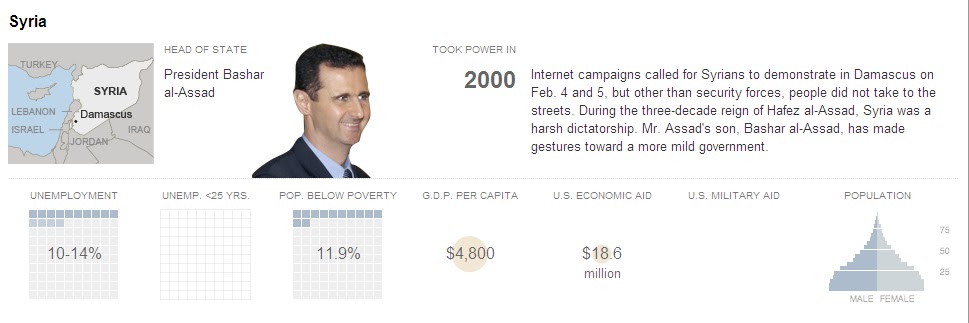     |
Friday, June 10, 2011
A nice graphic showing Skilled Immigrants out number Un-skilled immigrants in the US. This is a GOOD thing for us. Now we don't have to do math and science if we don't "feel like it"...
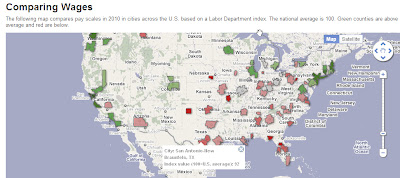
For the first time, immigrants classified as "skilled" outnumber those classified as "un-skilled" in the US. This graphic shows where in the country this is taking place. I saw this and immediately thought of two maps I posted a couple of weeks ago.The first one is the wage differential around the US and the second one for job postings relative to the areas population. Both are posted below... Notice a pattern? If you step back and look at them all together it i fairly obvious what is going on. Skilled immigrants "appear" in places where there are lots of job openings relative to the population AND the average wage in those areas is higher relative to other areas of the country. I believe many (most?) of these jobs are of a technical nature and require math and science knowledge at the highest levels. The demand simply cannot be satisfied domestically. What do you think? Please, REALLY think about this before you respond. Looking for thoughtful answers, not arrow slinging...Thanks!

 |
| Source: Chartporn |


Thursday, May 19, 2011
Electric Vehicles are NOT the answer to energy independence...Why does this have to be so hard???

The Rare-Earth Crisis
"...One argument I’ve heard is “national security,” the idea being that electric vehicles would make the United States less dependent on imported oil. Be careful what you wish for, however, because if electric cars become a mainstay, we may be trading one dependence for another that is even more troubling. Ninety-five percent of the world’s output of rare-earth metals today comes from one country: China. By some estimates, demand will outstrip supply within five years. At least with oil we know there are fifty years of oil reserves readily available. Moreover, oil is produced all over the world, limiting the monopoly power of any one country...." Source: Freakonomics
Saturday, January 1, 2011

Subscribe to:
Posts (Atom)
 View My Stats
